
Give answers for each item and each part but follow the nlsc responding, also give full notes about the topics involved basically in part b items also relevant examples
ScanSolve AI Answer
Answers
3 partsStep-by-step solution
15 stepsHere are the answers to your questions:
Part a· 3 steps
Simplify .
Simplify each surd individually by finding the largest perfect square factor.
Substitute the simplified surds back into the expression.
Combine the like surds.
Part b3.146
Given that and , evaluate without using tables or a calculator.
Rationalize the denominator by multiplying the numerator and denominator by the conjugate of the denominator.
The conjugate of is .
Apply the difference of squares formula to the denominator.
Substitute the given approximate values for and .
Perform the addition.
Part c2
Solve for : .
Express both sides of the equation with the same base.
Equate the exponents since the bases are the same.
Solve the linear equation for .
Notes on Topics Involved in Part b:
1. Rationalizing the Denominator
This is a key technique used to remove surds from the denominator of a fraction, making the expression simpler and easier to work with, especially for numerical evaluation.-
Case 1: Denominator is a single surd term (e.g., ) Multiply both the numerator and the denominator by the surd in the denominator. Example: Rationalize .
-
Case 2: Denominator is a binomial surd (e.g., or ) Multiply both the numerator and the denominator by the conjugate of the denominator. The conjugate is formed by changing the sign between the terms. This method uses the difference of squares identity: , which eliminates the surds from the denominator.
- The conjugate of is .
- The conjugate of is .
Example: Rationalize .
-
Identify the conjugate of the denominator.
The conjugate of $2 + \sqrt{7}$ is $2 - \sqrt{7}$.Multiply the numerator and denominator by the conjugate.
$$ \frac{5}{2 + \sqrt{7}} \times \frac{2 - \sqrt{7}}{2 - \sqrt{7}} $$Perform the multiplication.
$$ \frac{5(2 - \sqrt{7})}{2^2 - (\sqrt{7})^2} $$ $$ \frac{10 - 5\sqrt{7}}{4 - 7} $$ $$ \frac{10 - 5\sqrt{7}}{-3} = -\frac{10 - 5\sqrt{7}}{3} \text{ or } \frac{5\sqrt{7} - 10}{3} $$2. Substitution of Approximate Values
When asked to evaluate an expression involving surds using given approximate values (e.g., ), it is crucial to:- Simplify the expression completely first, including rationalizing any denominators.
- Then, substitute the approximate values into the simplified expression. This approach minimizes calculation errors and ensures accuracy, especially when dealing with complex fractions.
Example: Evaluate given and .
Rationalize the denominator.
The conjugate of is .
Substitute the given approximate values.
Try one yourself
A new problem that tests the same skill.
Still stuck on this one?
Ask a follow-up, and the answer starts from this question.
More Mathematics Questions
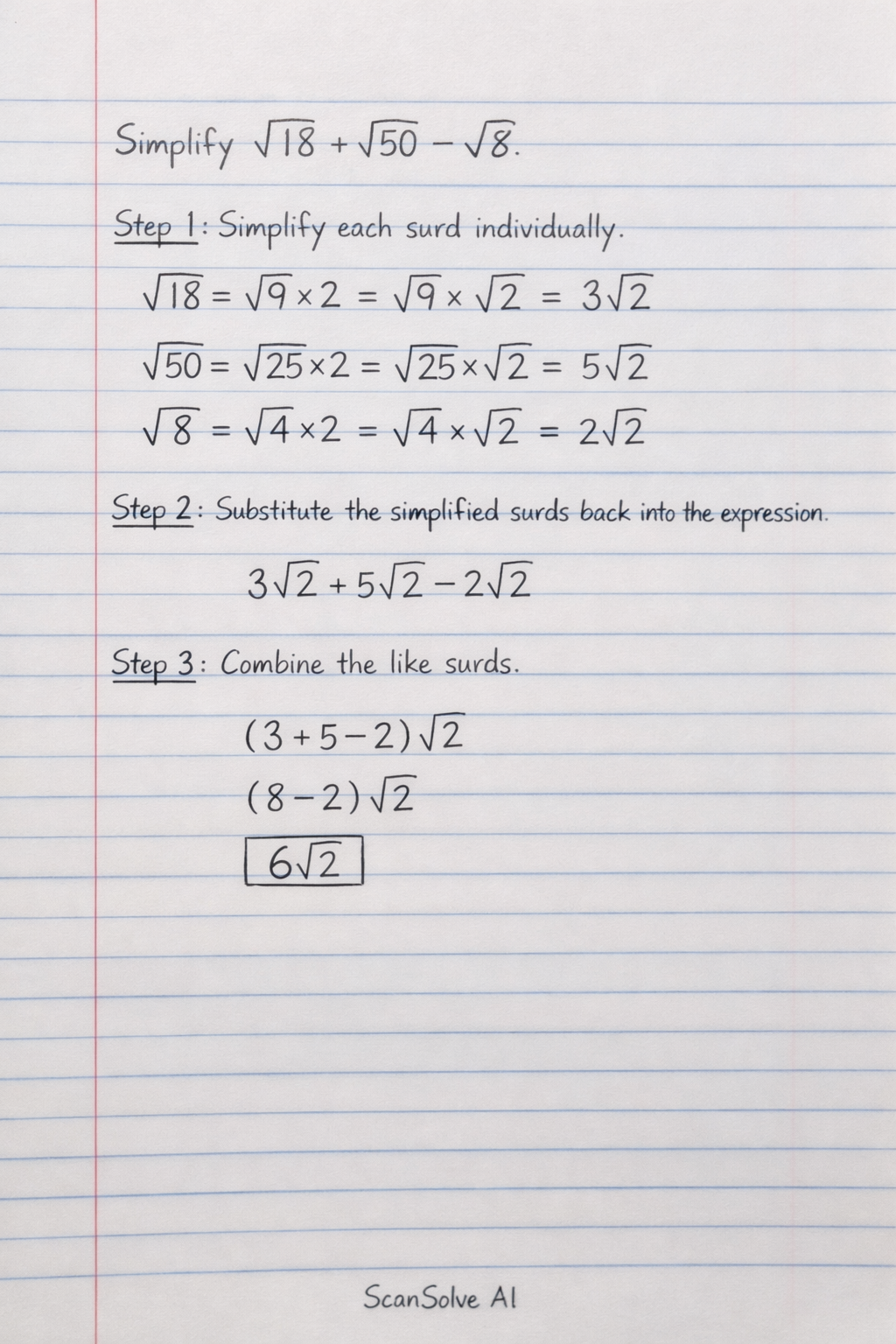
Handwritten Step-by-Step Solution
Get this as a handwritten image on WhatsApp — like a tutor wrote it for you.
Try on WhatsApp