
We read your photo as:
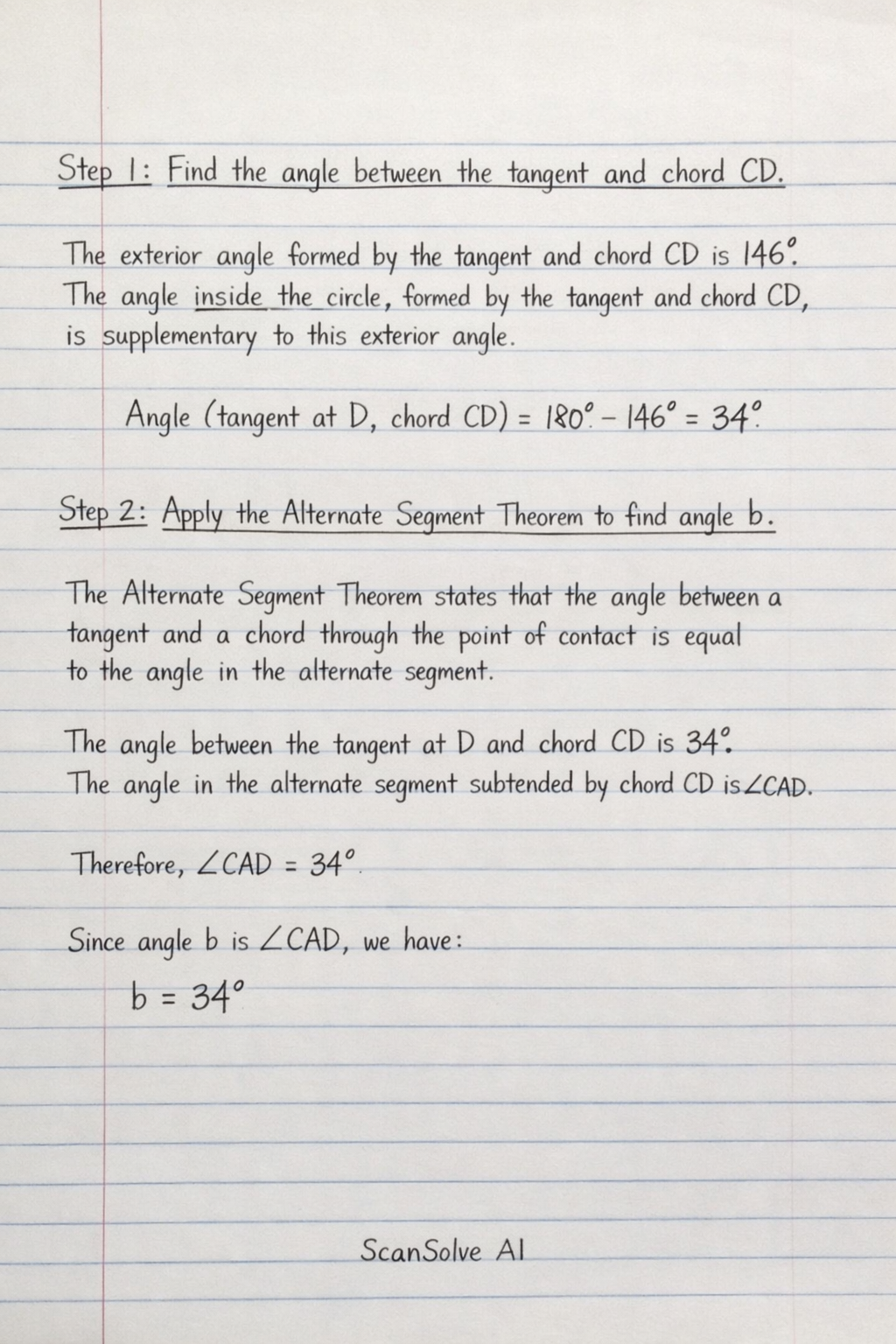
Find the angle between the tangent and chord CD.
ScanSolve AI Answer
Answer
Step-by-step solution
4 stepsFind the angle between the tangent and chord CD.
The exterior angle formed by the tangent and chord CD is . The angle inside the circle, formed by the tangent and chord CD, is supplementary to this exterior angle.
Apply the Alternate Segment Theorem to find angle .
The Alternate Segment Theorem states that the angle between a tangent and a chord through the point of contact is equal to the angle in the alternate segment.
The angle between the tangent at D and chord CD is . The angle in the alternate segment subtended by chord CD is .
Therefore, .
Since angle is , we have:Use the property of equal chords to find angle .
The chords AD and CD are marked with single dashes, indicating they are equal in length. This means that is an isosceles triangle.
In an isosceles triangle, the angles opposite the equal sides are equal.
So, .
Since , then .
Since angle is , we have:Relate the central angle to the inscribed angle .
Angle is the central angle . Angle is the inscribed angle . Both angles subtend the same arc AD.
The central angle subtended by an arc is twice the inscribed angle subtended by the same arc.
So, .The angles are:
Try one yourself
A new problem that tests the same skill.
Still stuck on this one?
Ask a follow-up, and the answer starts from this question.
More Mathematics Questions
Handwritten Step-by-Step Solution
Get this as a handwritten image on WhatsApp — like a tutor wrote it for you.
Try on WhatsApp