
We read your photo as:
Calculate the angle of depression of point Q from the top of the flag post.
ScanSolve AI Answer
This answer stops before the end.
It was cut off when it was first written. Ask ScanSolve this question again for the full working.
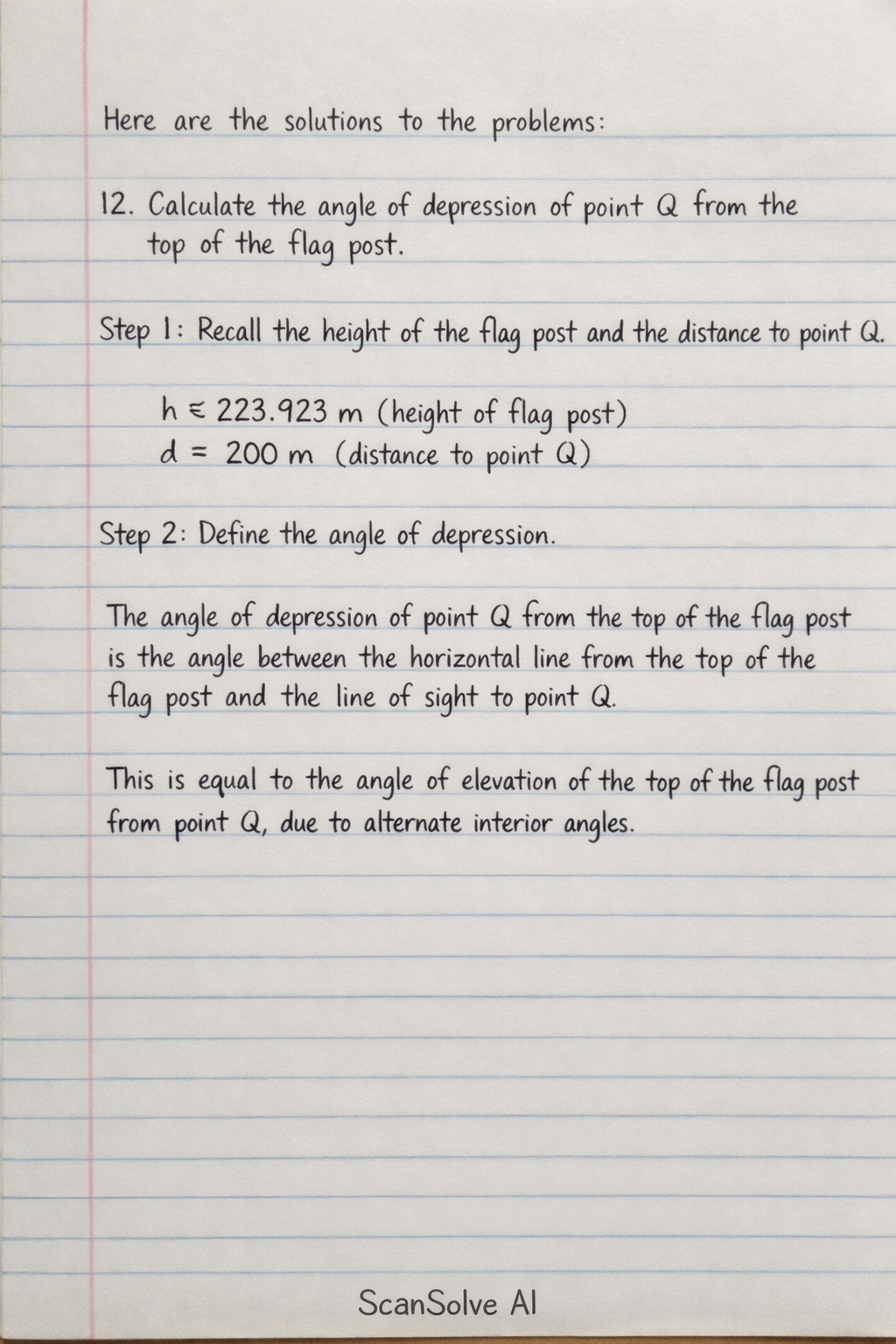
Here are the solutions to the problems:
12. Calculate the angle of depression of point Q from the top of the flag post.
Step 1: Recall the height of the flag post and the distance to point Q.
From the previous problem, the height of the flag post () was calculated as approximately 223.923 m.
The initial distance from point Q to the foot of the flag post is 200 m.
Step 2: Define the angle of depression.
The angle of depression of point Q from the top of the flag post is the angle formed between the horizontal line from the top of the flag post and the line of sight to point Q. This angle is equal to the angle of elevation of the top of the flag post from point Q, due to alternate interior angles.
Step 3: Use the tangent trigonometric ratio.
Let be the angle of depression. In the right-angled triangle formed by the flag post, the ground, and the line of sight from the top of the flag post to Q:
Opposite side = height of flag post = 223.923 m.
Adjacent side = distance from Q to the foot of the flag post = 200 m.
Step 4: Calculate the angle .
The angle of depression of point Q from the top of the flag post is approximately .
13. Two similar blocks have masses of 729g and 216g respectively. If the surface area of the smaller block is 300cm², calculate the surface area of the larger block.
Step 1: Find the ratio of the masses.
Let be the mass of the larger block and be the mass of the smaller block.
The ratio of masses is .
Step 2: Determine the linear scale factor.
For similar solids, the ratio of their volumes (and thus masses, assuming uniform density) is equal to the cube of the linear scale factor ().
Still stuck on this one?
Ask a follow-up, and the answer starts from this question.
More Mathematics Questions
Handwritten Step-by-Step Solution
Get this as a handwritten image on WhatsApp — like a tutor wrote it for you.
Try on WhatsApp