
We read your photo as:
Are the expressions A = m(2−m) and B = m(-m+2) algebraically equivalent?
ScanSolve AI Answer
Step-by-step solution
6 stepsHere are the solutions to the questions:
1.1.1 Substitute in A and B respectively.
Substitute into expression A.
Substitute into expression B.
Do you get the same answer?
YesConclusion:
The expressions A and B yield the same value when .1.1.2 Choose another value for , and substitute in A and B. Do you get the same answer?
Choose .
Substitute into expression A.
Substitute into expression B.
Do you get the same answer?
YesConclusion:
The expressions A and B yield the same value when .1.1.3 Multiply out expression A.
Apply the distributive property to expression A.
The multiplied-out expression A is .
1.1.4 Multiply out expression B.
Apply the distributive property to expression B.
The multiplied-out expression B is .
1.1.5 Are the multiplied-out expressions the same? Explain.
Are the multiplied-out expressions the same?
YesExplain:
The multiplied-out expressions and are the same. This is because the order of terms in an addition or subtraction does not change the value of the expression (commutative property of addition). can be rewritten as .
Still stuck on this one?
Ask a follow-up, and the answer starts from this question.
More Mathematics Questions
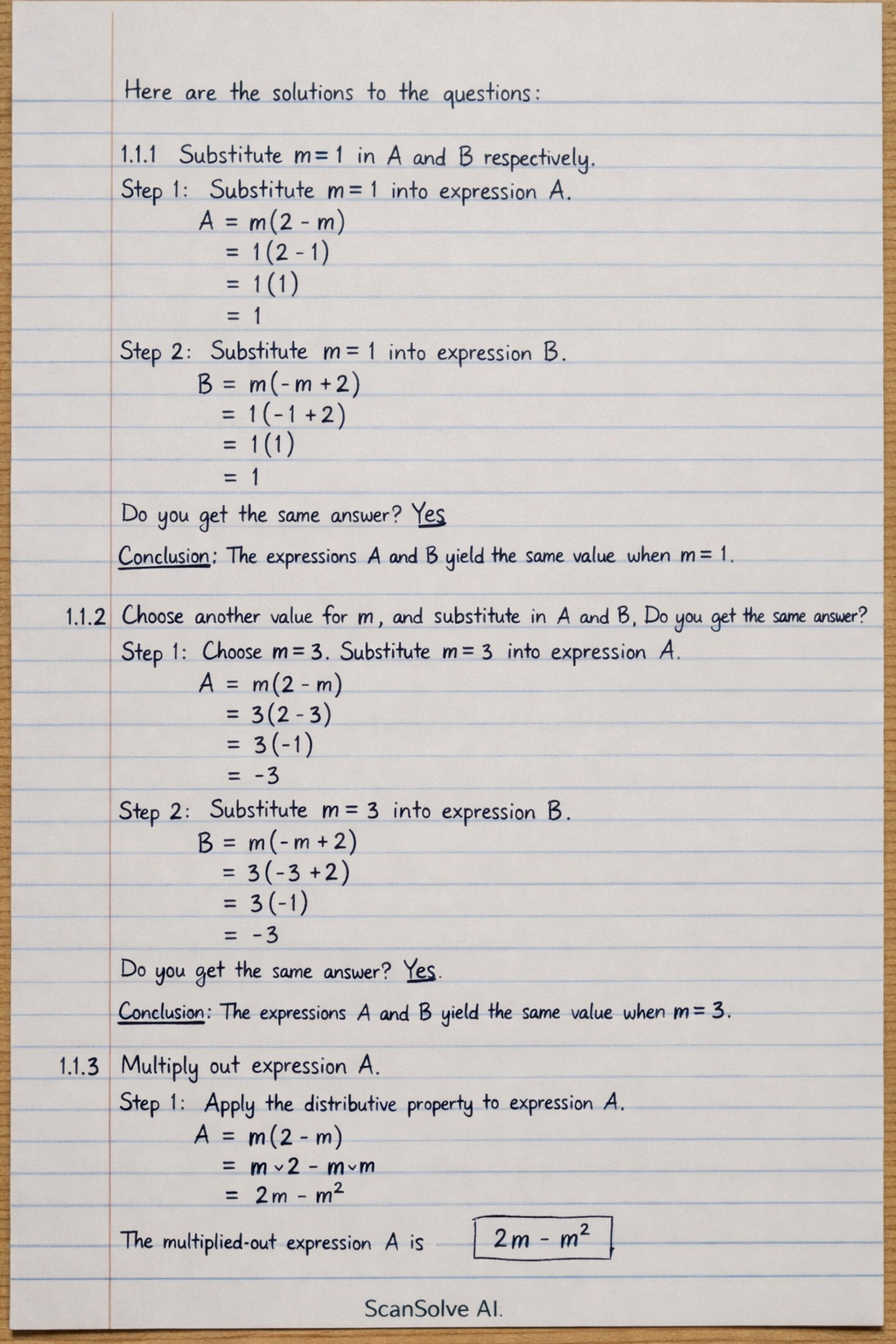
Handwritten Step-by-Step Solution
Get this as a handwritten image on WhatsApp — like a tutor wrote it for you.
Try on WhatsApp