
We read your photo as:
Calculate the area of a circle of radius 2cm. (pi = (22)/(7)) The area of a square of side 5cm is Approximate 589.57 to the nearest whole number.
ScanSolve AI Answer
Step-by-step solution
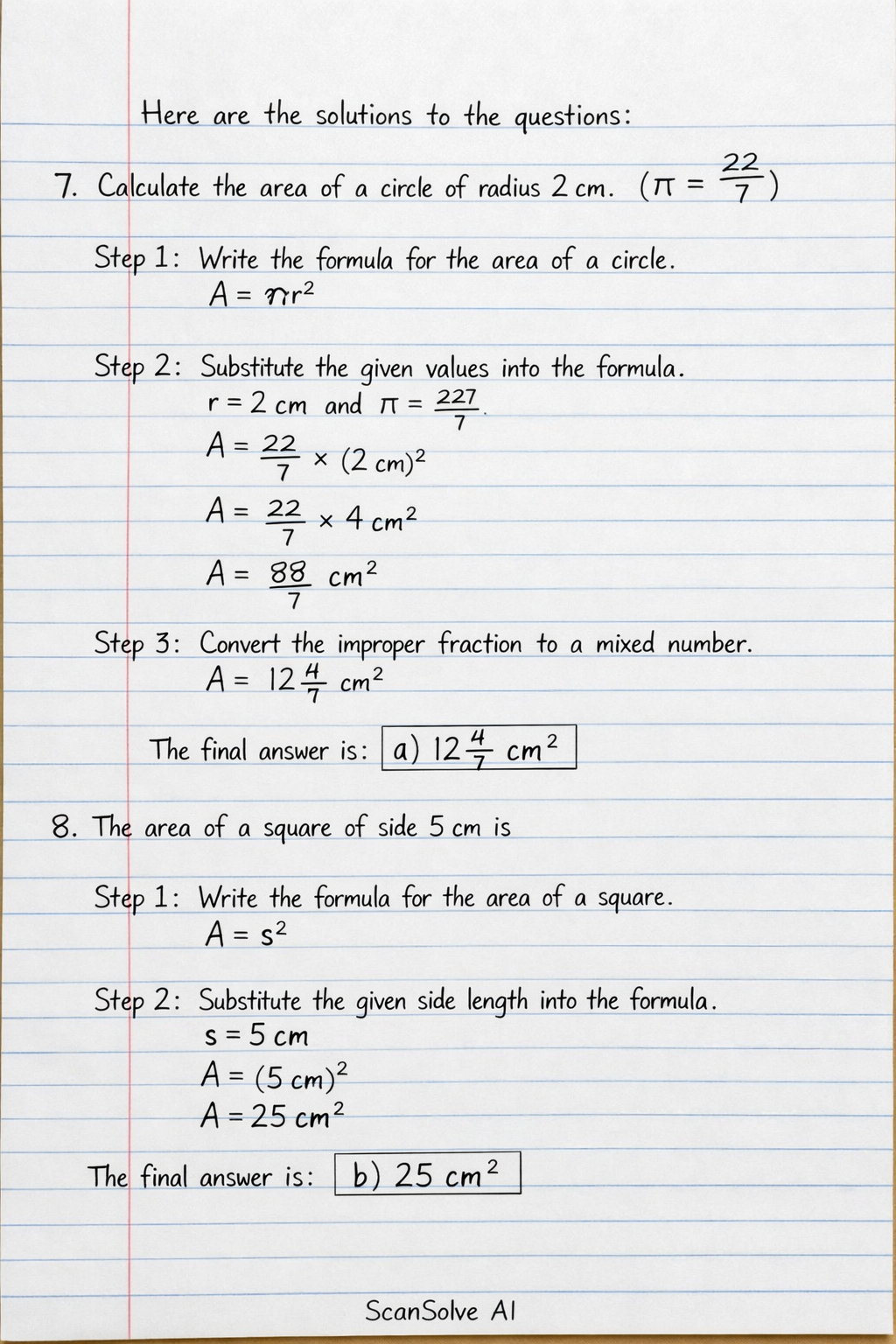
11 stepsHere are the solutions to the questions:
7. Calculate the area of a circle of radius 2cm. ()
Write the formula for the area of a circle.
The area of a circle is given by the formula , where is the radius.
Substitute the given values into the formula.
Given and .
Convert the improper fraction to a mixed number.
The final answer is
8. The area of a square of side 5cm is
Write the formula for the area of a square.
The area of a square is given by the formula , where is the side length.
Substitute the given side length into the formula.
Given .
The final answer is
9. Approximate 589.57 to the nearest whole number.
Identify the digit in the tenths place.
The number is 589.57. The digit in the tenths place is 5.
Apply the rounding rule.
If the digit in the tenths place is 5 or greater, round up the ones digit. If it is less than 5, keep the ones digit as it is. Since the tenths digit is 5, we round up the ones digit (9).
Rounding 589 up to the next whole number gives 590.The final answer is
10. How many students offer both Maths and Physics but not Chemistry?
Locate the "Maths" and "Physics" circles in the Venn diagram.
Identify the region where the "Maths" and "Physics" circles overlap.
This represents students offering both subjects. This region contains the numbers 2 and 4.
Exclude the part of this overlap that also includes "Chemistry".
The number 4 is in the intersection of all three subjects (Maths, Physics, and Chemistry).
The number 2 is in the intersection of only Maths and Physics, without overlapping with Chemistry.The number of students who offer both Maths and Physics but not Chemistry is 2.
The final answer is
Still stuck on this one?
Ask a follow-up, and the answer starts from this question.
More Mathematics Questions
Handwritten Step-by-Step Solution
Get this as a handwritten image on WhatsApp — like a tutor wrote it for you.
Try on WhatsApp