
We read your photo as:
Calculate the radius of a circle whose circumference is 22 cm.
ScanSolve AI Answer
This answer stops before the end.
It was cut off when it was first written. Ask ScanSolve this question again for the full working.
Here are the solutions to the problems:
5. Calculate the radius of a circle whose circumference is .
We will use the value .
Step 1: State the formula for the circumference of a circle.
The circumference of a circle is given by , where is the radius.
Step 2: Substitute the given circumference and the value of into the formula.
Step 3: Solve for the radius .
The radius of the circle is .
6. Calculate the perimeter of Fig. 14.41 (a) and (b).
We will use the value .
-
a) Fig. 14.41 (a): This shape consists of a rectangle and a semicircle. The rectangle has a length of and a width of . The semicircle has a diameter of .
Step 1: Identify the segments that form the perimeter.
The perimeter includes the top side of the rectangle, the bottom side of the rectangle, one vertical side of the rectangle, and the curved arc of the semicircle. The side of the rectangle where the semicircle is attached is internal and not part of the perimeter.Step 2: Calculate the length of the curved arc of the semicircle.
Circumference of a full circle . For a semicircle, the arc length is .
Arc length
Arc length
Arc lengthStep 3: Sum all the perimeter segments.
Perimeter
Perimeter
The perimeter of shape (a) is . -
b) Fig. 14.41 (b): This shape consists of a rectangle and two semicircles. The rectangle has a length of and a width of . Each semicircle has a diameter of .
Step 1: Identify the segments that form the perimeter.
The perimeter includes the top side of the rectangle, the bottom side of the rectangle, and the curved arcs of the two semicircles. The vertical sides of the rectangle where the semicircles are attached are internal and not part of the perimeter.Step 2: Calculate the total length of the curved arcs of the two semicircles.
Two semicircles with the same diameter form a full circle.
Total arc length
Total arc length
Total arc lengthStep 3: Sum all the perimeter segments.
Perimeter
Perimeter
The perimeter of shape (b) is .
7. Complete Table 14.6.
We will use the formula and .
-
a) Circumference (C) =
Step 1: Use the formula .
Step 2: Solve for .
The diameter is .
-
b) Diameter (D) =
Step 1: Use the formula .
The circumference is .
-
c) Diameter (D) =
Step 1: Use the formula .
Step 2: Simplify the expression.
The circumference is .
-
d) Circumference (C) =
Step 1: Use the formula .
Step 2: Solve for .
The diameter is .
8. A square has perimeter . What is the length of one side of the square?
Step 1: State the formula for the perimeter of a square.
The perimeter of a square is , where is the length of one side.
Step 2: Substitute the given perimeter into the formula.
Step 3: Solve for .
The length of one side of the square is .
9. What is the perimeter of your protractor?
A protractor is typically shaped like a semicircle.
Step 1: Describe the components of a protractor's perimeter.
The perimeter of a semicircular protractor consists of its straight edge (the diameter) and its curved edge (half the circumference of a full circle).
Step 2: State the general formula for the perimeter of a semicircle.
Perimeter
Perimeter
To calculate a specific numerical perimeter, the diameter (or radius) of the protractor would need to be known.
10. Which circle has the greater circumference, the circle with circumference or the one with radius ?
We will use the value .
Step 1: Identify the circumference of the first circle.
The first circle has a circumference .
Step 2: Calculate the circumference of the second circle.
The second circle has a radius .
Using the formula :
Still stuck on this one?
Ask a follow-up, and the answer starts from this question.
More Mathematics Questions
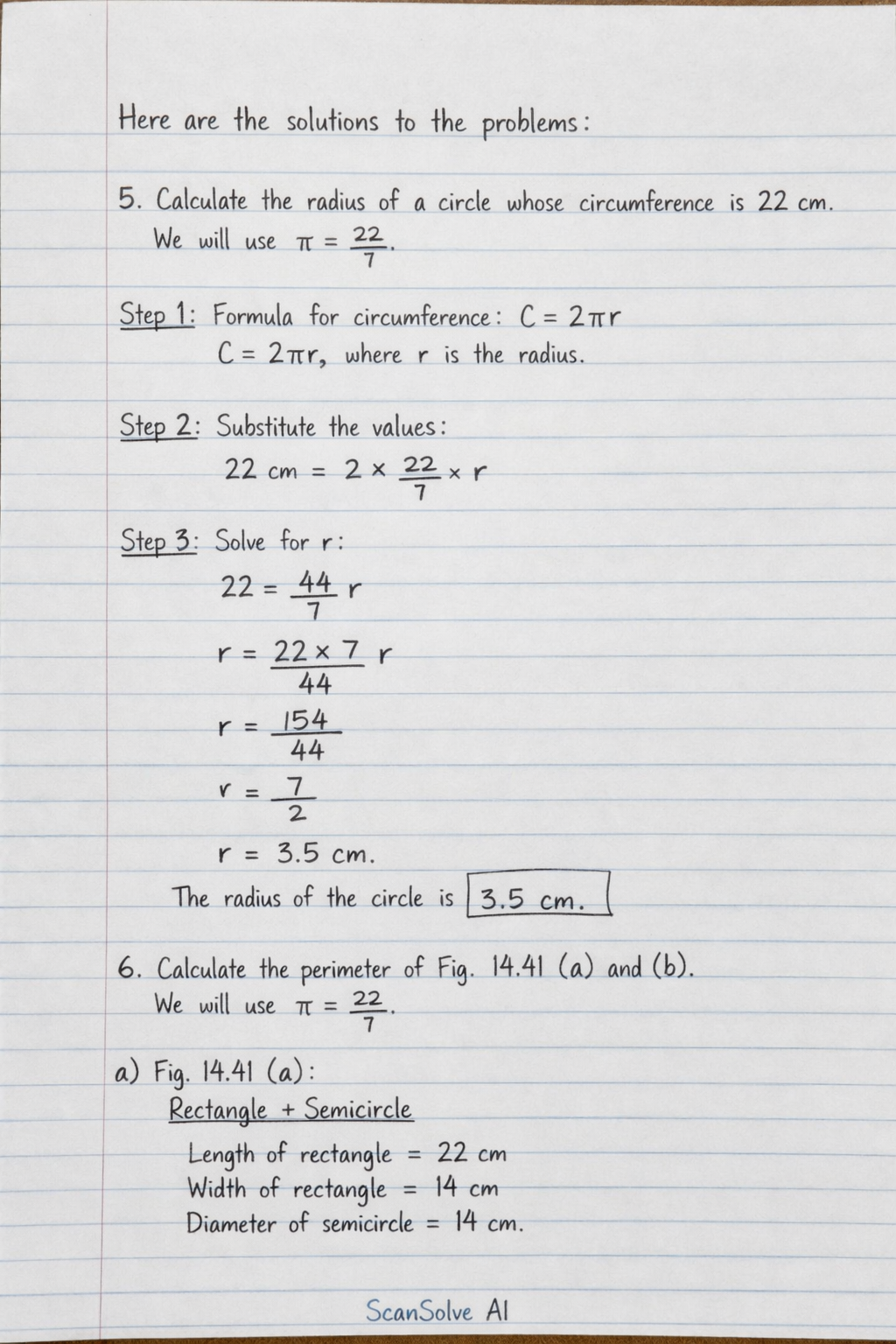
Handwritten Step-by-Step Solution
Get this as a handwritten image on WhatsApp — like a tutor wrote it for you.
Try on WhatsApp