We read your photo as:

Find the Missing Number

Mathematics

ScanSolve AI Answer

This answer stops before the end.

It was cut off when it was first written. Ask ScanSolve this question again for the full working.

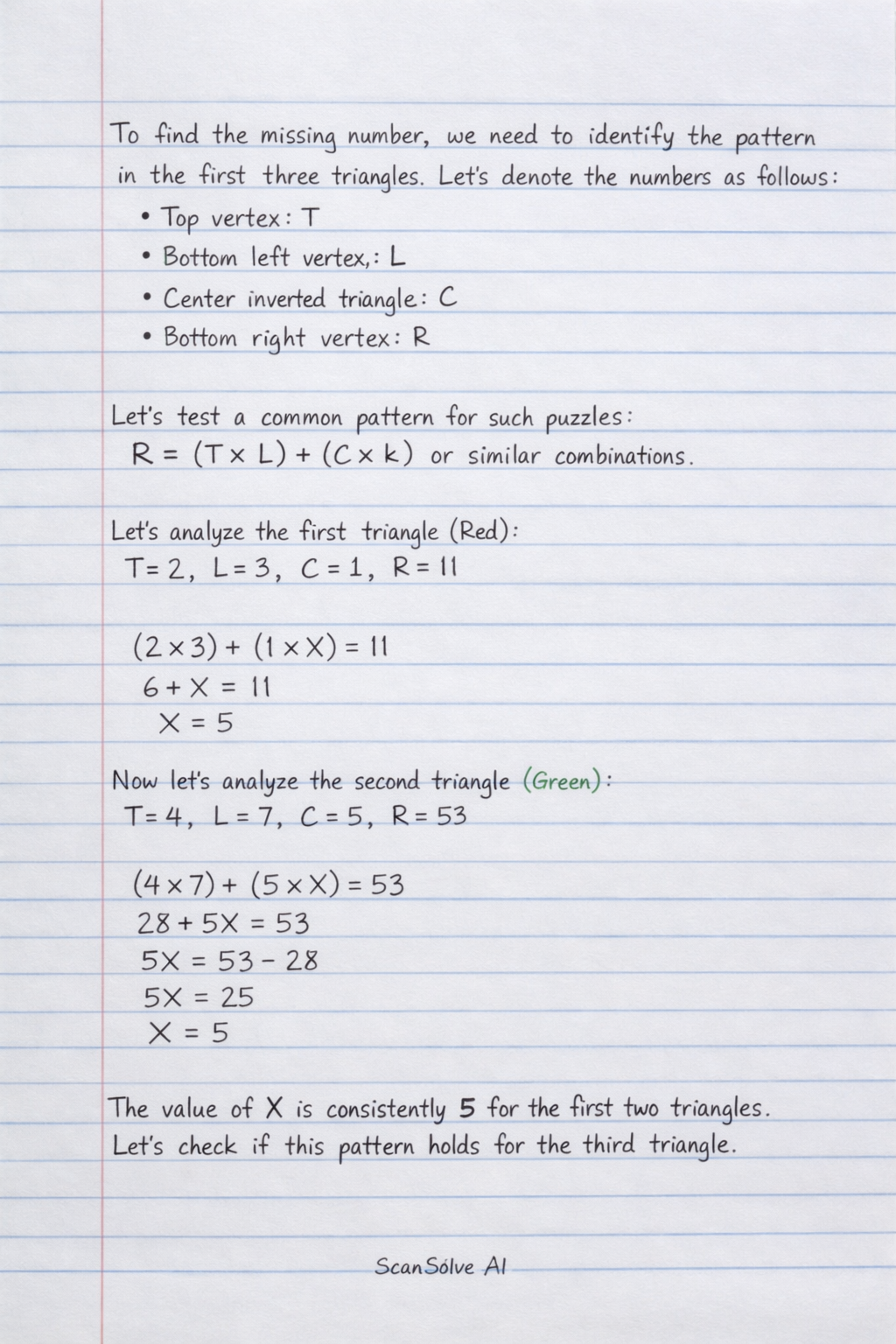
To find the missing number, we need to identify the pattern in the first three triangles. Let's denote the numbers as follows:

  • Top vertex: TT
  • Bottom left vertex: LL
  • Center inverted triangle: CC
  • Bottom right vertex: RR

Let's test a common pattern for such puzzles: R=(T×L)+(C×k)R = (T \times L) + (C \times k) or similar combinations.

Let's analyze the first triangle (Red):
T=2T=2, L=3L=3, C=1C=1, R=11R=11

Let's try the formula R=(T×L)+(C×X)R = (T \times L) + (C \times X), where XX is some value derived from T,L,CT, L, C.
For the first triangle:

(2×3)+(1×X)=11(2 \times 3) + (1 \times X) = 11 6+X=116 + X = 11 X=5X = 5

Now let's analyze the second triangle (Green):
T=4T=4, L=7L=7, C=5C=5, R=53R=53
Using the same structure:

(4×7)+(5×X)=53(4 \times 7) + (5 \times X) = 53 28+5X=5328 + 5X = 53 5X=53−285X = 53 - 28 5X=255X = 25 X=5X = 5

The value of XX is consistently 5 for the first two triangles. Let's check if this pattern holds for the third triangle.

For the third triangle (Blue):
T=6T=6, L=11L=11, C=5C=5, R=127R=127
Using the same structure:

(6×11)+(5×X)=127(6 \times 11) + (5 \times X) = 127 66+5X=12766 + 5X = 127 5X=127−665X = 127 - 66 5X=615X = 61 X=615=12.2X = \frac{61}{5} = 12.2

Since XX is not consistent (5,5,12.25, 5, 12.2), this pattern is incorrect.

Let's try another pattern. What if XX is related to TT?
Let's try the rule: R=(T×L)+C×(T+1)R = (T \times L) + C \times (T+1).
For the first triangle:

(2×3)+1×(2+1)=6+1×3=6+3=9≠11(2 \times 3) + 1 \times (2+1) = 6 + 1 \times 3 = 6 + 3 = 9 \neq 11

This is incorrect.

Let's try the rule: R=(T×L)+C×(L−1)R = (T \times L) + C \times (L-1).
For the first triangle:

(2×3)+1×(3−1)=6+1×2=6+2=8≠11(2 \times 3) + 1 \times (3-1) = 6 + 1 \times 2 = 6 + 2 = 8 \neq 11

This is incorrect.

Let's try the rule: R=(T×L)+C×(T+C)R = (T \times L) + C \times (T+C).
For the first triangle:

(2×3)+1×(2+1)=6+1×3=6+3=9≠11(2 \times 3) + 1 \times (2+1) = 6 + 1 \times 3 = 6 + 3 = 9 \neq 11

This is incorrect.

Let's try the rule: R=(L×C)+T×(L+C)R = (L \times C) + T \times (L+C).
For the first triangle:

(3×1)+2×(3+1)=3+2×4=3+8=11(3 \times 1) + 2 \times (3+1) = 3 + 2 \times 4 = 3 + 8 = 11

This works for the first triangle!

Let's test this rule on the second triangle (Green):
T=4T=4, L=7L=7, C=5C=5, R=53R=53

(7×5)+4×(7+5)=35+4×12=35+48=83≠53(7 \times 5) + 4 \times (7+5) = 35 + 4 \times 12 = 35 + 48 = 83 \neq 53

This rule is incorrect.

Let's try the rule: R=(T×C)+L×(T+C)R = (T \times C) + L \times (T+C).
For the first triangle:

(2×1)+3×(2+1)=2+3×3=2+9=11(2 \times 1) + 3 \times (2+1) = 2 + 3 \times 3 = 2 + 9 = 11

This works for the first triangle!

Let's test this rule on the second triangle (Green):
T=4T=4, L=7L=7, C=5C=5, R=53R=53

(4×5)+7×(4+5)=20+7×9=20+63=83≠53(4 \times 5) + 7 \times (4+5) = 20 + 7 \times 9 = 20 + 63 = 83 \neq 53

This rule is incorrect.

Let's re-examine the numbers and look for a pattern involving powers or larger multiplications.
Consider the pattern: R=(L×T)+C×(T+L−C)R = (L \times T) + C \times (T+L-C).
For the first triangle:

(3×2)+1×(2+3−1)=6+1×4=10≠11(3 \times 2) + 1 \times (2+3-1) = 6 + 1 \times 4 = 10 \neq 11

This is incorrect.

Let's try a pattern where R=(T×L)+C×(T+L−k)R = (T \times L) + C \times (T+L-k) where kk is a constant.
For the first triangle:

(2×3)+1×(2+3−k)=11(2 \times 3) + 1 \times (2+3-k) = 11 6+5−k=116 + 5 - k = 11 11−k=11  ⟹  k=011 - k = 11 \implies k=0

So, for the first triangle, the rule would be R=(T×L)+C×(T+L)R = (T \times L) + C \times (T+L).
Let's test this rule:

  1. T=2,L=3,C=1,R=11T=2, L=3, C=1, R=11: (2×3)+1×(2+3)=6+1×5=6+5=11(2 \times 3) + 1 \times (2+3) = 6 + 1 \times 5 = 6 + 5 = 11. (Works)
  2. T=4,L=7,C=5,R=53T=4, L=7, C=5, R=53: (4×7)+5×(4+7)=28+5×11=28+55=83≠53(4 \times 7) + 5 \times (4+7) = 28 + 5 \times 11 = 28 + 55 = 83 \neq 53. (Fails)

Let's try another pattern.
Consider the pattern: R=(T×L)+C×(T+C)R = (T \times L) + C \times (T+C).

  1. T=2,L=3,C=1,R=11T=2, L=3, C=1, R=11: (2×3)+1×(2+1)=6+1×3=9≠11(2 \times 3) + 1 \times (2+1) = 6 + 1 \times 3 = 9 \neq 11. (Fails)

Let's try the pattern: R=(T×L)+C×(L+C)R = (T \times L) + C \times (L+C).

  1. T=2,L=3,C=1,R=11T=2, L=3, C=1, R=11: (2×3)+1×(3+1)=6+1×4=10≠11(2 \times 3) + 1 \times (3+1) = 6 + 1 \times 4 = 10 \neq 11. (Fails)

Let's try the pattern: R=(L×C)+T×(T+L)R = (L \times C) + T \times (T+L).

  1. T=2,L=3,C=1,R=11T=2, L=3, C=1, R=11: (3×1)+2×(2+3)=3+2×5=3+10=13≠11(3 \times 1) + 2 \times (2+3) = 3 + 2 \times 5 = 3 + 10 = 13 \neq 11. (Fails)

Let's try the pattern: R=(T×C)+L×(L+C)R = (T \times C) + L \times (L+C).

  1. T=2,L=3,C=1,R=11T=2, L=3, C=1, R=11: (2×1)+3×(3+1)=2+3×4=2+12=14≠11(2 \times 1) + 3 \times (3+1) = 2 + 3 \times 4 = 2 + 12 = 14 \neq 11. (Fails)

Let's try a pattern involving T2T^2.
Consider the pattern: R=(T2×C)+LR = (T^2 \times C) + L.

  1. T=2,L=3,C=1,R=11T=2, L=3, C=1, R=11: (22×1)+3=(4×1)+3=4+3=7≠11(2^2 \times 1) + 3 = (4 \times 1) + 3 = 4 + 3 = 7 \neq 11. (Fails)

Consider the pattern: R=(L2×C)+TR = (L^2 \times C) + T.

  1. T=2,L=3,C=1,R=11T=2, L=3, C=1, R=11: (32×1)+2=(9×1)+2=9+2=11(3^2 \times 1) + 2 = (9 \times 1) + 2 = 9 + 2 = 11. (Works for T1!)

Let's test this rule on the second triangle (Green):
T=4T=4, L=7L=7, C=5C=5, R=53R=53
Rule: R=(L2×C)+TR = (L^2 \times C) + T

(72×5)+4=(49×5)+4=245+4=249≠53(7^2 \times 5) + 4 = (49 \times 5) + 4 = 245 + 4 = 249 \neq 53

This rule is incorrect.

Let's try the pattern: R=(T×L)+(C×T)+(C×L)R = (T \times L) + (C \times T) + (C \times L).

  1. T=2,L=3,C=1,R=11T=2, L=3, C=1, R=11: (2×3)+(1×2)+(1×3)=6+2+3=11(2 \times 3) + (1 \times 2) + (1 \times 3) = 6 + 2 + 3 = 11. (Works for T1!)

Let's test this rule on the second triangle (Green):
T=4T=4, L=7L=7, C=5C=5, R=53R=53
Rule: R=(T×L)+(C×T)+(C×L)R = (T \times L) + (C \times T) + (C \times L)

(4×7)+(5×4)+(5×7)=28+20+35=83≠53(4 \times 7) + (5 \times 4) + (5 \times 7) = 28 + 20 + 35 = 83 \neq 53

This rule is incorrect.

Let's try the pattern: R=(T×L)+(C×T)+CR = (T \times L) + (C \times T) + C.

  1. T=2,L=3,C=1,R=11T=2, L=3, C=1, R=11: (2×3)+(1×2)+1=6+2+1=9≠11(2 \times 3) + (1 \times 2) + 1 = 6 + 2 + 1 = 9 \neq 11. (Fails)

Let's try the pattern: R=(T×L)+(C×L)+CR = (T \times L) + (C \times L) + C.

  1. T=2,L=3,C=1,R=11T=2, L=3, C=1, R=11: (2×3)+(1×3)+1=6+3+1=10≠11(2 \times 3) + (1 \times 3) + 1 = 6 + 3 + 1 = 10 \neq 11. (Fails)

Let's try the pattern: R=(T×C)+(L×C)+TR = (T \times C) + (L \times C) + T.

  1. T=2,L=3,C=1,R=11T=2, L=3, C=1, R=11: (2×1)+(3×1)+2=2+3+2=7≠11(2 \times 1) + (3 \times 1) + 2 = 2 + 3 + 2 = 7 \neq 11. (Fails)

Let's try the pattern: R=(T×C)+(L×T)+CR = (T \times C) + (L \times T) + C.

  1. T=2,L=3,C=1,R=11T=2, L=3, C=1, R=11: (2×1)+(3×2)+1=2+6+1=9≠11(2 \times 1) + (3 \times 2) + 1 = 2 + 6 + 1 = 9 \neq 11. (Fails)

Let's try the pattern: R=(L×C)+(T×C)+LR = (L \times C) + (T \times C) + L.

  1. T=2,L=3,C=1,R=11T=2, L=3, C=1, R=11: (3×1)+(2×1)+3=3+2+3=8≠11(3 \times 1) + (2 \times 1) + 3 = 3 + 2 + 3 = 8 \neq 11. (Fails)

Let's try the pattern: R=(L×C)+(T×L)+TR = (L \times C) + (T \times L) + T.

  1. T=2,L=3,C=1,R=11T=2, L=3, C=1, R=11: (3×1)+(2×3)+2=3+6+2=11(3 \times 1) + (2 \times 3) + 2 = 3 + 6 + 2 = 11. (Works for T1!)

Let's test this rule on the second triangle (Green):
T=4T=4, L=7L=7, C=5C=5, R=53R=53
Rule: R=(L×C)+(T×L)+TR = (L \times C) + (T \times L) + T

(7×5)+(4×7)+4=35+28+4=67≠53(7 \times 5) + (4 \times 7) + 4 = 35 + 28 + 4 = 67 \neq 53

This rule is incorrect.

Let's try the pattern: R=(T×L)+(C×L)−TR = (T \times L) + (C \times L) - T.

  1. T=2,L=3,C=1,R=11T=2, L=3, C=1, R=11: (2×3)+(1×3)−2=6+3−2=7≠11(2 \times 3) + (1 \times 3) - 2 = 6 + 3 - 2 = 7 \neq 11. (Fails)

Let's try the pattern: R=(T×L)+(C×T)−LR = (T \times L) + (C \times T) - L.

  1. T=2,L=3,C=1,R=11T=2, L=3, C=1, R=11: (2×3)+(1×2)−3=6+2−3=5≠11(2 \times 3) + (1 \times 2) - 3 = 6 + 2 - 3 = 5 \neq 11. (Fails)

Let's try the pattern: R=(T×L)+(C×L)+T−CR = (T \times L) + (C \times L) + T - C.

  1. T=2,L=3,C=1,R=11T=2, L=3, C=1, R=11: (2×3)+(1×3)+2−1=6+3+2−1=10≠11(2 \times 3) + (1 \times 3) + 2 - 1 = 6 + 3 + 2 - 1 = 10 \neq 11. (Fails)

Let's try the pattern: R=(T×L)+(C×T)+L−CR = (T \times L) + (C \times T) + L - C.

  1. T=2,L=3,C=1,R=11T=2, L=3, C=1, R=11: (2×3)+(1×2)+3−1=6+2+3−1=10≠11(2 \times 3) + (1 \times 2) + 3 - 1 = 6 + 2 + 3 - 1 = 10 \neq 11. (Fails)

Let's try the pattern: R=(T×L)+(C×L)+CR = (T \times L) + (C \times L) + C.

  1. T=2,L=3,C=1,R=11T=2, L=3, C=1, R=11: (2×3)+(1×3)+1=6+3+1=10≠11(2 \times 3) + (1 \times 3) + 1 = 6 + 3 + 1 = 10 \neq 11. (Fails)

Let's try the pattern: R=(T×L)+(C×T)+CR = (T \times L) + (C \times T) + C.

  1. T=2,L=3,C=1,R=11T=2, L=3, C=1, R=11: (2×3)+(1×2)+1=6+2+1=9≠11(2 \times 3) + (1 \times 2) + 1 = 6 + 2 + 1 = 9 \neq 11. (Fails)

Let's try the pattern: R=(T×C)+(L×C)+T+LR = (T \times C) + (L \times C) + T + L.

  1. T=2,L=3,C=1,R=11T=2, L=3, C=1, R=11: (2×1)+(3×1)+2+3=2+3+2+3=10≠11(2 \times 1) + (3 \times 1) + 2 + 3 = 2 + 3 + 2 + 3 = 10 \neq 11. (Fails)

Let's try the pattern: R=(T×L)+(C×L)+(T×C)R = (T \times L) + (C \times L) + (T \times C).

  1. T=2,L=3,C=1,R=11T=2, L=3, C=1, R=11: (2×3)+(1×3)+(2×1)=6+3+2=11(2 \times 3) + (1 \times 3) + (2 \times 1) = 6 + 3 + 2 = 11. (Works for T1!)

Let's test this rule on the second triangle (Green):
T=4T=4, L=7L=7, C=5C=5, R=53R=53
Rule: R=(T×L)+(C×L)+(T×C)R = (T \times L) + (C \times L) + (T \times C)

(4×7)+(5×7)+(4×5)=28+35+20=83≠53(4 \times 7) + (5 \times 7) + (4 \times 5) = 28 + 35 + 20 = 83 \neq 53

This rule is incorrect.

Let's try the pattern: R=(T×L)+(C×T)+(L×C)R = (T \times L) + (C \times T) + (L \times C).
This is the same as the previous one, just reordered.

Let's try R=(T×L)+(C×T)+(L×C)−(T+L+C)R = (T \times L) + (C \times T) + (L \times C) - (T+L+C).

  1. T=2,L=3,C=1,R=11T=2, L=3, C=1, R=11: (2×3)+(1×2)+(3×1)−(2+3+1)=6+2+3−6=11−6=5≠11(2 \times 3) + (1 \times 2) + (3 \times 1) - (2+3+1) = 6 + 2 + 3 - 6 = 11 - 6 = 5 \neq 11. (Fails)

Let's try R=(T×L)+(C×T)+(L×C)−(T+L)R = (T \times L) + (C \times T) + (L \times C) - (T+L).

  1. T=2,L=3,C=1,R=11T=2, L=3, C=1, R=11: $(2 \times 3) + (1 \times 2) + (3 \times 1) - (2+3) = 6 + 2 + 3 - 5 = 11 -
Was this helpful?

Still stuck on this one?

Ask a follow-up, and the answer starts from this question.

Got a different question?Ask your own question
Handwritten step-by-step solution preview

Handwritten Step-by-Step Solution

Get this as a handwritten image on WhatsApp — like a tutor wrote it for you.

Try on WhatsApp