
We read your photo as:
Y2 = x3 − x + 1. Prize: 1 million dollars. rank E(Q) = ord s=1 L(E, s)
ScanSolve AI Answer
Step-by-step solution
3 stepsThe equation and graph
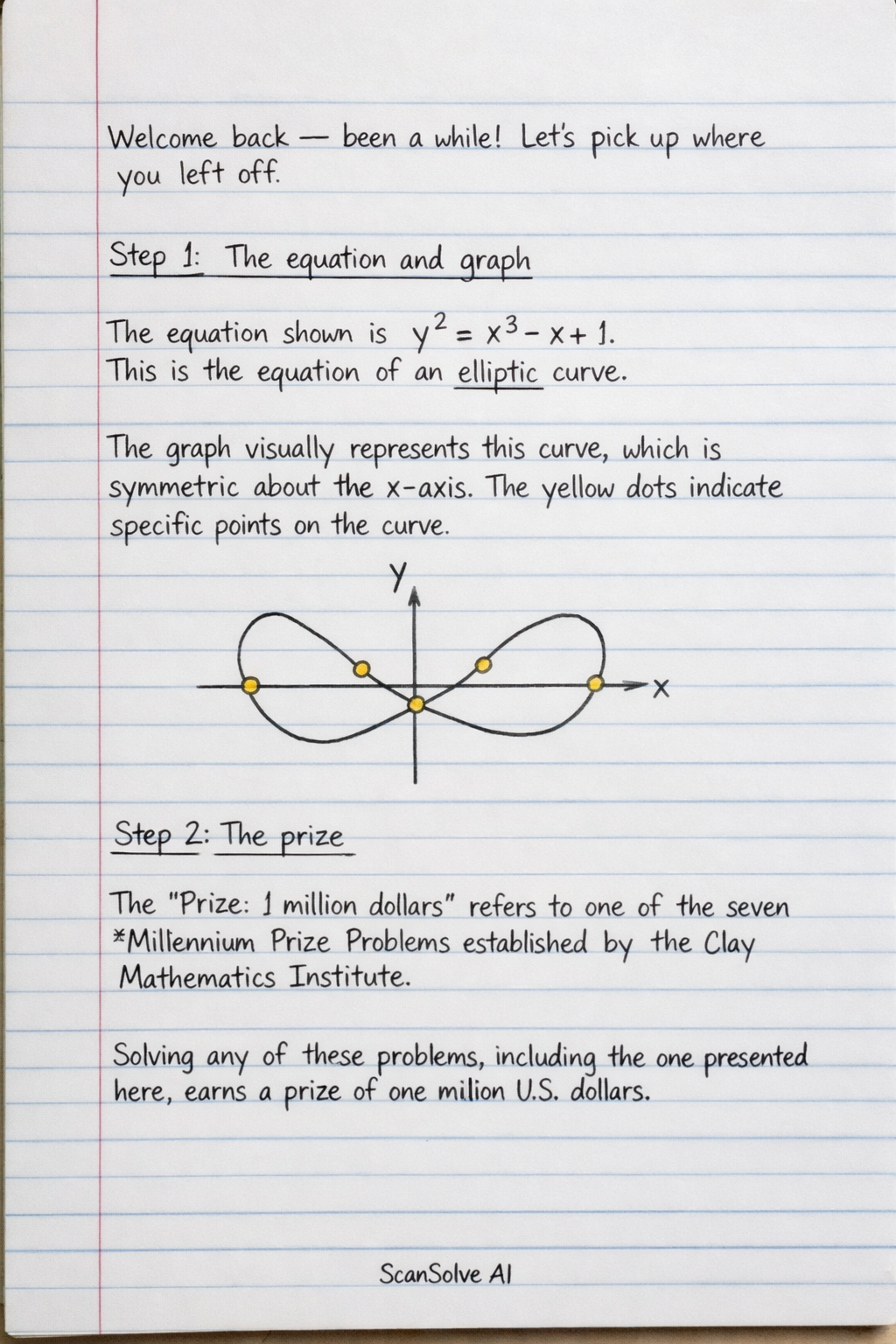
The equation shown is . This is the equation of an elliptic curve. The graph visually represents this curve, which is symmetric about the x-axis. The yellow dots indicate specific points on the curve.
The prize
The "Prize: 1 million dollars" refers to one of the seven Millennium Prize Problems established by the Clay Mathematics Institute. Solving any of these problems, including the one presented here, earns a prize of one million U.S. dollars.
The Birch and Swinnerton-Dyer (BSD) conjecture
The mathematical statement
is the Birch and Swinnerton-Dyer (BSD) conjecture. It proposes that the rank of the group of rational points on an elliptic curve (which measures the number of independent rational solutions) is equal to the order of vanishing of its associated -function at . This conjecture links the algebraic properties of an elliptic curve to the analytic properties of its -function.
Still stuck on this one?
Ask a follow-up, and the answer starts from this question.
More Mathematics Questions
Handwritten Step-by-Step Solution
Get this as a handwritten image on WhatsApp — like a tutor wrote it for you.
Try on WhatsApp