
We read your photo as:
Given Y = 3 − 2X, E[X] = 5, and Var(X) = 4, which statement is correct?
Mathematics
ScanSolve AI Answer
Step-by-step solution
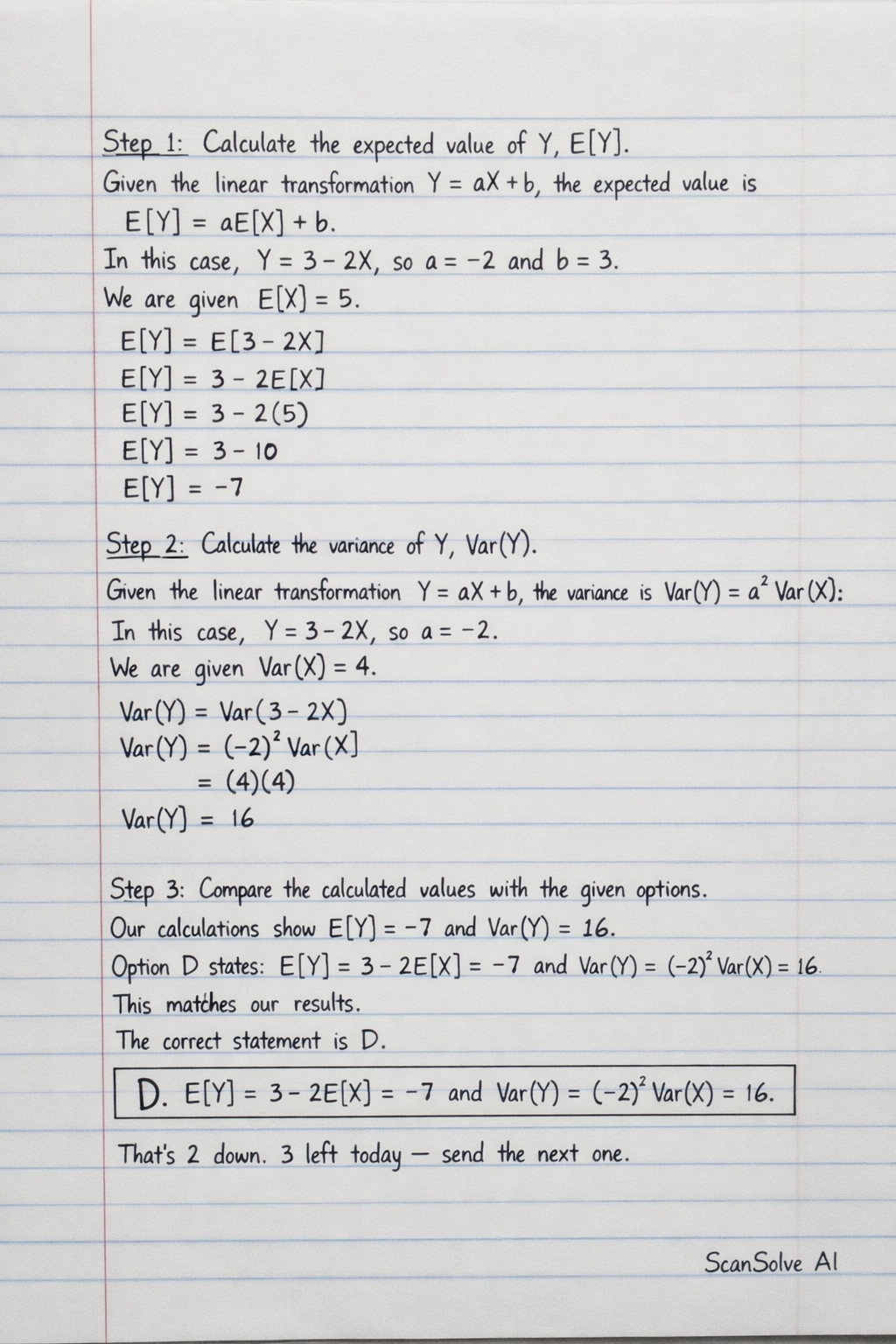
3 stepsCalculate the expected value of , .
Given the linear transformation , the expected value is .
In this case, , so and .
We are given .Calculate the variance of , .
Given the linear transformation , the variance is .
In this case, , so .
We are given .Compare the calculated values with the given options.
Our calculations show and .
Option D states: and . This matches our results.The correct statement is D.
Was this helpful?
Still stuck on this one?
Ask a follow-up, and the answer starts from this question.
Got a different question?Ask your own question
More Mathematics Questions
QTo calculate E[Y+4] and Var[3Y] for the given probability distribution.QFind a simple discrete model for X with E[X]=1.2 and Var(X)=2.5.QGiven a random variable X with E[X] = 0 and Var(X) = 1, find the expected value and variance of Z…QGiven the probability mass function P(x=0) = 1/3, P(x=1) = 1/8, and P(x=2) = 1/2, find E[x] and…QCalculate Var[5X − 2] given Var[X] = (17/8)2.
Handwritten Step-by-Step Solution
Get this as a handwritten image on WhatsApp — like a tutor wrote it for you.
Try on WhatsApp