

This mathematics problem involves applying core mathematical principles and formulas. Below you will find a complete step-by-step solution with detailed explanations for each step, helping you understand not just the answer but the method behind it.
ScanSolve AI Answer
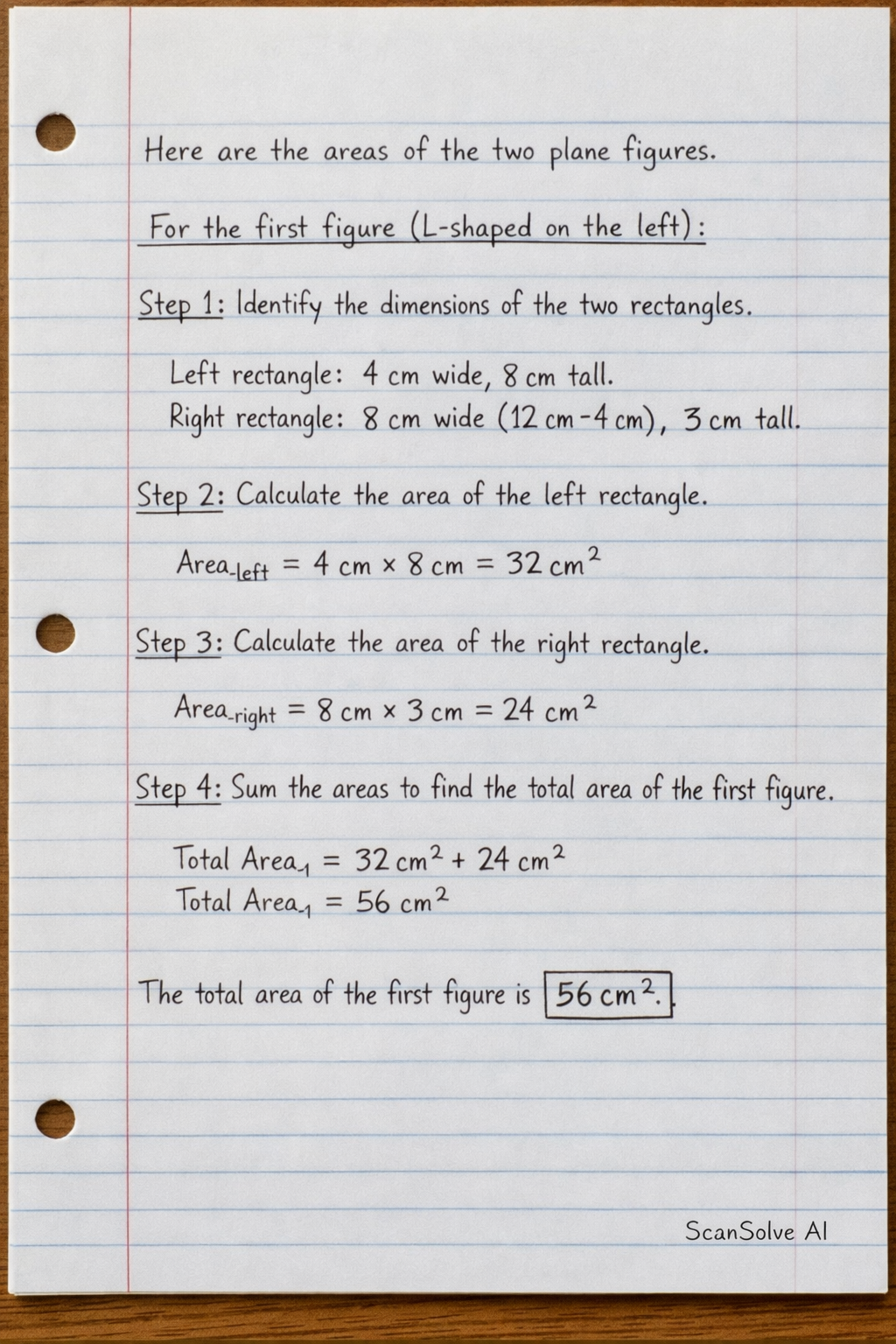
Here are the areas of the two plane figures. For the first figure (L-shaped on the left): This figure can be divided into two rectangles. Step 1: Identify the dimensions of the two rectangles. Divide the L-shape into a left vertical rectangle and a right horizontal rectangle. The left rectangle has a width of 4 cm and a height of 8 cm. The right rectangle has a height of 3 cm. Its width is the total bottom length minus the width of the left part: 12 cm - 4 cm = 8 cm. Step 2: Calculate the area of the left rectangle. Area_left = 4 cm × 8 cm = 32 cm^2 Step 3: Calculate the area of the right rectangle. Area_right = 8 cm × 3 cm = 24 cm^2 Step 4: Sum the areas to find the total area of the first figure. Total Area_1 = 32 cm^2 + 24 cm^2 = 56 cm^2 The total area of the first figure is 56 cm^2. For the second figure (two stacked rectangles on the right): This figure is composed of two rectangles. Step 1: Identify the dimensions of the top rectangle. The top rectangle has a width of 4 cm and a height of 8 cm. Step 2: Calculate the area of the top rectangle. Area_top = 4 cm × 8 cm = 32 cm^2 Step 3: Identify the dimensions of the bottom rectangle. The bottom rectangle has a width of 8 cm and a height of 3 cm. Step 4: Calculate the area of the bottom rectangle. Area_bottom = 8 cm × 3 cm = 24 cm^2 Step 5: Sum the areas to find the total area of the second figure. Total Area_2 = 32 cm^2 + 24 cm^2 = 56 cm^2 The total area of the second figure is 56 cm^2. That's 2 down. 3 left today — send the next one.