
We read your photo as:
Calculate the perimeter of the L-shaped figure A and the T-shaped figure B.
ScanSolve AI Answer
This answer stops before the end.
It was cut off when it was first written. Ask ScanSolve this question again for the full working.
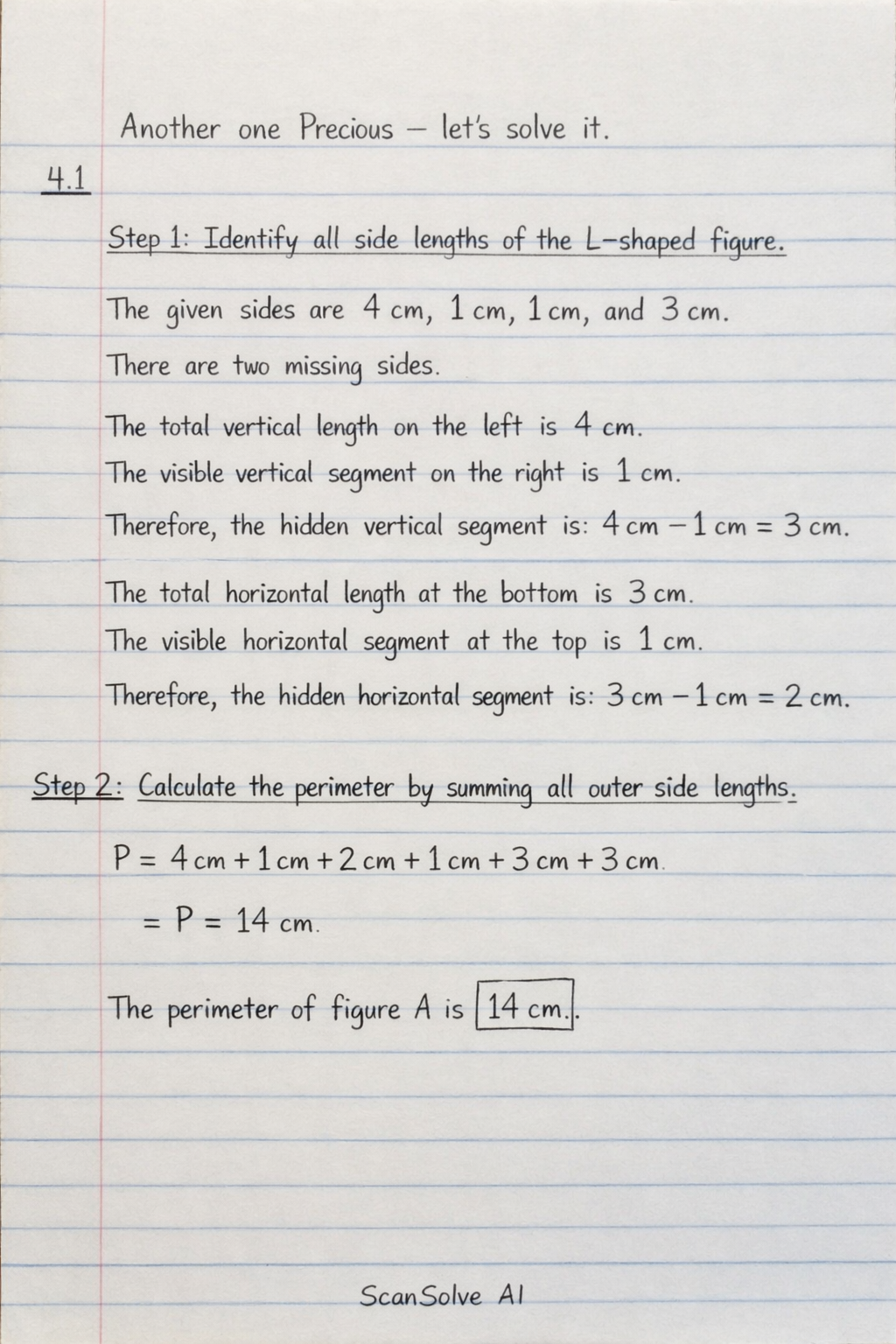
4.1
Step 1: Identify all side lengths of the L-shaped figure.
The given sides are , , , and .
There are two missing sides.
The total vertical length on the left is . The visible vertical segment on the right is . Therefore, the hidden vertical segment is .
The total horizontal length at the bottom is . The visible horizontal segment at the top is . Therefore, the hidden horizontal segment is .
Step 2: Calculate the perimeter by summing all outer side lengths.
The perimeter of figure A is .
4.2
Step 1: Identify all side lengths of the T-shaped figure.
The given sides are , , , and .
Due to symmetry, the other small vertical side is , and the other main vertical side is .
The top horizontal length is and the bottom horizontal length is . The two small horizontal segments connecting the top and bottom parts are equal.
Length of each small horizontal segment = .
Step 2: Calculate the perimeter by summing all outer side lengths.
The perimeter of figure B is .
4.3
Step 1: Convert all units to centimeters.
The top side is .
The right slant side is .
The bottom base consists of three segments: , , and .
Convert to centimeters: .
The total bottom base length is .
Step 2: Calculate the length of the left slant side.
The figure shows a right-angled triangle on the left with a base of and a height of . Use the Pythagorean theorem: .
Rounding to two decimal places, the left slant side is approximately .
Step 3: Calculate the perimeter by summing all four side lengths.
The perimeter of the trapezium is .
4.4
Step 1: Identify the components of the figure and state assumptions.
The figure consists of a rectangular base and a semicircle on top.
The vertical side of the rectangular part is given as .
Assumption: Since no other horizontal dimension is given, we assume the rectangular part is a square, meaning its width is also . This width is also the diameter of the semicircle.
Step 2: Calculate the perimeter.
The perimeter consists of:
- Two vertical sides of the rectangle:
- The bottom horizontal side of the rectangle: (based on assumption)
- The arc length of the semicircle:
Still stuck on this one?
Ask a follow-up, and the answer starts from this question.
More Mathematics Questions
Handwritten Step-by-Step Solution
Get this as a handwritten image on WhatsApp — like a tutor wrote it for you.
Try on WhatsApp