
We read your photo as:
Find the areas of the following trapeziums. A) Given a trapezium with parallel sides 7cm and 9cm, and non-parallel sides 8cm.
ScanSolve AI Answer
Step-by-step solution
3 stepsHere's how to find the area of the trapezium.
The formula for the area of a trapezium is:
where and are the lengths of the parallel sides, and is the perpendicular height.
From the image, we have:
Parallel side
Parallel side
The non-parallel sides are both .
Find the perpendicular height () of the trapezium.
Since it's an isosceles trapezium, we can draw perpendiculars from the ends of the shorter parallel side to the longer parallel side. This forms a rectangle in the middle and two right-angled triangles on the sides.
The length of the base of each right-angled triangle is .
Using the Pythagorean theorem for one of the right-angled triangles:We can simplify as .
Substitute the values of , , and into the area formula.
Calculate the area.
The area of the trapezium is
\boxed{\text{24\sqrt{7} cm}^2}.
Still stuck on this one?
Ask a follow-up, and the answer starts from this question.
More Mathematics Questions
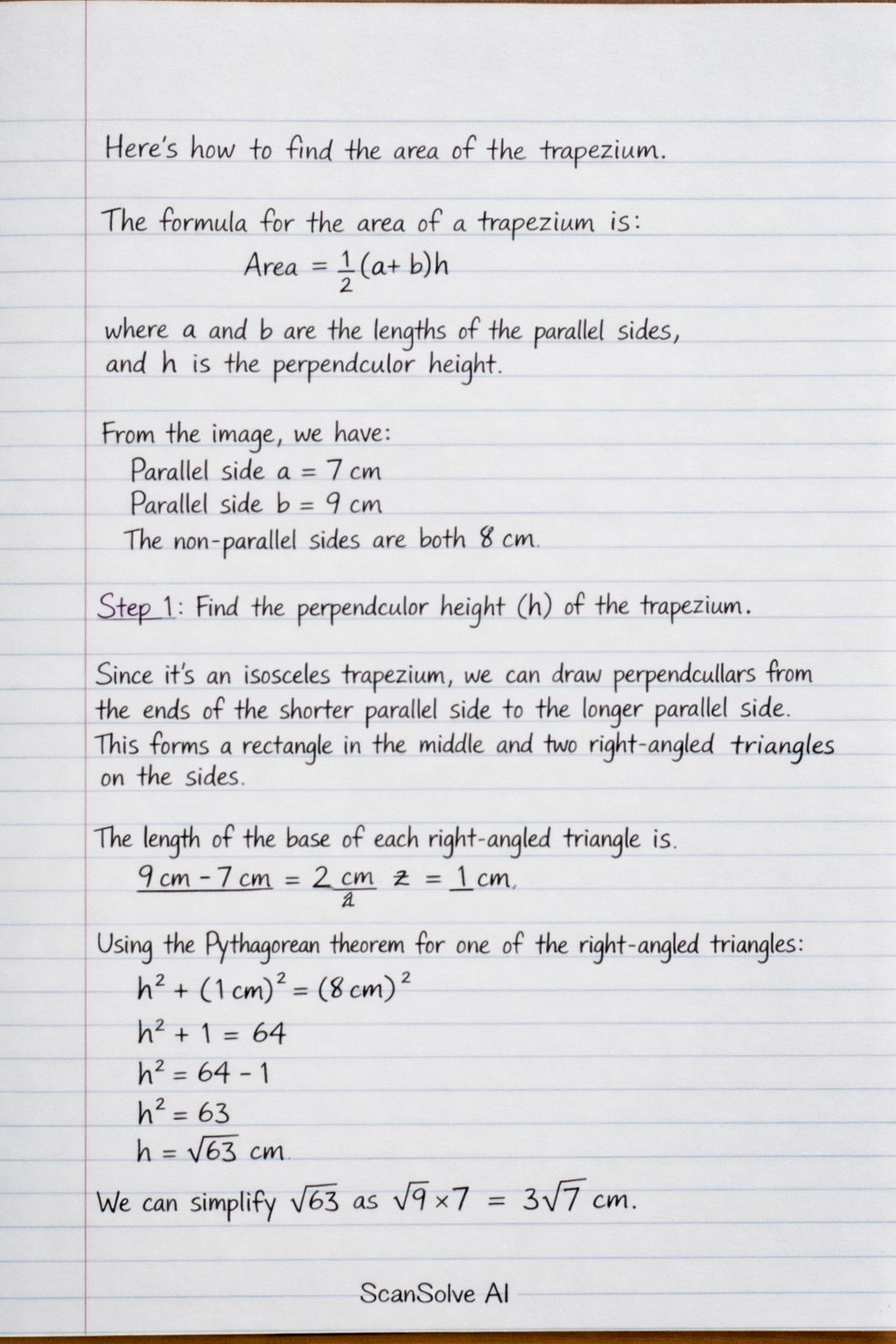
Handwritten Step-by-Step Solution
Get this as a handwritten image on WhatsApp — like a tutor wrote it for you.
Try on WhatsApp