
We read your photo as:
Arrange 1/2, 2/5, 5/8 and 7/10 in ascending order, from the smallest to biggest.
ScanSolve AI Answer
Answer
Step-by-step solution
21 steps9. Arrange and in ascending order, from the smallest to the biggest.
Find a common denominator for all fractions.
The denominators are 2, 5, 8, and 10. The least common multiple (LCM) of these numbers is 40.
Convert each fraction to an equivalent fraction with a denominator of 40.
Arrange the fractions in ascending order based on their numerators.
The fractions are .
Converting back to the original fractions: .Compare with the given options.
Option B is .
The correct option is B.10. Simplify
Simplify the fractions and convert the mixed number to an improper fraction.
The expression becomes:
Perform the division operation first (following order of operations).
Perform the addition.
Find a common denominator, which is 15.
The calculated answer is . This answer is not among the given options (A. , B. , C. 1, D. , E. ). There might be an error in the question or the provided options. Based on standard mathematical operations, is the correct simplification. Since I must select an option, and none match, I cannot provide a definitive answer from the given choices.
11. Some bricklayers working on the fencing of a school compound took 10 days to complete of the job. If they are working at the same rate, how many more days will they spend to finish the job?
Determine the rate of work.
The bricklayers completed of the job in 10 days.
This means they complete of the job per day.Calculate the remaining portion of the job.
The total job is 1 (or ).
Remaining job = .Calculate the number of days needed to complete the remaining job.
Number of days =
The correct option is B.
12. Which of the following is equal to ?
Evaluate each option.
A.
B.
C.
D.
E.Identify the option equal to .
Option D is equal to .
The correct option is D.13. Simplify
Multiply the numbers in the numerator.
Multiply the numbers in the denominator.
Divide the numerator by the denominator.
The correct option is E.
14. Find the sum of 18.206, 200 and 1.02.
Align the decimal points and add the numbers.
The sum is 219.226.
The correct option is A.15. Express 300cm, as a decimal of 3 km.
Convert all measurements to the same unit, preferably meters.
1 km = 1000 m
3 km =
1 m = 100 cm
300 cm =Express 300 cm (which is 3 m) as a decimal of 3 km (which is 3000 m).
Simplify the fraction to a decimal.
The correct option is D.
16. Convert to a decimal number.
Divide the numerator by the denominator.
The correct option is D.
17. If , how much will a trader pay for $100.00?
Use the given exchange rate to find the cost in Naira.
Given:
To find the cost for $100.00, multiply the rate by 100.The question asks "how much will a trader pay for $100.00?". The answer is N732.17. There are no options provided for this question.
Try one yourself
A new problem that tests the same skill.
Still stuck on this one?
Ask a follow-up, and the answer starts from this question.
More Mathematics Questions
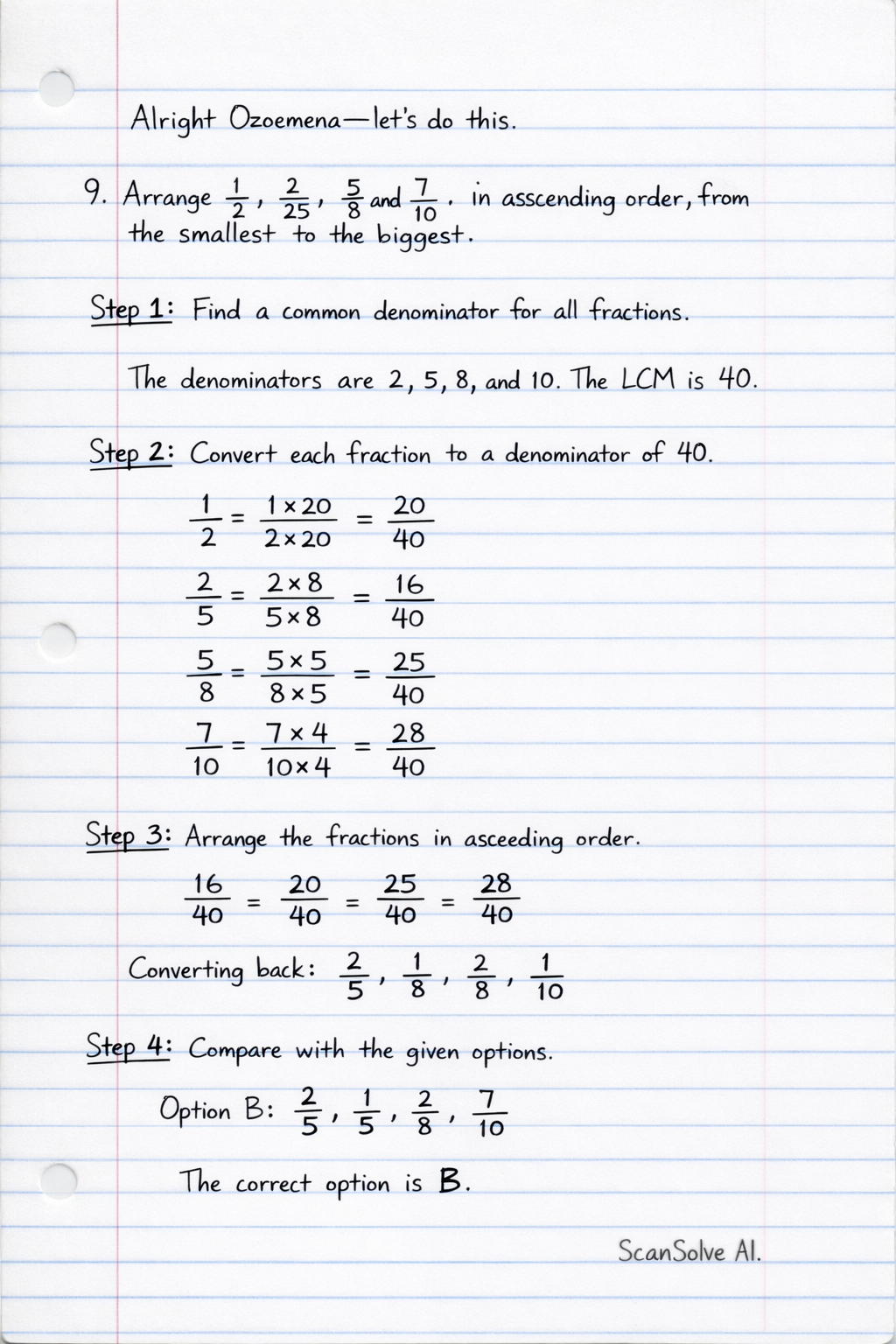
Handwritten Step-by-Step Solution
Get this as a handwritten image on WhatsApp — like a tutor wrote it for you.
Try on WhatsApp