
We read your photo as:
Arrange these fractions in ascending order 3/4, 1/6, 9/8, 1/13 10/15, 8/6, 9/4, 1/3 3/4, 8/6, 1/13, 10/9 1/6, 3/4, 10/13, 9/8 Arrange these fractions in descending order 7/8, 5/6, 2/3, 1/7 5/6, 1/7, 2/3, 7/8 5/6, 7/8, 2/3, 1/7 1/7, 2/3, 5/6, 7/8
ScanSolve AI Answer
Answers
2 partsStep-by-step solution
8 stepsPart 28· 4 steps
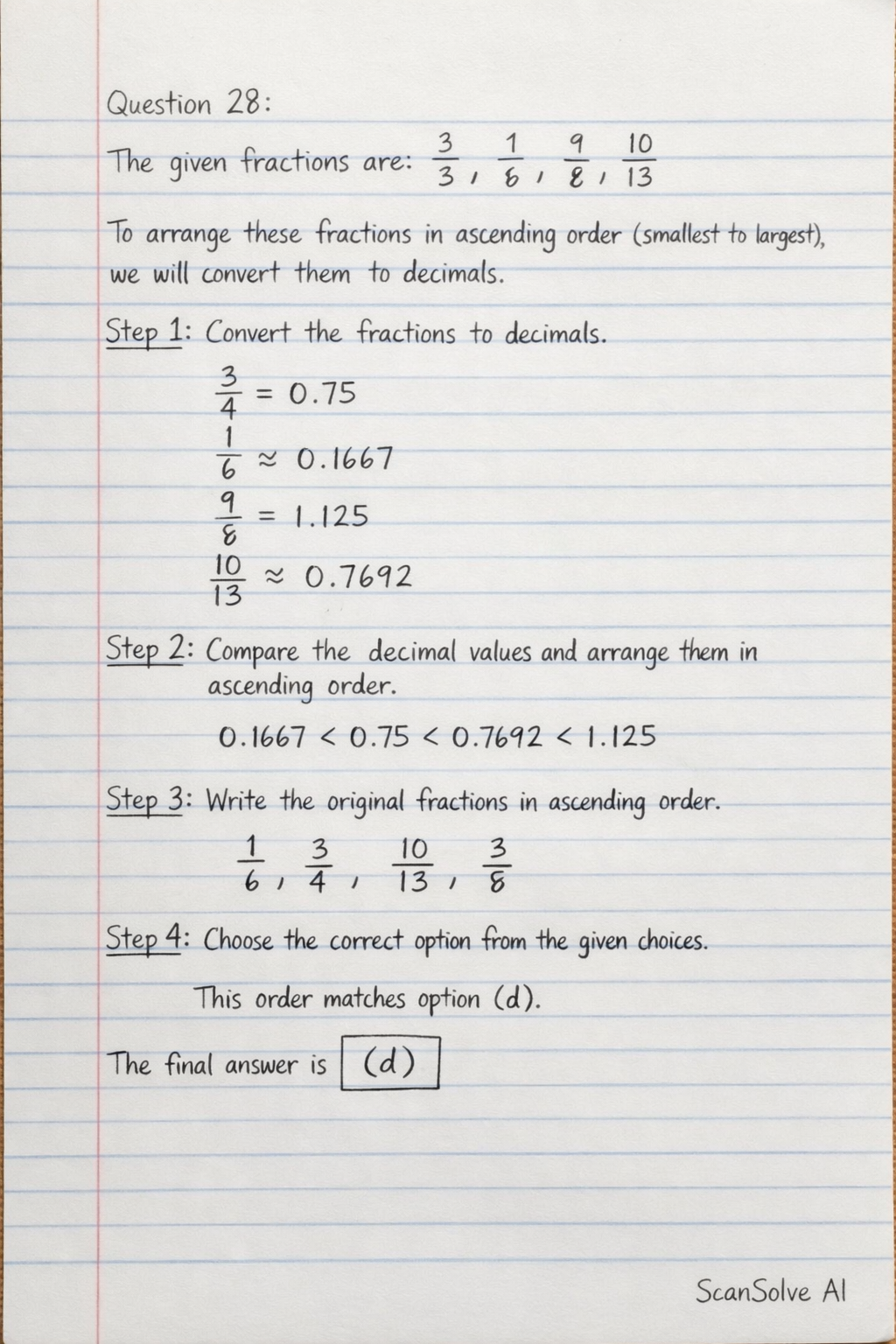
The given fractions are:
To arrange these fractions in ascending order (smallest to largest), we will convert them to decimals.
Convert the fractions to decimals.
Compare the decimal values and arrange them in ascending order.
Write the original fractions in ascending order.
Choose the correct option from the given choices.
This order matches option (d).
The final answer is .
Part 29
The question asks to arrange fractions in descending order. The fractions listed above the options are . However, these fractions do not appear in any of the options. The options themselves contain the set of fractions . We will assume the question intends for us to arrange this set of fractions in descending order, as this is a common pattern in such questions and leads to one of the options.
The fractions to arrange in descending order are:
Convert the fractions to decimals.
Compare the decimal values and arrange them in descending order.
Write the original fractions in descending order.
Choose the correct option from the given choices.
This order matches option (a).
The final answer is .
Try one yourself
A new problem that tests the same skill.
Still stuck on this one?
Ask a follow-up, and the answer starts from this question.
More Mathematics Questions
Handwritten Step-by-Step Solution
Get this as a handwritten image on WhatsApp — like a tutor wrote it for you.
Try on WhatsApp