

This mathematics problem involves applying core mathematical principles and formulas. Below you will find a complete step-by-step solution with detailed explanations for each step, helping you understand not just the answer but the method behind it.
ScanSolve AI Answer
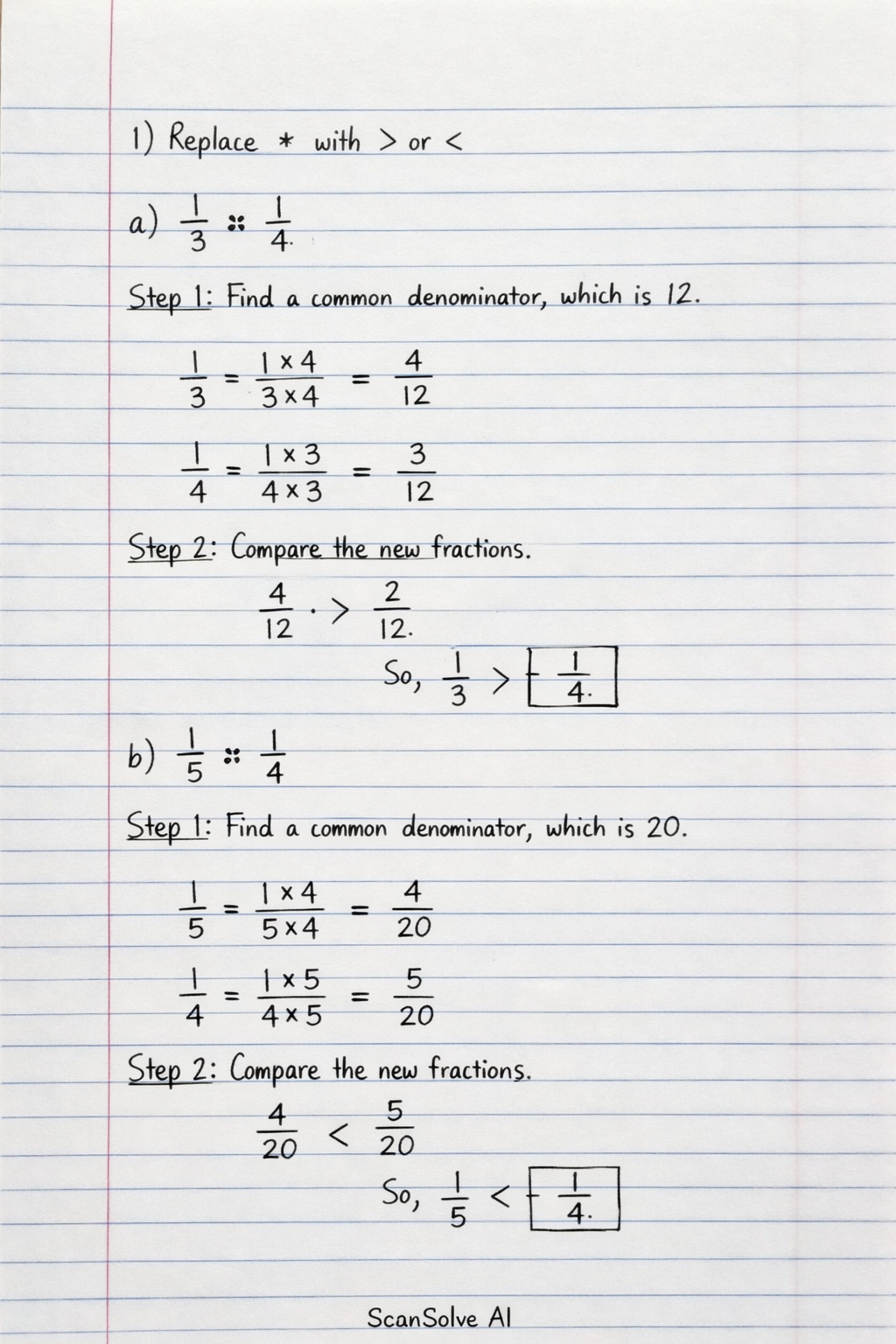
let's tackle these fraction problems! 1) Replace * with > or < To compare fractions, we find a common denominator for each pair. a) (1)/(3) (1)/(4) Step 1: Find a common denominator, which is 12. (1)/(3) = (1 × 4)/(3 × 4) = (4)/(12) (1)/(4) = (1 × 3)/(4 × 3) = (3)/(12) Step 2: Compare the new fractions. Since (4)/(12) > (3)/(12), then (1)/(3) > (1)/(4). b) (1)/(5) (1)/(4) Step 1: Find a common denominator, which is 20. (1)/(5) = (1 × 4)/(5 × 4) = (4)/(20) (1)/(4) = (1 × 5)/(4 × 5) = (5)/(20) Step 2: Compare the new fractions. Since (4)/(20) < (5)/(20), then (1)/(5) < (1)/(4). c) (1)/(6) (1)/(10) Step 1: Find a common denominator, which is 30. (1)/(6) = (1 × 5)/(6 × 5) = (5)/(30) (1)/(10) = (1 × 3)/(10 × 3) = (3)/(30) Step 2: Compare the new fractions. Since (5)/(30) > (3)/(30), then (1)/(6) > (1)/(10). d) (1)/(7) (1)/(6) Step 1: Find a common denominator, which is 42. (1)/(7) = (1 × 6)/(7 × 6) = (6)/(42) (1)/(6) = (1 × 7)/(6 × 7) = (7)/(42) Step 2: Compare the new fractions. Since (6)/(42) < (7)/(42), then (1)/(7) < (1)/(6). 2) Order the fraction from biggest to smallest To order fractions, we find a common denominator for all fractions in the set. a) (1)/(4), (1)/(8), (1)/(2) Step 1: Find a common denominator, which is 8. (1)/(4) = (1 × 2)/(4 × 2) = (2)/(8) (1)/(8) = (1)/(8) (1)/(2) = (1 × 4)/(2 × 4) = (4)/(8) Step 2: Order the fractions from biggest to smallest. Comparing (4)/(8), (2)/(8), (1)/(8), the order is (1)/(2), (1)/(4), (1)/(8). b) (1)/(7), (1)/(3), (1)/(5) Step 1: Find a common denominator, which is 3 × 5 × 7 = 105. (1)/(7) = (1 × 15)/(7 × 15) = (15)/(105) (1)/(3) = (1 × 35)/(3 × 35) = (35)/(105) (1)/(5) = (1 × 21)/(5 × 21) = (21)/(105) Step 2: Order the fractions from biggest to smallest. Comparing (35)/(105), (21)/(105), (15)/(105), the order is (1)/(3), (1)/(5), (1)/(7). c) (1)/(6), (1)/(4), (1)/(3) Step 1: Find a common denominator, which is 12. (1)/(6) = (1 × 2)/(6 × 2) = (2)/(12) (1)/(4) = (1 × 3)/(4 × 3) = (3)/(12) (1)/(3) = (1 × 4)/(3 × 4) = (4)/(12) Step 2: Order the fractions from biggest to smallest. Comparing (4)/(12), (3)/(12), (2)/(12), the order is (1)/(3), (1)/(4), (1)/(6). 3) Copy and complete to more equivalent fractions. To find equivalent fractions, multiply or divide the numerator and denominator by the same non-zero whole number. a) (1)/(4) = ()/(8) To change the denominator from 4 to 8, we multiply by 2. So, multiply the numerator by 2. (1)/(4) = (1 × 2)/(4 × 2) = (2)/(8) b) (3)/(6) = ()/(2) To change the denominator from 6 to 2, we divide by 3. So, divide the numerator by 3. (3)/(6) = (3 ÷ 3)/(6 ÷ 3) = (1)/(2) c) 1 whole = ()/(7) A whole can be written as a fraction where the numerator and denominator are the same. 1 whole = (7)/(7) d) 1 = ()/(2) = ()/(3) = ()/(4) = ()/(6) = ()/(7) = ()/(8) For 1 whole, the numerator is equal to the denominator. 1 = (2)/(2) = (3)/(3) = (4)/(4) = (6)/(6) = (7)/(7) = (8)/(8) e) (1)/(3) = ()/(4) = ()/(6) = ()/(8) We find equivalent fractions by multiplying the numerator and denominator by the same whole number. For (1)/(3) = ()/(4): There is no whole number that multiplies 3 to get 4, so this equivalent fraction cannot be formed with a whole number numerator. For (1)/(3) = ()/(6): To change the denominator from 3 to 6, we multiply by 2. So, multiply the numerator by 2. (1)/(3) = (1 × 2)/(3 × 2) = (2)/(6) For (1)/(3) = ()/(8): There is no whole number that multiplies 3 to get 8, so this equivalent fraction cannot be formed with a whole number numerator. Drop the next question!