
We read your photo as:
Assignment on Differentiation, find the derivation of the following with x using first principle: 1. F(x) = x2 − x 2. F(x) = sqrt(x+1) 3. g(x) = 1/x2 4. h(x) = 1/sqrt(x) 5. y = 1/(2x-1)
Mathematics
ScanSolve AI Answer
Step-by-step solution
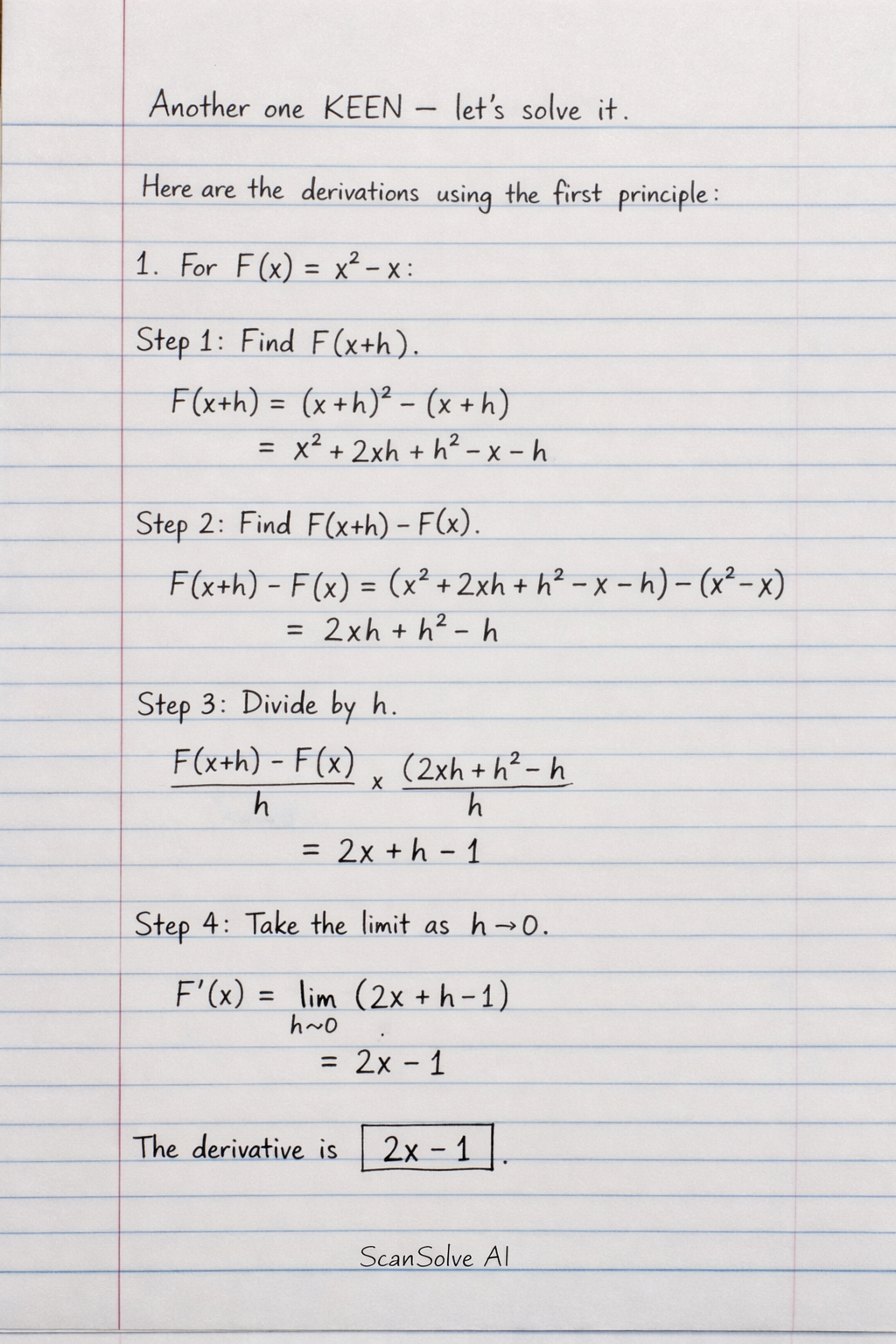
22 stepsHere are the derivations using the first principle:
- For : The first principle definition is .
Find .
$$ F(x+h) = (x+h)^2 - (x+h) = x^2 + 2xh + h^2 - x - h $$Find .
$$ F(x+h) - F(x) = (x^2 + 2xh + h^2 - x - h) - (x^2 - x) = 2xh + h^2 - h $$Divide by .
$$ \frac{F(x+h) - F(x)}{h} = \frac{2xh + h^2 - h}{h} = 2x + h - 1 $$Take the limit as .
$$ F'(x) = \lim_{h \to 0} (2x + h - 1) = 2x - 1 $$ The derivative is $\boxed{2x-1}$.2. For : The first principle definition is .
Find .
$$ F(x+h) - F(x) = \sqrt{(x+h)+1} - \sqrt{x+1} $$Multiply the numerator and denominator by the conjugate of the numerator.
$$ \frac{\sqrt{x+h+1} - \sqrt{x+1}}{h} \times \frac{\sqrt{x+h+1} + \sqrt{x+1}}{\sqrt{x+h+1} + \sqrt{x+1}} $$Simplify the numerator using .
$$ \frac{(x+h+1) - (x+1)}{h(\sqrt{x+h+1} + \sqrt{x+1})} = \frac{h}{h(\sqrt{x+h+1} + \sqrt{x+1})} $$Cancel from the numerator and denominator.
$$ \frac{1}{\sqrt{x+h+1} + \sqrt{x+1}} $$Take the limit as .
$$ F'(x) = \lim_{h \to 0} \frac{1}{\sqrt{x+h+1} + \sqrt{x+1}} = \frac{1}{\sqrt{x+0+1} + \sqrt{x+1}} = \frac{1}{2\sqrt{x+1}} $$ The derivative is $\boxed{\frac{1}{2\sqrt{x+1}}}$.3. For : The first principle definition is .
Find .
$$ g(x+h) - g(x) = \frac{1}{(x+h)^2} - \frac{1}{x^2} $$Combine the fractions in the numerator.
$$ \frac{x^2 - (x+h)^2}{x^2(x+h)^2} = \frac{x^2 - (x^2 + 2xh + h^2)}{x^2(x+h)^2} = \frac{-2xh - h^2}{x^2(x+h)^2} $$Divide by .
$$ \frac{g(x+h) - g(x)}{h} = \frac{-2xh - h^2}{h \cdot x^2(x+h)^2} = \frac{h(-2x - h)}{h \cdot x^2(x+h)^2} = \frac{-2x - h}{x^2(x+h)^2} $$Take the limit as .
$$ g'(x) = \lim_{h \to 0} \frac{-2x - h}{x^2(x+h)^2} = \frac{-2x - 0}{x^2(x+0)^2} = \frac{-2x}{x^2 \cdot x^2} = \frac{-2x}{x^4} = -\frac{2}{x^3} $$ The derivative is $\boxed{-\frac{2}{x^3}}$.4. For : The first principle definition is .
Find .
$$ h(x+h) - h(x) = \frac{1}{\sqrt{x+h}} - \frac{1}{\sqrt{x}} $$Combine the fractions in the numerator.
$$ \frac{\sqrt{x} - \sqrt{x+h}}{\sqrt{x}\sqrt{x+h}} $$Multiply the numerator and denominator by the conjugate of the numerator.
$$ \frac{\sqrt{x} - \sqrt{x+h}}{\sqrt{x}\sqrt{x+h}} \times \frac{\sqrt{x} + \sqrt{x+h}}{\sqrt{x} + \sqrt{x+h}} = \frac{x - (x+h)}{\sqrt{x}\sqrt{x+h}(\sqrt{x} + \sqrt{x+h})} = \frac{-h}{\sqrt{x}\sqrt{x+h}(\sqrt{x} + \sqrt{x+h})} $$Divide by .
$$ \frac{h(x+h) - h(x)}{h} = \frac{-h}{h \cdot \sqrt{x}\sqrt{x+h}(\sqrt{x} + \sqrt{x+h})} = \frac{-1}{\sqrt{x}\sqrt{x+h}(\sqrt{x} + \sqrt{x+h})} $$Take the limit as .
$$ h'(x) = \lim_{h \to 0} \frac{-1}{\sqrt{x}\sqrt{x+h}(\sqrt{x} + \sqrt{x+h})} = \frac{-1}{\sqrt{x}\sqrt{x+0}(\sqrt{x} + \sqrt{x+0})} = \frac{-1}{\sqrt{x}\sqrt{x}(2\sqrt{x})} = \frac{-1}{x(2\sqrt{x})} = -\frac{1}{2x^{3/2}} $$ The derivative is $\boxed{-\frac{1}{2x^{3/2}}}$.5. For : Let . The first principle definition is .
Find .
$$ f(x+h) - f(x) = \frac{1}{2(x+h)-1} - \frac{1}{2x-1} = \frac{1}{2x+2h-1} - \frac{1}{2x-1} $$Combine the fractions in the numerator.
$$ \frac{(2x-1) - (2x+2h-1)}{(2x+2h-1)(2x-1)} = \frac{2x-1-2x-2h+1}{(2x+2h-1)(2x-1)} = \frac{-2h}{(2x+2h-1)(2x-1)} $$Divide by .
$$ \frac{f(x+h) - f(x)}{h} = \frac{-2h}{h(2x+2h-1)(2x-1)} = \frac{-2}{(2x+2h-1)(2x-1)} $$Take the limit as .
$$
f'(x) = \lim_{h \to 0} \frac{-2}{(2x+2h-1)(2x-1)} = \frac{-2}{(2x+2(0)-1)(2x-1)} = \frac{-2}{(2x-1)(2x-1)} = \frac{-2}{(2x-1)^2}
$$
The derivative is $\boxed{-\frac{2}{(2x-1)^2}}$.
Was this helpful?
Still stuck on this one?
Ask a follow-up, and the answer starts from this question.
Got a different question?Ask your own question
More Mathematics Questions
QFind the derivatives of the following with first principle: 1) f(x) = x2-x 2) f(x) = sqrt(x+1) 3)…QFind the derivatives of the following functions from first principles or by using differentiation…QFind the derivatives of the following functions using first principles: f(x) = x3 and f(x)…QFind the derivative of the following functions from first principles: i) y = x2 ii) y = 3x + 2 iii)…QIf f(x) = x², then find f' from the first principle. 2. Complete the following statement. Derivative…
Browse by topic:Calculus
Handwritten Step-by-Step Solution
Get this as a handwritten image on WhatsApp — like a tutor wrote it for you.
Try on WhatsApp