
We read your photo as:
b) Calculate the total amount that must be repaid if you choose Option 2 (compound interest) c) Compare the two options and justify which repayment option is cheaper.
ScanSolve AI Answer
Answer
Step-by-step solution
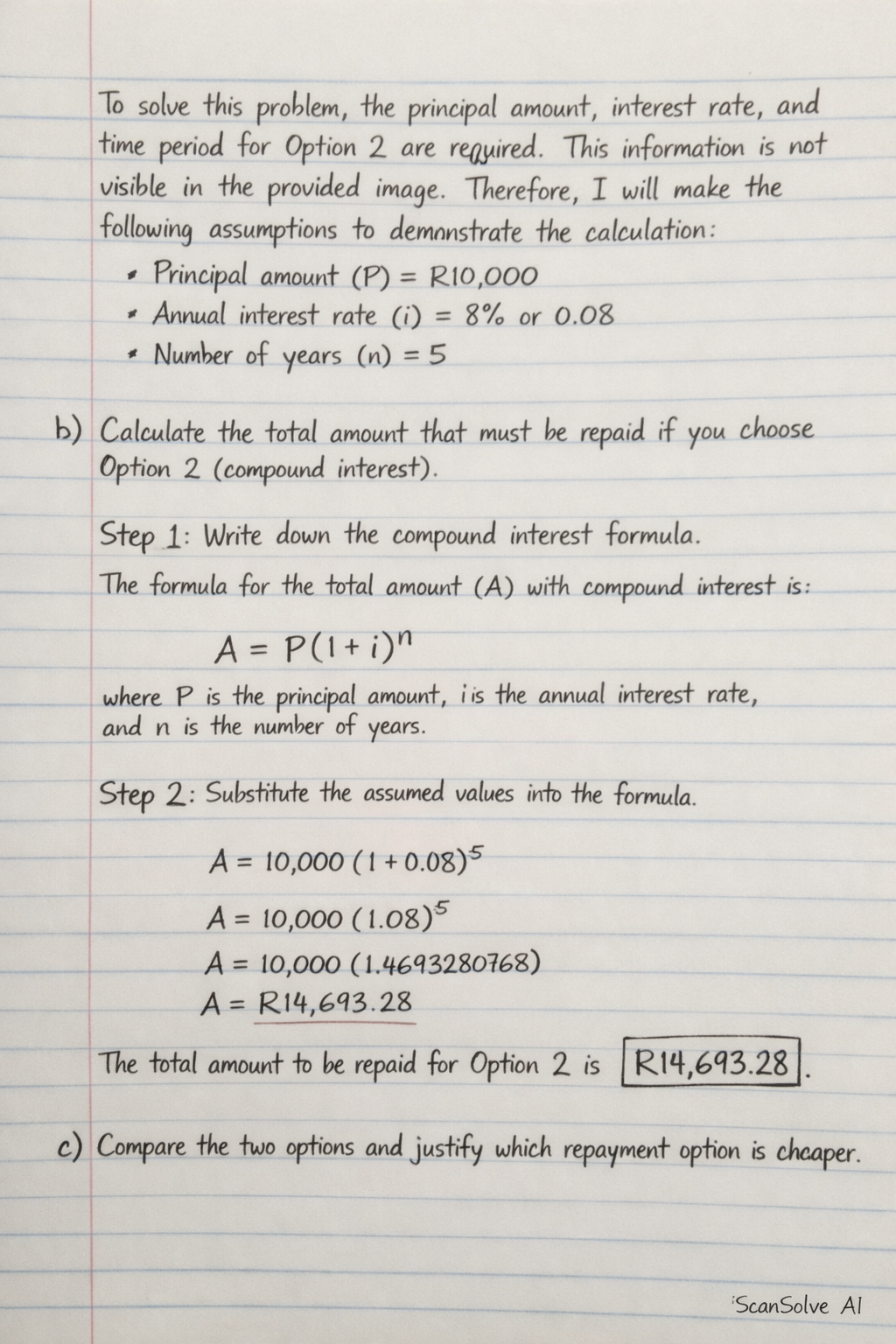
6 stepsTo solve this problem, the principal amount, interest rate, and time period for Option 2 are required. This information is not visible in the provided image. Therefore, I will make the following assumptions to demonstrate the calculation:
- Principal amount
- Annual interest rate or 0.08
- Number of years
Part b· 3 steps
Calculate the total amount that must be repaid if you choose Option 2 (compound interest).
Write down the compound interest formula.
The formula for the total amount with compound interest is:
where is the principal amount, is the annual interest rate, and is the number of years.
Substitute the assumed values into the formula.
Calculate the total amount.
The total amount to be repaid for Option 2 is .
Part c· 3 steps
Compare the two options and justify which repayment option is cheaper.
To compare the options, we need the total repayment amount for Option 1. Since this is not provided, I will assume Option 1 is a simple interest loan with the same principal, rate, and time as assumed for Option 2.
Calculate the total amount for Option 1 (Simple Interest, based on assumptions).
Assumptions: , , years.
The formula for simple interest total amount is:Compare the total amounts for Option 1 and Option 2.
Total for Option 1:
Total for Option 2:Justify which option is cheaper.
Comparing the two amounts, .
Therefore, Option 1 is cheaper. This is because simple interest calculates interest only on the principal amount, whereas compound interest calculates interest on the principal and also on the accumulated interest from previous periods, leading to a higher total repayment over time.
Try one yourself
A new problem that tests the same skill.
Still stuck on this one?
Ask a follow-up, and the answer starts from this question.
More Mathematics Questions
Handwritten Step-by-Step Solution
Get this as a handwritten image on WhatsApp — like a tutor wrote it for you.
Try on WhatsApp