
We read your photo as:
Below is a weather prediction table. Answer the following questions based on the table: 2.1. Determine the number of days for which this weather prediction table is valid. 2.2. Write down the percenta
ScanSolve AI Answer
Step-by-step solution
8 stepshere are the solutions to the questions:
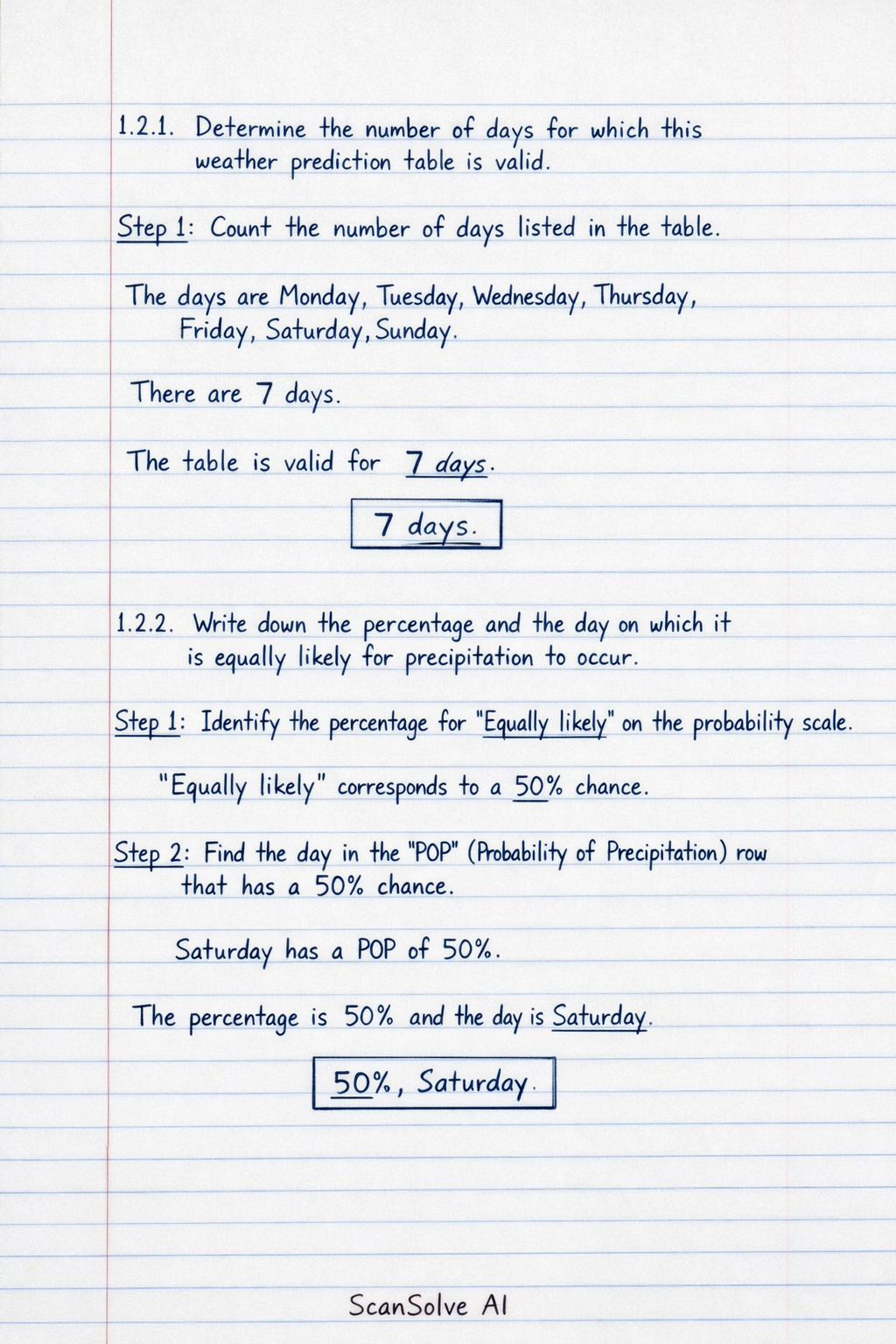
1.2.1. Determine the number of days for which this weather prediction table is valid.
The table provides predictions for Monday (04/19) through Sunday (04/25).
Count the number of days listed in the table.
The days are Monday, Tuesday, Wednesday, Thursday, Friday, Saturday, Sunday.
There are 7 days.
The table is valid for 7 days.1.2.2. Write down the percentage and the day on which it is equally likely for precipitation to occur.
Identify the percentage for "Equally likely" on the probability scale.
"Equally likely" corresponds to a 50% chance.
Find the day in the "POP" (Probability of Precipitation) row that has a 50% chance.
Saturday has a POP of 50%.
The percentage is 50% and the day is Saturday.\boxed{\text{50%, Saturday}}1.2.3. Name the day on which the predicted temperature is higher than what it actually feels like.
Calculate the difference between "Predicted" and "Feels like" temperatures for each day.
- Monday:
- Tuesday:
- Wednesday:
- Thursday:
- Friday:
- Saturday:
- Sunday:
Identify the day with a difference of .
The day is Sunday.
1.2.4. The actual rainfall for Monday, Thursday and Sunday was , and respectively. Calculate, in mm, the total rainfall for these days.
Sum the given rainfall amounts.
Total rainfall
Total rainfall
Total rainfall
The total rainfall for these days is 20.7 mm.1.2.5. It started to snow at 14:53 on Wednesday. Write down this time in words.
Convert the 24-hour time to 12-hour format.
is .
Write the time in words.
The time in words is fifty-three minutes past two in the afternoon.
Still stuck on this one?
Ask a follow-up, and the answer starts from this question.
More Mathematics Questions
Handwritten Step-by-Step Solution
Get this as a handwritten image on WhatsApp — like a tutor wrote it for you.
Try on WhatsApp