This mathematics problem involves applying core mathematical principles and formulas. Below you will find a complete step-by-step solution with detailed explanations for each step, helping you understand not just the answer but the method behind it.
ScanSolve AI Answer
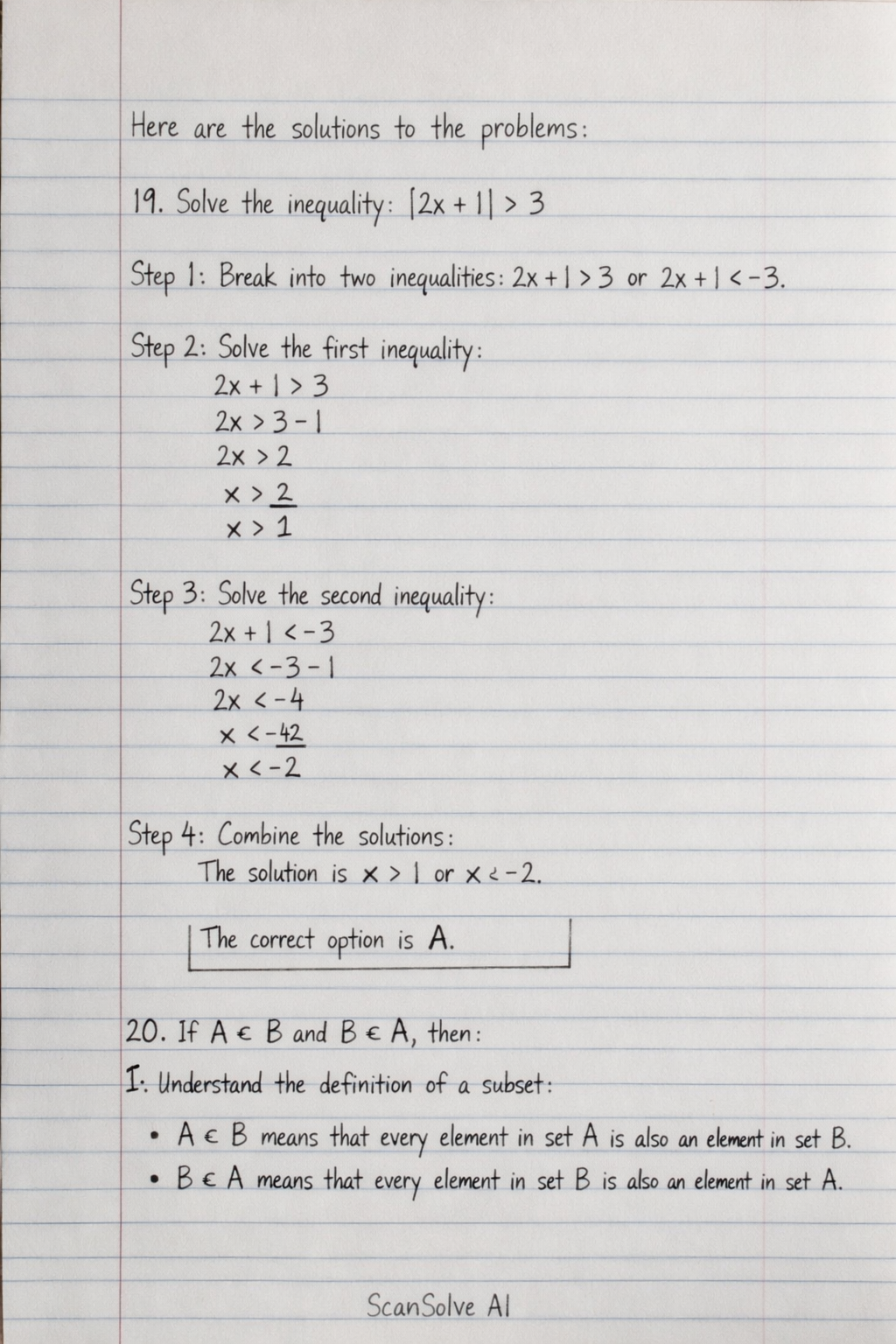
Here are the solutions to the problems:
19. Solve the inequality: $|2x + 1| > 3$
Step 1: Break the absolute value inequality into two separate inequalities.
If $|u| > a$, then $u > a$ or $u < -a$.
So, we have:
$$2x + 1 > 3 \quad \text{or} \quad 2x + 1 < -3$$
Step 2: Solve the first inequality.
$$2x + 1 > 3$$
$$2x > 3 - 1$$
$$2x > 2$$
$$x > \frac{2}{2}$$
$$x > 1$$
Step 3: Solve the second inequality.
$$2x + 1 < -3$$
$$2x < -3 - 1$$
$$2x < -4$$
$$x < \frac{-4}{2}$$
$$x < -2$$
Step 4: Combine the solutions.
The solution is $x > 1$ or $x < -2$.
The correct option is A.
$\boxed{\text{A. } x > 1 \text{ or } x < -2}$
20. If $A \subseteq B$ and $B \subseteq A$, then:
Step 1: Understand the definition of a subset.
$A \subseteq B$ means that every element in set $A$ is also an element in set $B$.
$B \subseteq A$ means that every element in set $B$ is also an element in set $A$.
Step 2: Apply the definitions to the given conditions.
If $A$ is a subset of $B$ and $B$ is a subset of $A$, it implies that both sets contain exactly the same elements. This is the definition of set equality.
Step 3: Conclude the relationship between A and B.
Therefore, $A = B$.
The correct option is B.
$\boxed{\text{B. } A = B}$
21. Rationalize: $\frac{1}{\sqrt{5} - 2}$
Step 1: Identify the conjugate of the denominator.
The denominator is $\sqrt{5} - 2$. Its conjugate is $\sqrt{5} + 2$.
Step 2: Multiply the numerator and the denominator by the conjugate.
$$ \frac{1}{\sqrt{5} - 2} \times \frac{\sqrt{5} + 2}{\sqrt{5} + 2} $$
Step 3: Perform the multiplication.
In the numerator: $1 \times (\sqrt{5} + 2) = \sqrt{5} + 2$.
In the denominator, use the difference of squares formula $(a - b)(a + b) = a^2 - b^2$:
$$ (\sqrt{5} - 2)(\sqrt{5} + 2) = (\sqrt{5})^2 - (2)^2 $$
$$ = 5 - 4 $$
$$ = 1 $$
Step 4: Write the simplified expression.
$$ \frac{\sqrt{5} + 2}{1} = \sqrt{5} + 2 $$
The correct option is A.
$\boxed{\text{A. } \sqrt{5} + 2}$
22. If $z = 2 - 2i$, find $|z|$
Step 1: Identify the real and imaginary parts of the complex number.
For a complex number $z = a + bi$, $a$ is the real part and $b$ is the imaginary part.
Here, $z = 2 - 2i$, so $a = 2$ and $b = -2$.
Step 2: Use the formula for the modulus of a complex number.
The modulus (or absolute value) of a complex number $z = a + bi$ is given by:
$$ |z| = \sqrt{a^2 + b^2} $$
Step 3: Substitute the values of $a$ and $b$ into the formula.
$$ |z| = \sqrt{(2)^2 + (-2)^2} $$
Step 4: Calculate the squares and sum them.
$$ |z| = \sqrt{4 + 4} $$
$$ |z| = \sqrt{8} $$
Step 5: Simplify the square root.
$$ |z| = \sqrt{4 \times 2} $$
$$ |z| = \sqrt{4} \times \sqrt{2} $$
$$ |z| = 2\sqrt{2} $$
The modulus of $z$ is $\boxed{2\sqrt{2}}$.
Question
Break the absolute value inequality into two separate inequalities.
|Mathematics
Break the absolute value inequality into two separate inequalities.
Answer
Here are the solutions to the problems:
19. Solve the inequality: ∣2x+1∣>3
Step 1: Break the absolute value inequality into two separate inequalities.
If ∣u∣>a, then u>a or u<−a.
So, we have:
2x+1>3or2x+1<−3
Step 2: Solve the first inequality.
2x+1>32x>3−12x>2x>22x>1
Step 3: Solve the second inequality.
2x+1<−32x<−3−12x<−4x<2−4x<−2
Step 4: Combine the solutions.
The solution is x>1 or x<−2.
The correct option is A.
A.x>1orx<−2
20. If A⊆B and B⊆A, then:
Step 1: Understand the definition of a subset.
A⊆B means that every element in set A is also an element in set B.
B⊆A means that every element in set B is also an element in set A.
Step 2: Apply the definitions to the given conditions.
If A is a subset of B and B is a subset of A, it implies that both sets contain exactly the same elements. This is the definition of set equality.
Step 3: Conclude the relationship between A and B.
Therefore, A=B.
The correct option is B.
B.A=B
21. Rationalize: 5−21
Step 1: Identify the conjugate of the denominator.
The denominator is 5−2. Its conjugate is 5+2.
Step 2: Multiply the numerator and the denominator by the conjugate.
5−21×5+25+2
Step 3: Perform the multiplication.
In the numerator: 1×(5+2)=5+2.
In the denominator, use the difference of squares formula (a−b)(a+b)=a2−b2:
(5−2)(5+2)=(5)2−(2)2=5−4=1
Step 4: Write the simplified expression.
15+2=5+2
The correct option is A.
A.5+2
22. If z=2−2i, find ∣z∣
Step 1: Identify the real and imaginary parts of the complex number.
For a complex number z=a+bi, a is the real part and b is the imaginary part.
Here, z=2−2i, so a=2 and b=−2.
Step 2: Use the formula for the modulus of a complex number.
The modulus (or absolute value) of a complex number z=a+bi is given by:
∣z∣=a2+b2
Step 3: Substitute the values of a and b into the formula.
∣z∣=(2)2+(−2)2
Step 4: Calculate the squares and sum them.
∣z∣=4+4∣z∣=8
Step 5: Simplify the square root.
∣z∣=4×2∣z∣=4×2∣z∣=22
The modulus of z is 22.
Need help with your own homework?
Get instant step-by-step solutions to any question. Free to start.