
We read your photo as:
Explain the build-up method for solving problems, including its advantages, disadvantages, and how it differs from the formula method. Provide an example of converting kilometers to meters using this
ScanSolve AI Answer
Answer
Step-by-step solution
2 stepsHere's a summary of your notes on the "Build up unit" method:
Disadvantages of the Build-up Method:
- It can be slow for large numbers.
- It requires patience and practical application.
- Some students might rely on counting instead of practical understanding.
When to use the Build-up Method:
- In primary school.
- For introducing proportion and rate.
- For beginners in solving problems.
Differences between Build-up Method and Formula Method:
- Build-up Method: Step-by-step, easy for beginners, uses tables.
- Formula Method: Direct calculation, faster for experts, uses equations.
Definition of Rate Build-up:
A rate build-up is where a student starts from a known unit, multiplies it step by step, and builds up to the required value. It is considered one of the best fundamental strategies for teaching.
Example Problem: Convert 60 kilometers to meters using the build-up method.
Given:
Start with the known unit.
Build up to the required value (60 km) by multiplying both sides.
The conversion of 60 kilometers using the build-up method is:
Try one yourself
A new problem that tests the same skill.
Still stuck on this one?
Ask a follow-up, and the answer starts from this question.
More Mathematics Questions
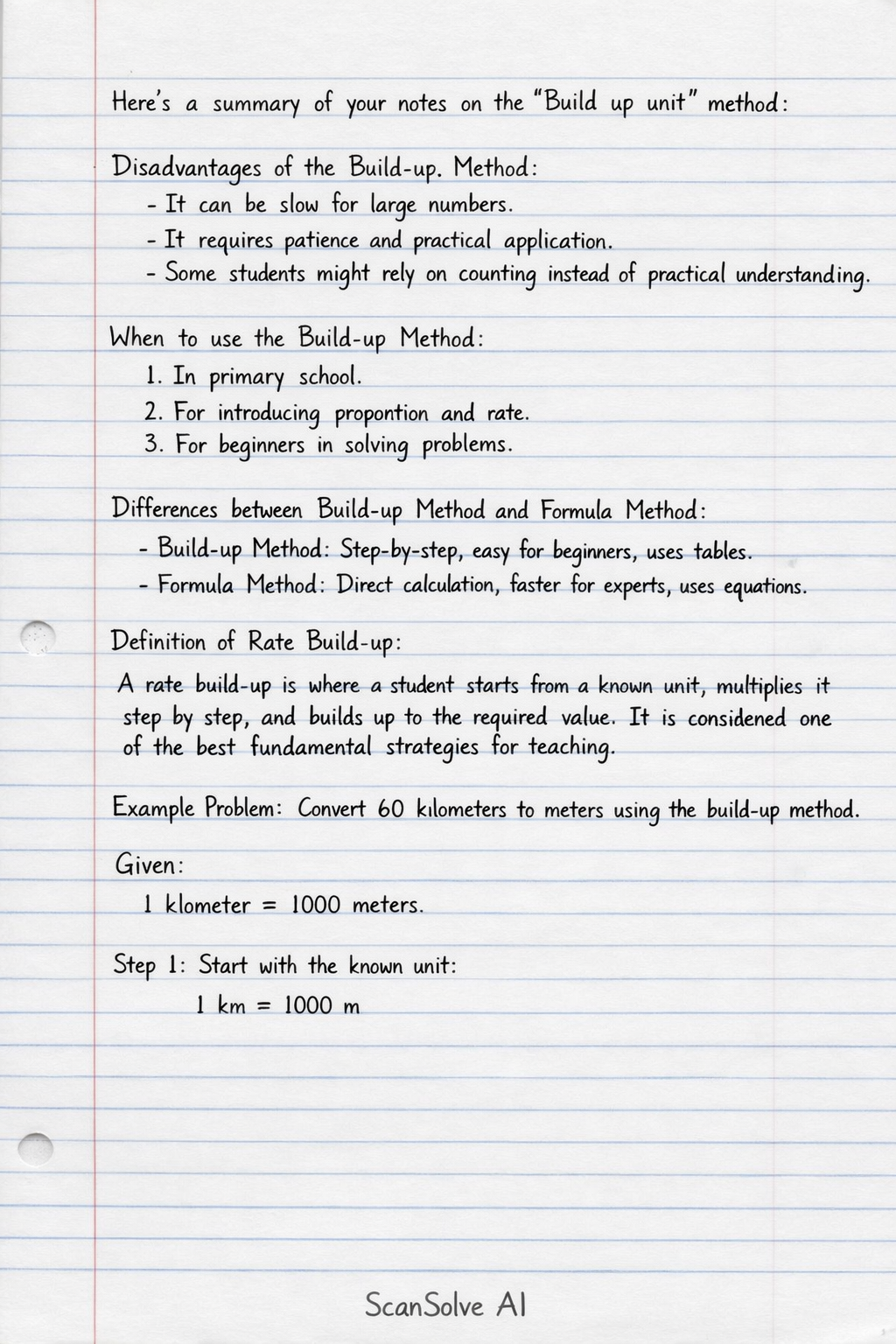
Handwritten Step-by-Step Solution
Get this as a handwritten image on WhatsApp — like a tutor wrote it for you.
Try on WhatsApp