
Solve using base units
Chemistry
ScanSolve AI Answer
Answer
Step-by-step solution
4 stepsDefine specific charge in terms of fundamental quantities.
Specific charge () is defined as the ratio of charge () to mass ().
Express charge in terms of base units.
Charge () is not a base unit. However, electric current () is a base unit (Ampere, A), and current is defined as the rate of flow of charge ().
Therefore, charge can be expressed as .
The base unit for current is Ampere (A).
The base unit for time is second (s).
So, the base unit for charge is Ampere-second (A s).Express mass in terms of base units.
Mass () is a base unit.
The base unit for mass is kilogram (kg).Substitute the base units into the equation for specific charge.
This can also be written as:
The base units of specific charge are .
Was this helpful?
Try one yourself
A new problem that tests the same skill.
Still stuck on this one?
Ask a follow-up, and the answer starts from this question.
Got a different question?Ask your own question
More Chemistry Questions
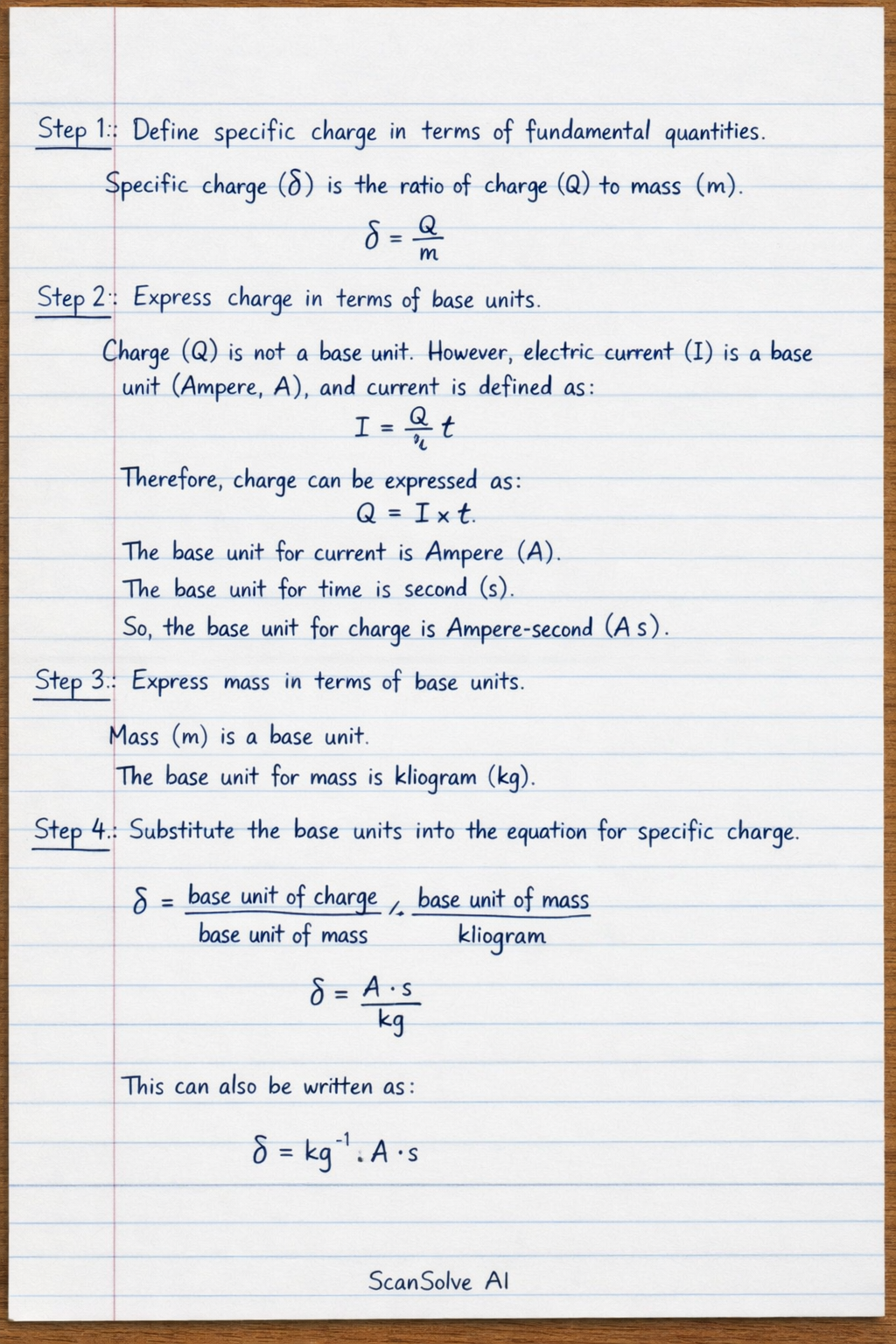
Handwritten Step-by-Step Solution
Get this as a handwritten image on WhatsApp — like a tutor wrote it for you.
Try on WhatsApp