
We read your photo as:
Which is an SI base unit?
ScanSolve AI Answer
Answer
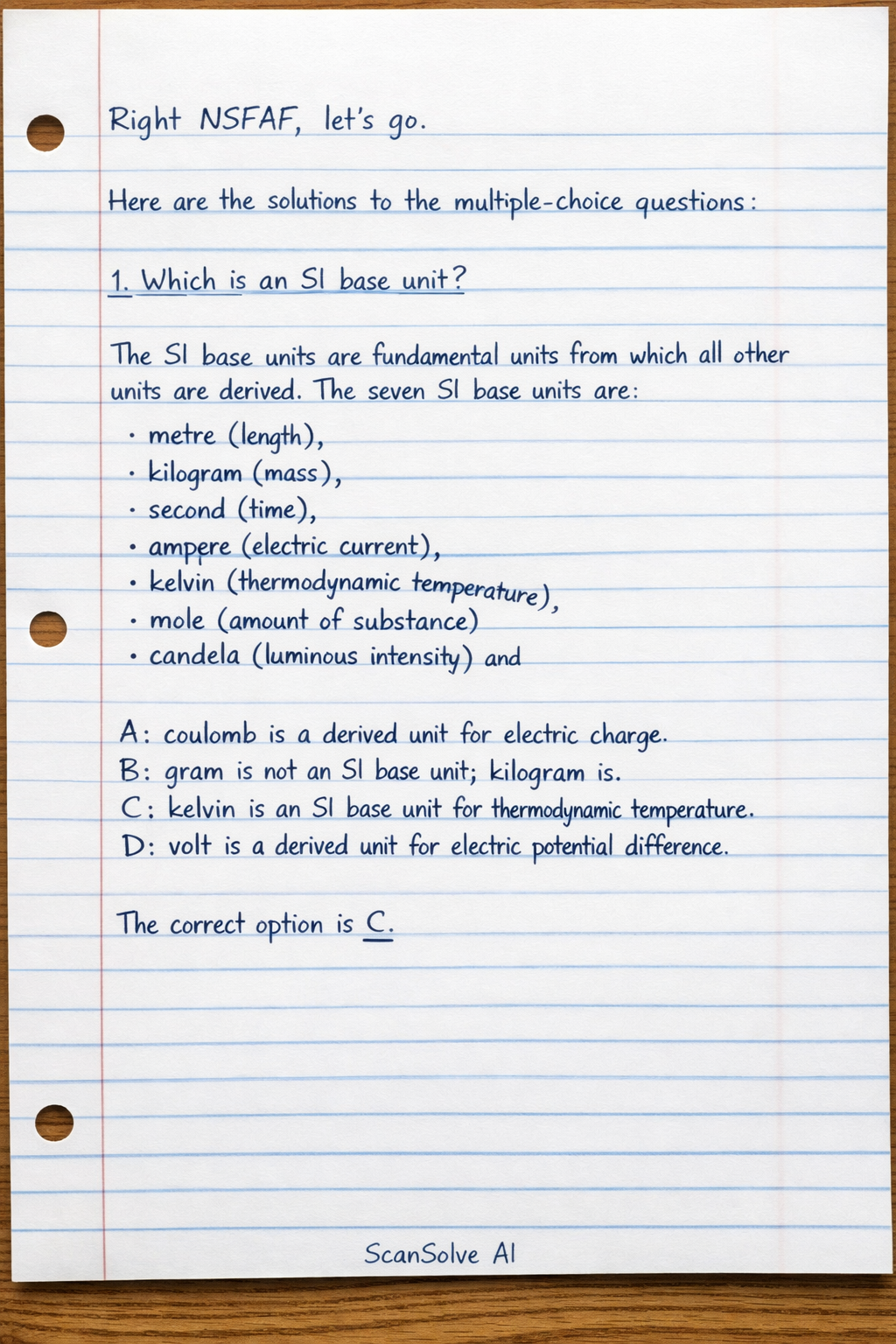
Here are the solutions to the multiple-choice questions:
1. Which is an SI base unit?
The SI base units are fundamental units from which all other units are derived. The seven SI base units are metre (length), kilogram (mass), second (time), ampere (electric current), kelvin (thermodynamic temperature), mole (amount of substance), and candela (luminous intensity).
- A: coulomb is a derived unit for electric charge.
- B: gram is not an SI base unit; kilogram is.
- C: kelvin is an SI base unit for thermodynamic temperature.
- D: volt is a derived unit for electric potential difference. The correct option is C.
2. Two quantities and are directly proportional to each other. Experimental results are taken and plotted in a graph of against . Which graph shows that there were random errors in the measurements of and ?
If and are directly proportional, their graph should be a straight line passing through the origin. Random errors cause data points to scatter randomly around the expected trend line.
- Graph A shows points perfectly on a straight line through the origin, indicating no random errors.
- Graph B shows points perfectly on a curve, indicating no random errors and a non-linear relationship.
- Graph C shows points scattered around a straight line that passes through the origin. This scattering is characteristic of random errors.
- Graph D shows points perfectly on a straight line that does not pass through the origin, indicating a systematic error or a different linear relationship, but no random errors. The correct option is C.
3. Which reading is given to the nearest millimetre?
1 millimetre (mm) is equal to 0.1 centimetre (cm). A reading given to the nearest millimetre means it is precise to one decimal place in centimetres.
- A: 4.1 cm is given to one decimal place, meaning it is precise to the nearest 0.1 cm, or 1 mm.
- B: 4.51 cm is given to two decimal places, meaning it is precise to the nearest 0.01 cm, or 0.1 mm.
- C: 4.510 cm is given to three decimal places, meaning it is precise to the nearest 0.001 cm, or 0.01 mm.
- D: 4.512 cm is given to three decimal places, meaning it is precise to the nearest 0.001 cm, or 0.01 mm. The correct option is A.
4. A student measures the dimensions of a cylindrical glass beaker. For which measurement should she use a micrometer screw gauge?
A micrometer screw gauge is a precision instrument used for measuring very small lengths, typically thicknesses or diameters of small objects, with high accuracy (usually to 0.01 mm).
- A: Circumference of the beaker is too large for a micrometer; a tape measure would be suitable.
- B: Diameter of the beaker can be measured with vernier calipers, which are less precise than a micrometer but suitable for larger diameters. A micrometer is generally for smaller diameters.
- C: Height of the beaker is too large for a micrometer; a ruler or measuring tape would be suitable.
- D: Thickness of the glass wall of the beaker is a very small dimension requiring high precision, making a micrometer screw gauge the most appropriate instrument. The correct option is D.
5. When does an object falling vertically through the air reach terminal velocity?
Terminal velocity is the constant speed that a freely falling object eventually reaches when the resistance of the medium through which it is falling prevents further acceleration. This occurs when the net force on the object is zero.
- A: When the acceleration becomes negative, it implies an upward acceleration, which is not the case for a falling object reaching terminal velocity.
- B: When the acceleration is equal to , this happens at the very beginning of the fall when air resistance is negligible.
- C: When the air resistance equals the weight of the object, the net force on the object is zero, so its acceleration becomes zero, and it falls at a constant (terminal) velocity.
- D: When the air resistance is greater than the weight of the object, the object would accelerate upwards, which is incorrect for a falling object. The correct option is C.
Try one yourself
A new problem that tests the same skill.
Still stuck on this one?
Ask a follow-up, and the answer starts from this question.
More Physics Questions
Handwritten Step-by-Step Solution
Get this as a handwritten image on WhatsApp — like a tutor wrote it for you.
Try on WhatsApp