
We read your photo as:
Which of the following sets consists of S.I. units only?
Physics
ScanSolve AI Answer
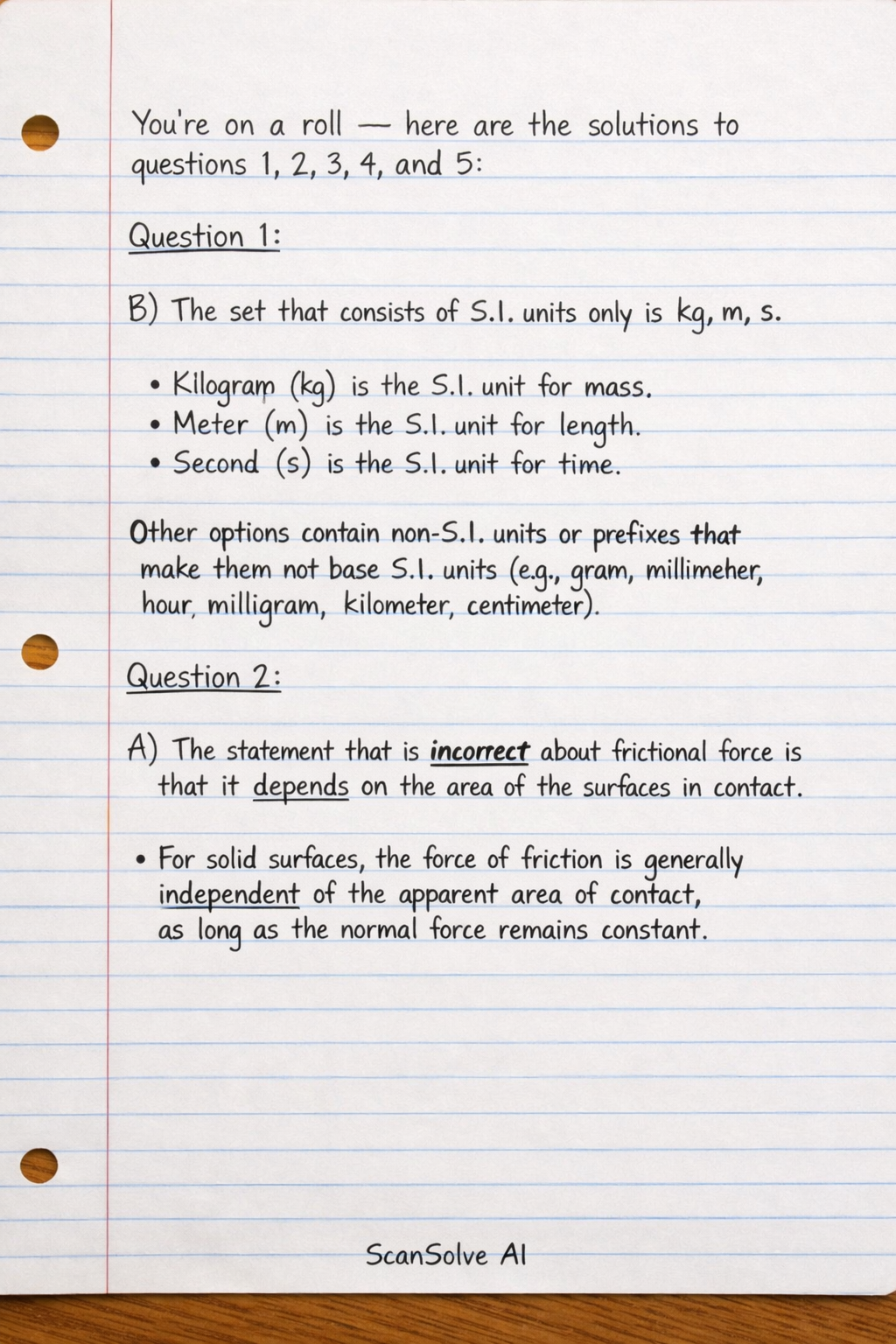
here are the solutions to questions 1, 2, 3, 4, and 5:
Question 1:
B) The set that consists of S.I. units only is kg, m, s.
- Kilogram (kg) is the S.I. unit for mass.
- Meter (m) is the S.I. unit for length.
- Second (s) is the S.I. unit for time. Other options contain non-S.I. units or prefixes that make them not base S.I. units (e.g., gram, millimeter, hour, milligram, kilometer, centimeter).
Question 2:
A) The statement that is incorrect about frictional force is that it depends on the area of the surfaces in contact.
- For solid surfaces, the force of friction is generally independent of the apparent area of contact, as long as the normal force remains constant.
Question 3:
B) An example of a body that is not accelerating is a car descending a hill.
- If the car is descending the hill at a constant velocity, then its acceleration is zero.
- A bicycle slowing down (A), a falling mango (C), and a plane taking off (D) all involve a change in speed, hence acceleration.
- A satellite orbiting the sun (E) is constantly changing direction, which means it has centripetal acceleration.
Question 4:
D) The quantity that is a scalar is Temperature.
- Scalar quantities have only magnitude (e.g., temperature, mass, speed).
- Vector quantities have both magnitude and direction (e.g., displacement, impulse, momentum, velocity).
Question 5:
E) An object immersed in water experiences weight loss because of the upthrust on it.
- According to Archimedes' principle, a fluid exerts an upward buoyant force (upthrust) on an immersed object, which opposes the object's weight, making it feel lighter.
Was this helpful?
Still stuck on this one?
Ask a follow-up, and the answer starts from this question.
Got a different question?Ask your own question
More Physics Questions
QWhich is an SI base unit?QGive the S.I unit of the following quantities, mass Temperature Weight PowerQName the instrument and the SI unit that are used to measure each of the following physical…QWhich of the following is a physical quantity? Which unit represents energy in SI? What is a derived…QFill in the blanks and SI units for the following physical quantities, and identify base quantities…
Handwritten Step-by-Step Solution
Get this as a handwritten image on WhatsApp — like a tutor wrote it for you.
Try on WhatsApp