
We read your photo as:
Show by calculation that HJ = JK. If it is further given that HL = LK, what type of quadrilateral is HJKL? Motivate your answer.
ScanSolve AI Answer
Answer
HJ = JK
Step-by-step solution
6 stepsTo solve this problem, we will use the distance formula between two points and :
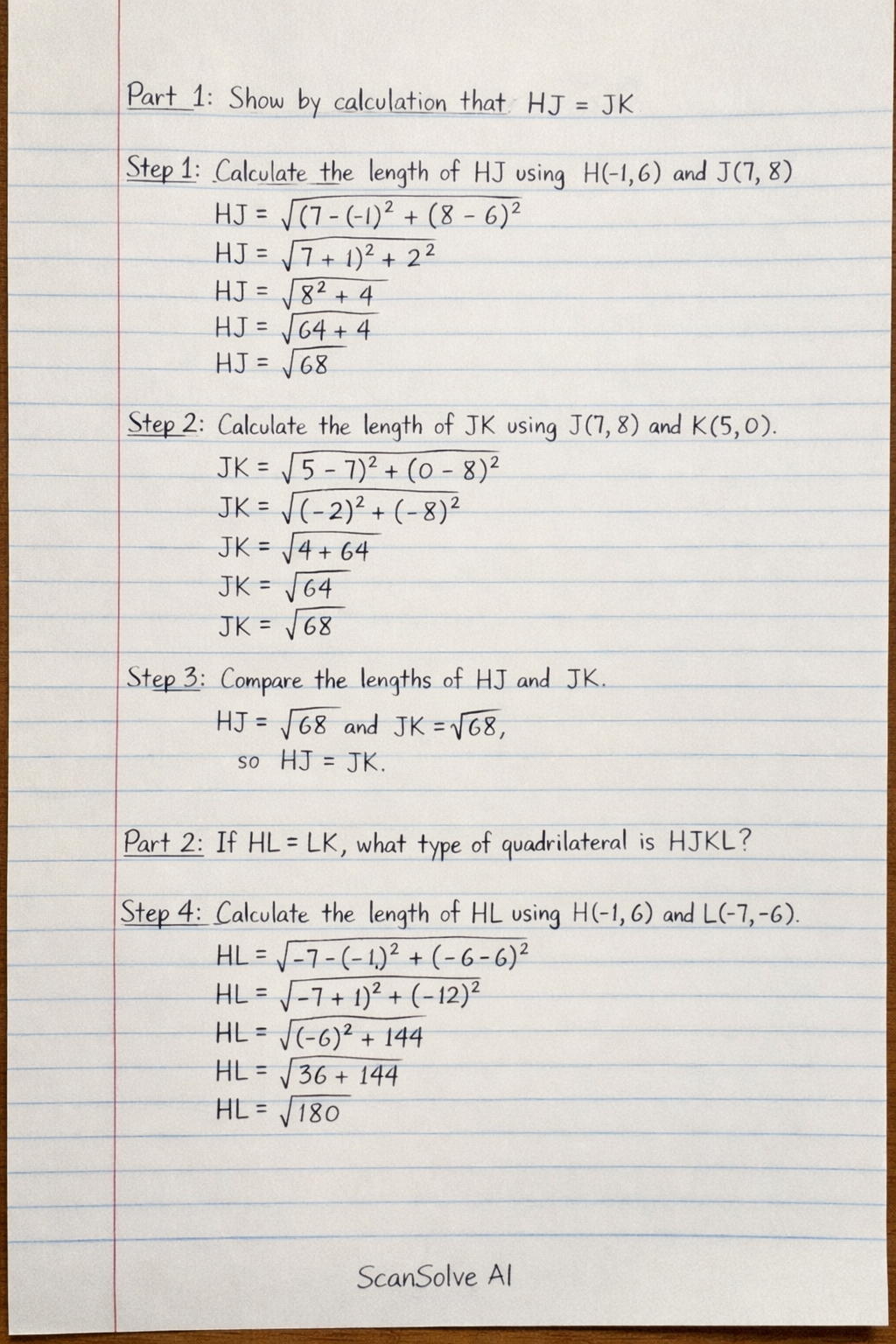
Part 1· 3 steps
Show by calculation that HJ = JK
Calculate the length of HJ using coordinates H() and J().
Calculate the length of JK using coordinates J($7, 8$) and K($5, 0$).
Compare the lengths of HJ and JK.
Since and , we can conclude that .
Part 2· 3 steps
If it is further given that HL = LK, what type of quadrilateral is HJKL? Motivate your answer.
Calculate the length of HL using coordinates H() and L().
Calculate the length of LK using coordinates L() and K().
Determine the type of quadrilateral HJKL.
From our calculations, we have:
We observe that and . Also, (since ).
A quadrilateral with two distinct pairs of equal-length adjacent sides is a kite.The type of quadrilateral is a kite.
Motivation: A kite is defined as a quadrilateral where two pairs of equal-length sides are adjacent to each other. In HJKL, the adjacent sides HJ and JK are equal, and the adjacent sides HL and LK are equal.
Still stuck on this one?
Ask a follow-up, and the answer starts from this question.
More Mathematics Questions
Handwritten Step-by-Step Solution
Get this as a handwritten image on WhatsApp — like a tutor wrote it for you.
Try on WhatsApp