

This mathematics problem involves applying core mathematical principles and formulas. Below you will find a complete step-by-step solution with detailed explanations for each step, helping you understand not just the answer but the method behind it.
ScanSolve AI Answer
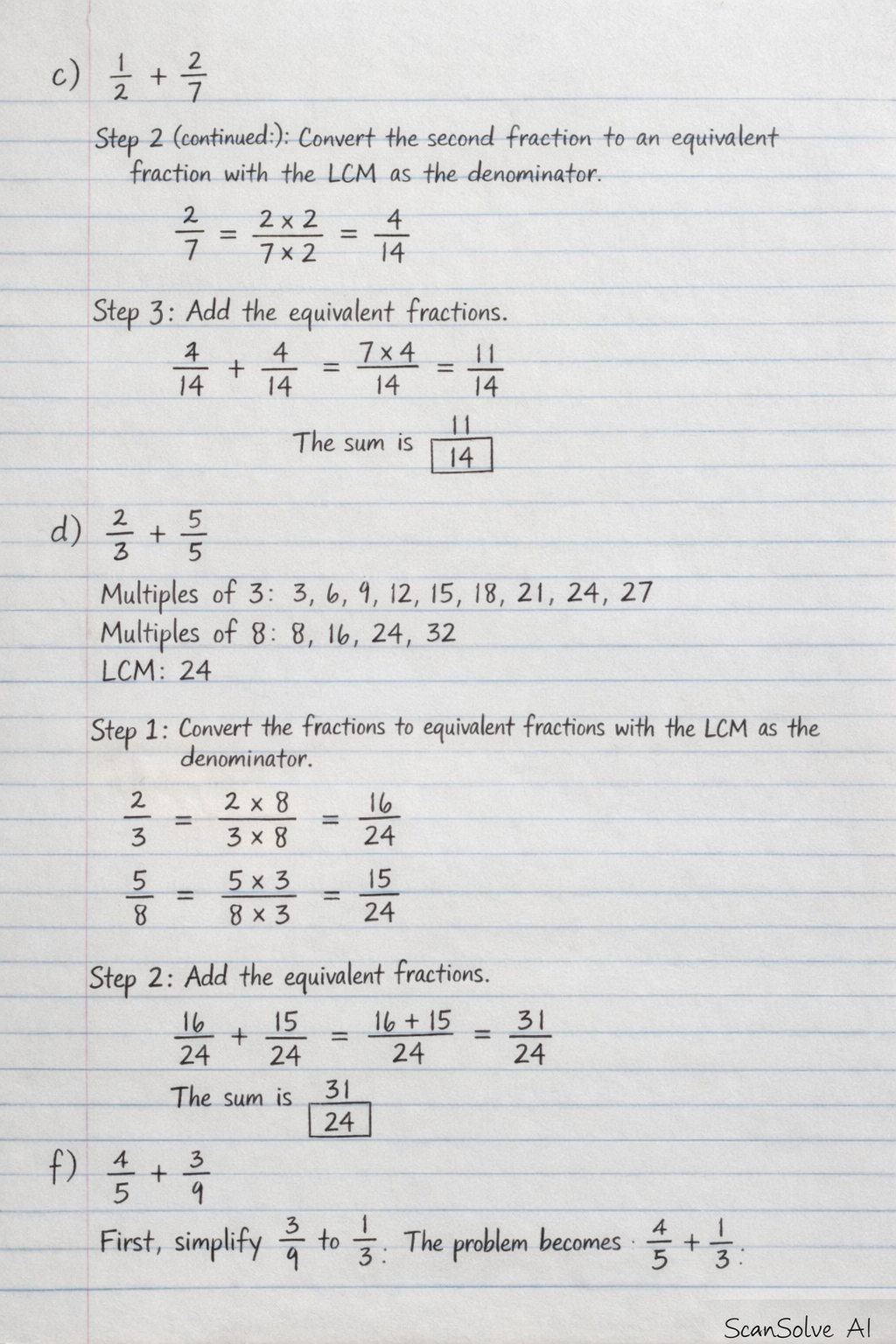
Here's the rest of the solution for problem c) and the solutions for d), f), and h): c) (1)/(2) + (2)/(7) Step 2 (continued): Convert the second fraction to an equivalent fraction with the LCM as the denominator. (2)/(7) = (2 × 2)/(7 × 2) = (4)/(14) Step 3: Add the equivalent fractions. (7)/(14) + (4)/(14) = (7+4)/(14) = (11)/(14) The sum is (11)/(14). (11)/(14) d) (2)/(3) + (5)/(8) Multiples of 3: 3, 6, 9, 12, 15, 18, 21, 24, 27 Multiples of 8: 8, 16, 24, 32 LCM: 24 Step 1: Convert the fractions to equivalent fractions with the LCM as the denominator. (2)/(3) = (2 × 8)/(3 × 8) = (16)/(24) (5)/(8) = (5 × 3)/(8 × 3) = (15)/(24) Step 2: Add the equivalent fractions. (16)/(24) + (15)/(24) = (16+15)/(24) = (31)/(24) The sum is (31)/(24). (31)/(24) f) (4)/(5) + (3)/(9) First, simplify (3)/(9) to (1)/(3). The problem becomes (4)/(5) + (1)/(3). Multiples of 5: 5, 10, 15, 20 Multiples of 3: 3, 6, 9, 12, 15, 18 LCM: 15 Step 1: Convert the fractions to equivalent fractions with the LCM as the denominator. (4)/(5) = (4 × 3)/(5 × 3) = (12)/(15) (1)/(3) = (1 × 5)/(3 × 5) = (5)/(15) Step 2: Add the equivalent fractions. (12)/(15) + (5)/(15) = (12+5)/(15) = (17)/(15) The sum is (17)/(15). (17)/(15) h) (1)/(2) + (5)/(11) Multiples of 2: 2, 4, 6, 8, 10, 12, 1