
We read your photo as:
C lies on a circle with diameter AD. B lies on AC and E lies on AD such that BE is parallel to CD. AB=21 cm, CD=18 cm and BE=13.5 cm. (a) Show that triangle ABE is similar to triangle ACD. (b) Find the length of the diameter AD. (c) Work out the circumference of the circle.
ScanSolve AI Answer
Step-by-step solution
8 stepsHere are the solutions to the problems from the image:
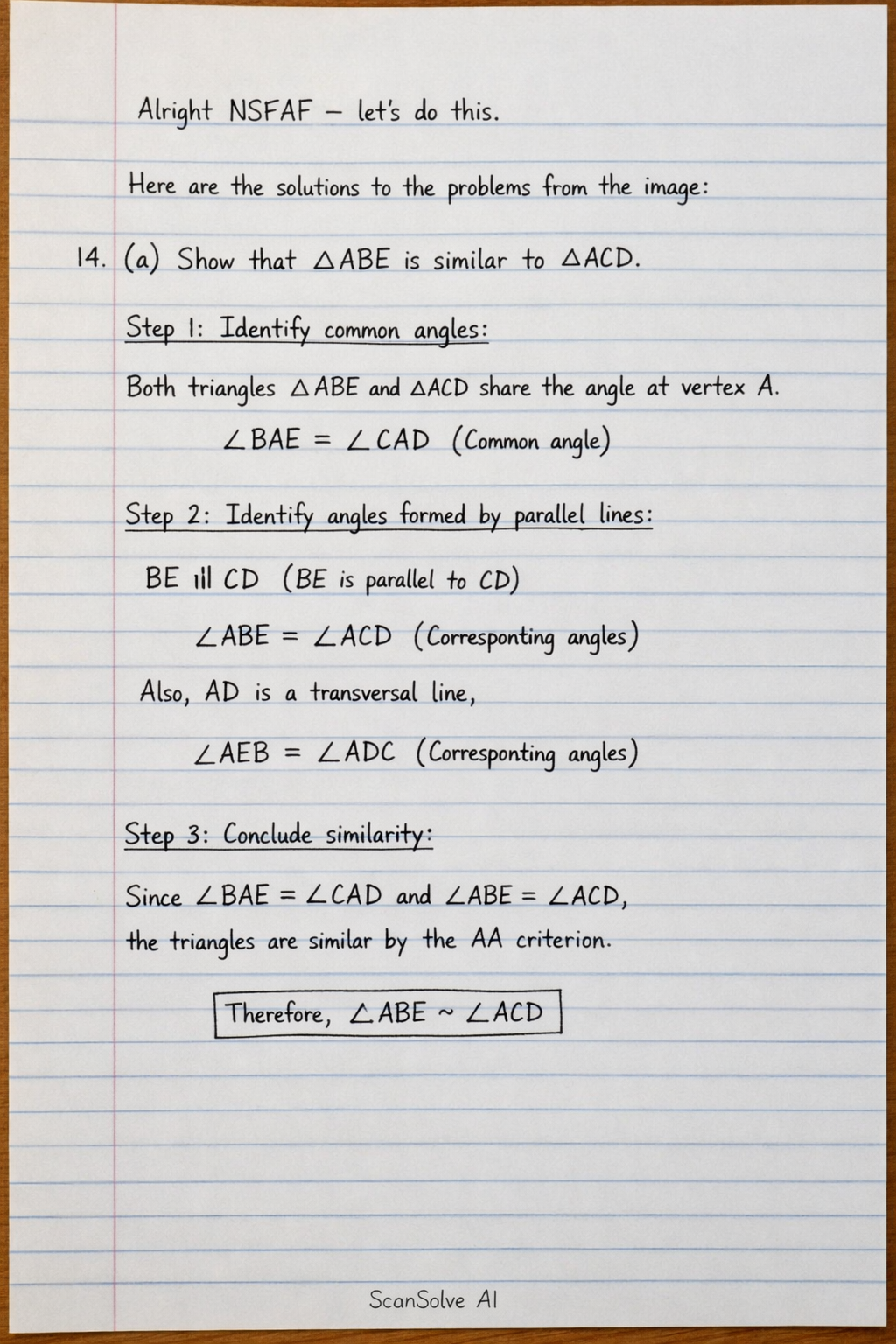
14. (a) Show that triangle is similar to triangle .
Identify common angles.
Both triangles and share the angle at vertex A.
Identify angles formed by parallel lines.
Given that is parallel to ().
Since is a transversal line intersecting two parallel lines, the corresponding angles are equal.Alternatively, since is a transversal line intersecting two parallel lines, the corresponding angles are equal.
Conclude similarity.
Since two pairs of corresponding angles are equal ( and ), the triangles are similar by the Angle-Angle (AA) similarity criterion.
Therefore, .14. (b) Find the length of the diameter .
Use the similarity of triangles to find .
Since , the ratio of corresponding sides is equal:
Substitute the given values: , , .
To find , rearrange the equation:
Use the property of angles in a semicircle.
The problem states that C lies on a circle with diameter AD. An angle subtended by a diameter at any point on the circumference is a right angle ().
Therefore, . This means is a right-angled triangle with hypotenuse .Use the Pythagorean theorem to find .
In right-angled :
Substitute the values and :
The length of the diameter is (rounded to 3 significant figures).
14. (c) Work out the circumference of the circle.
Use the formula for the circumference of a circle.
The circumference of a circle is given by , where is the diameter.
From part (b), the diameter .Calculate the circumference.
Rounding to one decimal place:
The circumference of the circle is .
Still stuck on this one?
Ask a follow-up, and the answer starts from this question.
More Mathematics Questions
Handwritten Step-by-Step Solution
Get this as a handwritten image on WhatsApp — like a tutor wrote it for you.
Try on WhatsApp