
We read your photo as:
Categorize each line as Increasing, Decreasing, or Constant.
ScanSolve AI Answer
Answer
Step-by-step solution
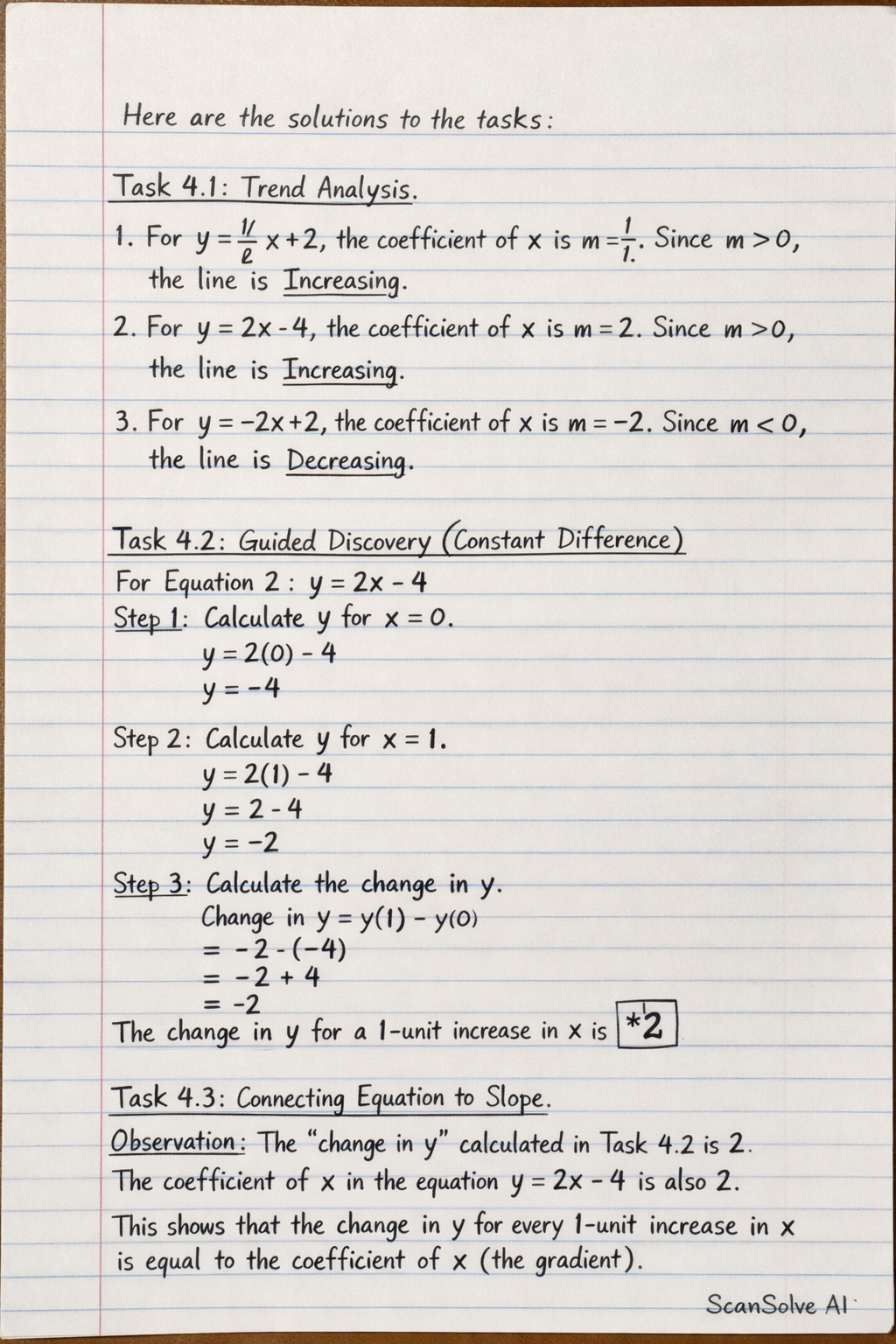
3 stepsHere are the solutions to the tasks:
Task 4.1: Trend Analysis
- For , the coefficient of is . Since , the line is Increasing.
- For , the coefficient of is . Since , the line is Increasing.
- For , the coefficient of is . Since , the line is Decreasing.
Task 4.2: Guided Discovery (Constant Difference)
For Equation 2: .
Calculate for .
Calculate for .
Calculate the change in .
The change in for a 1-unit increase in is .
Task 4.3: Connecting Equation to Slope
Observation: The "change in y" calculated in Task 4.2 is 2. The coefficient of in the equation is also 2. This shows that the change in y for every 1-unit increase in x is equal to the coefficient of x (the gradient).
Task 5.1: The General Rule
Based on the investigation, for a linear equation in the form :
- The value of represents the gradient (slope) of the line. It indicates the rate of change of with respect to .
- If , the line is increasing.
- If , the line is decreasing.
- If , the line is constant (horizontal).
- The value of represents the y-intercept, which is the value of when .
Try one yourself
A new problem that tests the same skill.
Still stuck on this one?
Ask a follow-up, and the answer starts from this question.
More Mathematics Questions
Handwritten Step-by-Step Solution
Get this as a handwritten image on WhatsApp — like a tutor wrote it for you.
Try on WhatsApp