
We read your photo as:
Classify the following numbers as prime or composite: 201, 211, 55, 112, 73. Then, find the product of odd numbers between 27 and 32, and determine the difference between the count of even and odd dig
ScanSolve AI Answer
Step-by-step solution
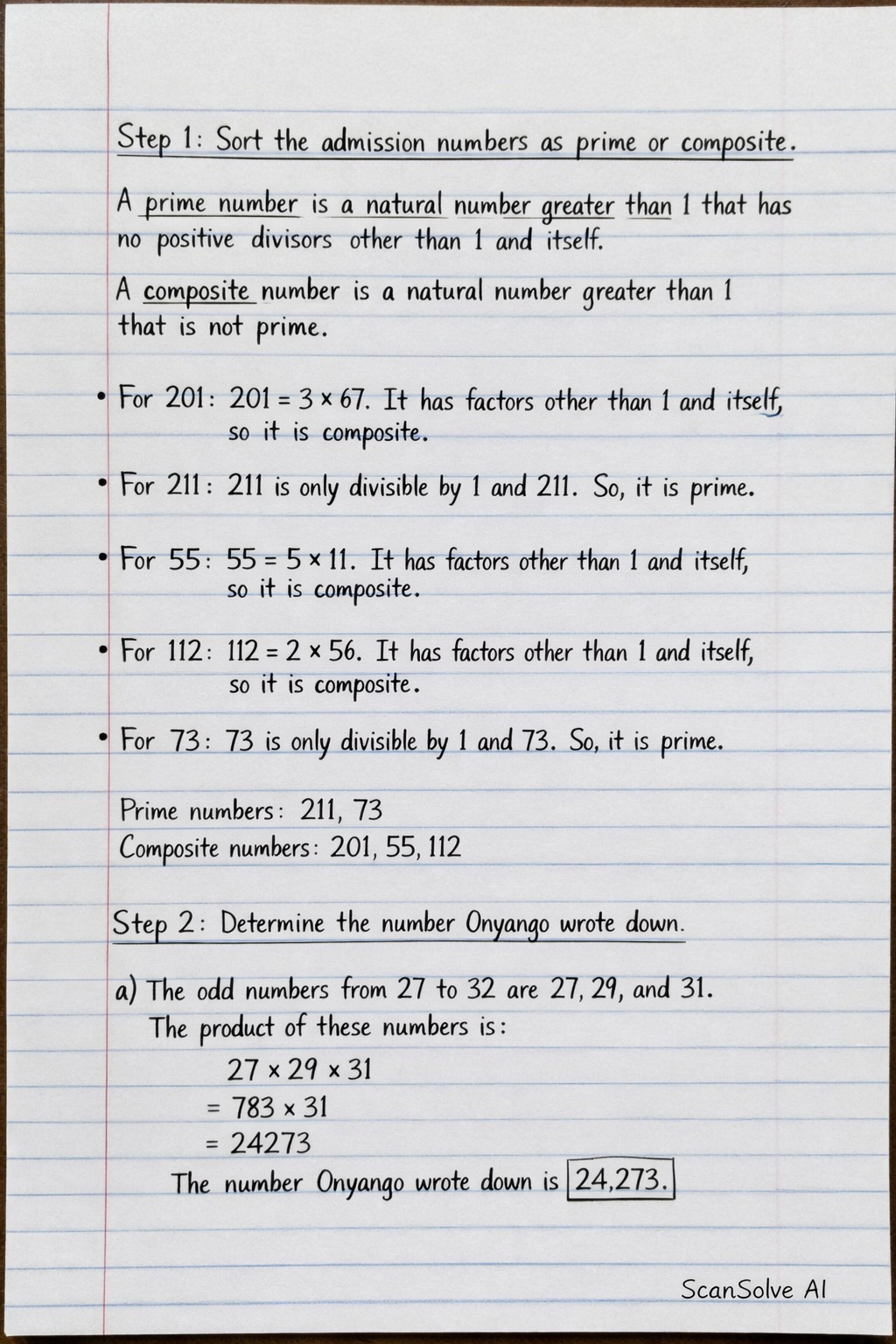
3 stepsStep 1: Sort the admission numbers as prime or composite.
A prime number is a natural number greater than 1 that has no positive divisors other than 1 and itself. A composite number is a natural number greater than 1 that is not prime.
- For 201: . It has factors other than 1 and itself, so it is composite.
- For 211: 211 is only divisible by 1 and 211. So, it is prime.
- For 55: . It has factors other than 1 and itself, so it is composite.
- For 112: . It has factors other than 1 and itself, so it is composite.
- For 73: 73 is only divisible by 1 and 73. So, it is prime.
Prime numbers: 211, 73
Composite numbers: 201, 55, 112
Step 2: Determine the number Onyango wrote down.
Part a
The odd numbers from 27 to 32 are 27, 29, and 31.
The product of these numbers is:
The number Onyango wrote down is .
Part b· 3 steps
Determine the difference between the number of even digits and odd digits in 24273.
The digits in 24273 are 2, 4, 2, 7, 3.
Even digits: 2, 4, 2 (There are 3 even digits).
Odd digits: 7, 3 (There are 2 odd digits).
Difference = (Number of even digits) - (Number of odd digits)
The difference is .
Determine and write down the irrational numbers.
An irrational number cannot be expressed as a simple fraction and has a non-terminating, non-repeating decimal expansion. Square roots of non-perfect squares are irrational.
- : Since 79 is not a perfect square (, ), is an irrational number.
- : This can be written as . Since 2197 is not a perfect square (it ends in 7), is irrational. Therefore, is an irrational number.
- : This can be written as . Since 3042 is not a perfect square (it ends in 2), is irrational. Therefore, is an irrational number.
The irrational numbers from the list are .
Factorise .
This expression is in the form of a difference of squares, .
Here, .
And .Substitute these into the difference of squares formula:
The factored form is .
Express 729 and 2187 in index form, then evaluate .
First, find the prime factorization of 729:
So, .
Next, find the prime factorization of 2187:
Since , we have:
Now, evaluate :
Using the exponent rule :
The index forms are and .
The evaluation is .
Still stuck on this one?
Ask a follow-up, and the answer starts from this question.
More Mathematics Questions
Handwritten Step-by-Step Solution
Get this as a handwritten image on WhatsApp — like a tutor wrote it for you.
Try on WhatsApp