
We read your photo as:
Find the coefficient of x3 in the binomial expansion of (3x2/4 - 23x)9.
ScanSolve AI Answer
Answer
Step-by-step solution
5 stepsTo find the coefficient of in the binomial expansion of , we use the binomial theorem.
Identify the components of the binomial expansion.
The general term in the expansion of is given by .
In this problem, , , and .Substitute these values into the general term formula.
Simplify the powers of .
Set the exponent of equal to 3 and solve for .
We are looking for the coefficient of , so we set the exponent equal to 3:
Check the validity of .
For the binomial expansion , the value of must be an integer such that .
In this case, , but we found . Since , this value of is not valid. This means there is no term with in the expansion.Therefore, the coefficient of is .
Try one yourself
A new problem that tests the same skill.
Still stuck on this one?
Ask a follow-up, and the answer starts from this question.
More Mathematics Questions
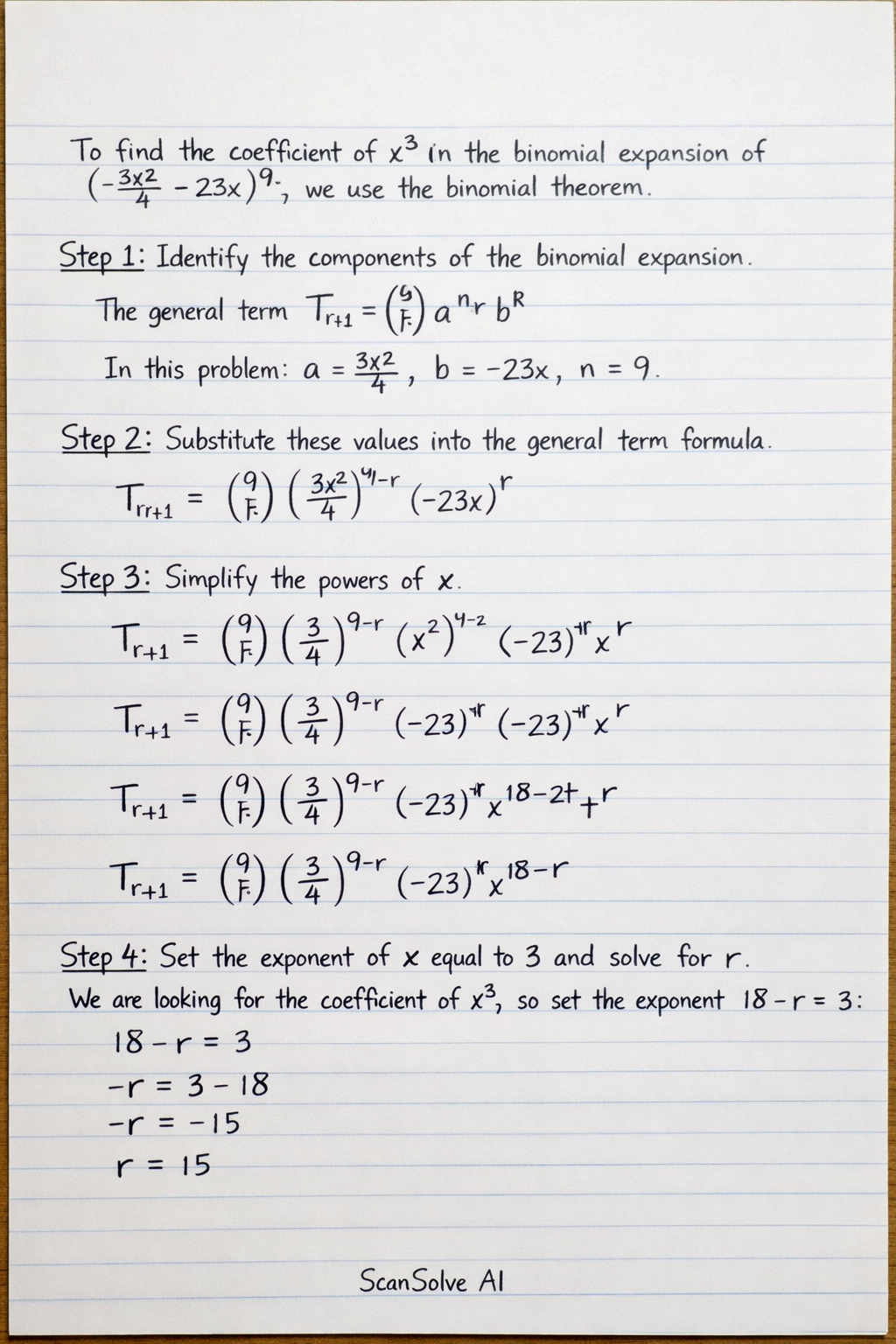
Handwritten Step-by-Step Solution
Get this as a handwritten image on WhatsApp — like a tutor wrote it for you.
Try on WhatsApp