
We read your photo as:
Find a common denominator for (2)/(9) and (3)/(8).
ScanSolve AI Answer
This answer stops before the end.
It was cut off when it was first written. Ask ScanSolve this question again for the full working.
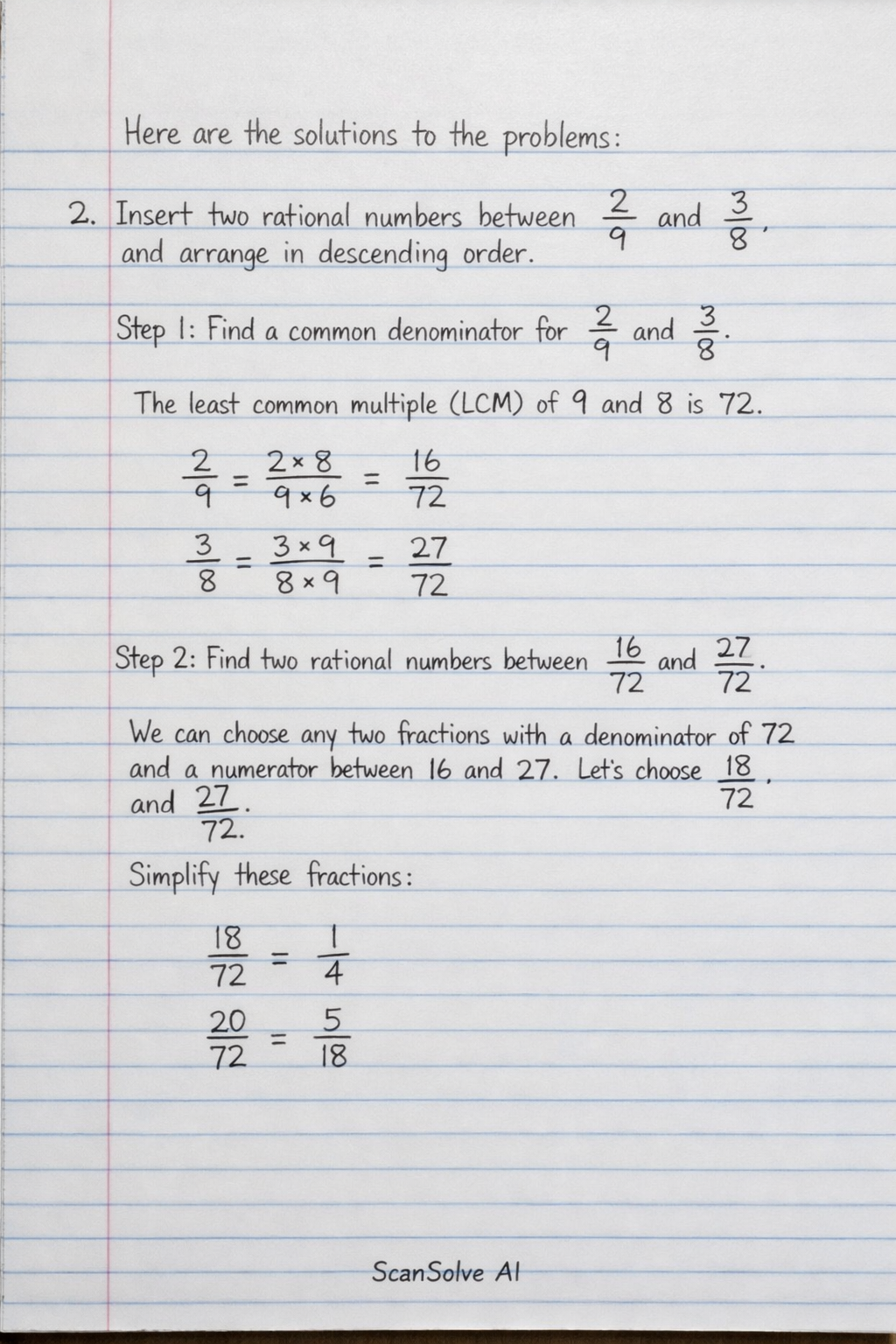
Here are the solutions to the problems:
2. Insert two rational numbers between and , and arrange in descending order.
Step 1: Find a common denominator for and .
The least common multiple (LCM) of 9 and 8 is 72.
Step 2: Find two rational numbers between and .
We can choose any two fractions with a denominator of 72 and a numerator between 16 and 27. Let's choose and .
Simplify these fractions:
Step 3: Arrange all numbers in descending order.
The numbers are , , , and .
Descending order means from largest to smallest:
Therefore, the numbers in descending order are:
3. Insert two rational numbers between and , and arrange in ascending order.
Step 1: Find a common denominator for and .
The LCM of 3 and 4 is 12.
Step 2: Find two rational numbers between and .
To find numbers between them, we can multiply the numerator and denominator by a factor, for example, 10.
Now, we need two numbers between and . Let's choose and .
Simplify these fractions:
Step 3: Arrange all numbers in ascending order.
The numbers are , , , and .
Ascending order means from smallest (most negative) to largest (least negative):
Still stuck on this one?
Ask a follow-up, and the answer starts from this question.
More Mathematics Questions
Handwritten Step-by-Step Solution
Get this as a handwritten image on WhatsApp — like a tutor wrote it for you.
Try on WhatsApp