
We read your photo as:
Which of the following BEST describes a ratio scale from an interval scale?
ScanSolve AI Answer
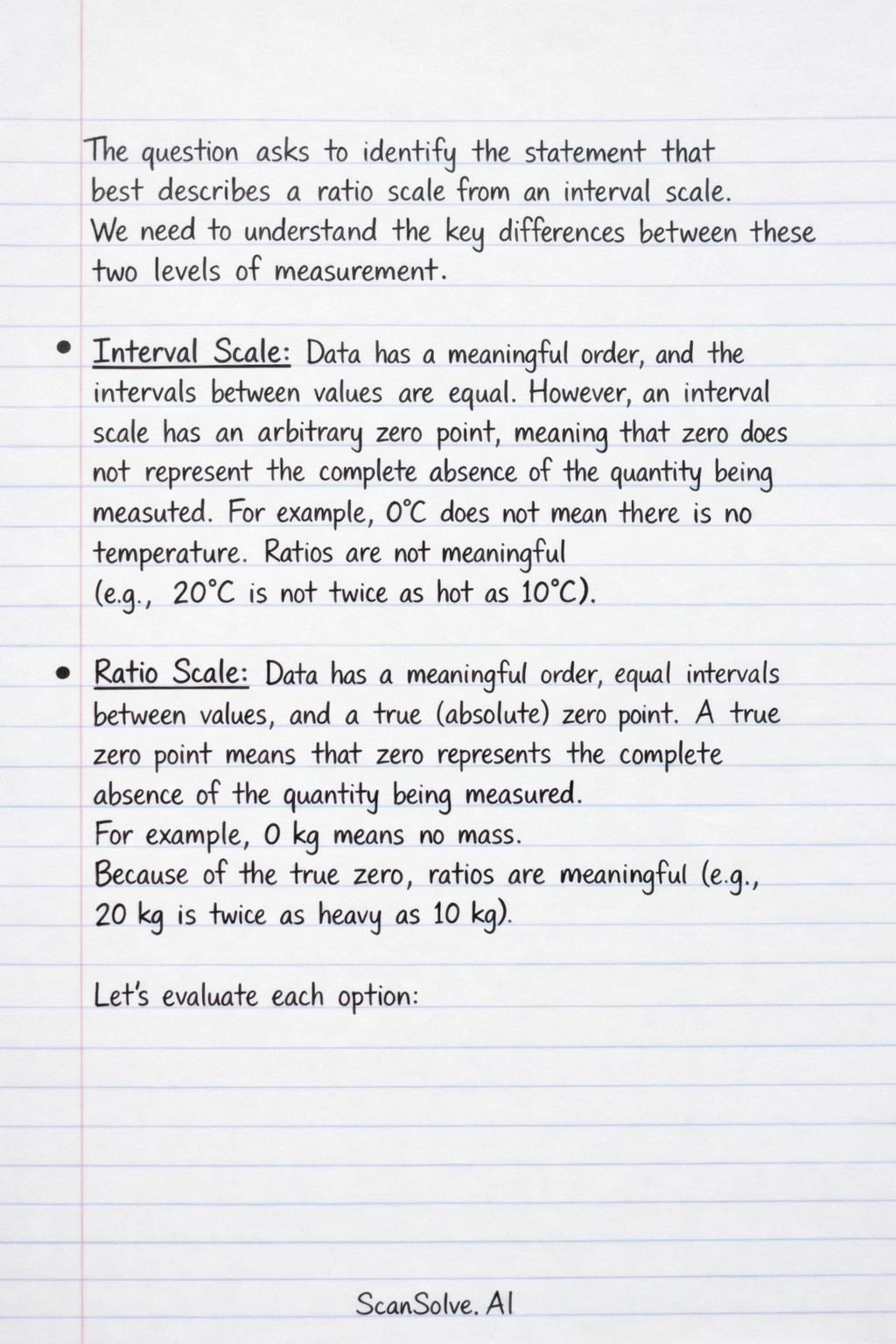
The question asks to identify the statement that best describes a ratio scale from an interval scale. We need to understand the key differences between these two levels of measurement.
- Interval Scale: Data has a meaningful order, and the intervals between values are equal. However, an interval scale has an arbitrary zero point, meaning that zero does not represent the complete absence of the quantity being measured. For example, 0°C does not mean there is no temperature. Ratios are not meaningful (e.g., 20°C is not twice as hot as 10°C).
- Ratio Scale: Data has a meaningful order, equal intervals between values, and a true (absolute) zero point. A true zero point means that zero represents the complete absence of the quantity being measured. For example, 0 kg means no mass. Because of the true zero, ratios are meaningful (e.g., 20 kg is twice as heavy as 10 kg).
Let's evaluate each option:
-
a. A ratio scale includes a true zero point, while an interval scale has no zero point.
- The first part, "A ratio scale includes a true zero point," is correct.
- The second part, "while an interval scale has no zero point," is slightly ambiguous. An interval scale does have a point labeled zero (e.g., 0°C), but it does not have a true zero point (meaning zero does not signify the absence of the attribute). In the context of distinguishing from a ratio scale's true zero, this phrasing is often used as a shorthand for "no true zero point." Compared to other options, this is the most accurate distinction.
-
b. Ratio scales have equal intervals but lack a true zero point.
- "Ratio scales have equal intervals" is correct.
- "but lack a true zero point" is incorrect. Ratio scales are defined by having a true zero point.
-
c. Interval scales allow for multiplication and division of values, unlike the ratio scale.
- "Interval scales allow for multiplication and division of values" is incorrect. Meaningful multiplication and division are not possible with interval scales due to the lack of a true zero.
- "unlike the ratio scale" implies ratio scales don't allow it, which is also incorrect. Ratio scales do allow for meaningful multiplication and division.
-
d. Interval scales are used only for ordinal data, while ratio categorical.
- "Interval scales are used only for ordinal data" is incorrect. Interval scales are used for quantitative data, not ordinal (which is a lower level of measurement).
- "while ratio categorical" is incorrect. Ratio scales are used for quantitative data, not categorical data.
Based on the analysis, option 'a' provides the best description of the difference, despite the slight imprecision in the phrasing for the interval scale's zero point. The critical distinction is the presence of a true zero point in ratio scales, which is correctly stated.
The final answer is .
Still stuck on this one?
Ask a follow-up, and the answer starts from this question.
More Mathematics Questions
Handwritten Step-by-Step Solution
Get this as a handwritten image on WhatsApp — like a tutor wrote it for you.
Try on WhatsApp