
We read your photo as:
Compare the following two decimal fractions by replacing the with the correct relationship sign <, > or =.
ScanSolve AI Answer
Step-by-step solution
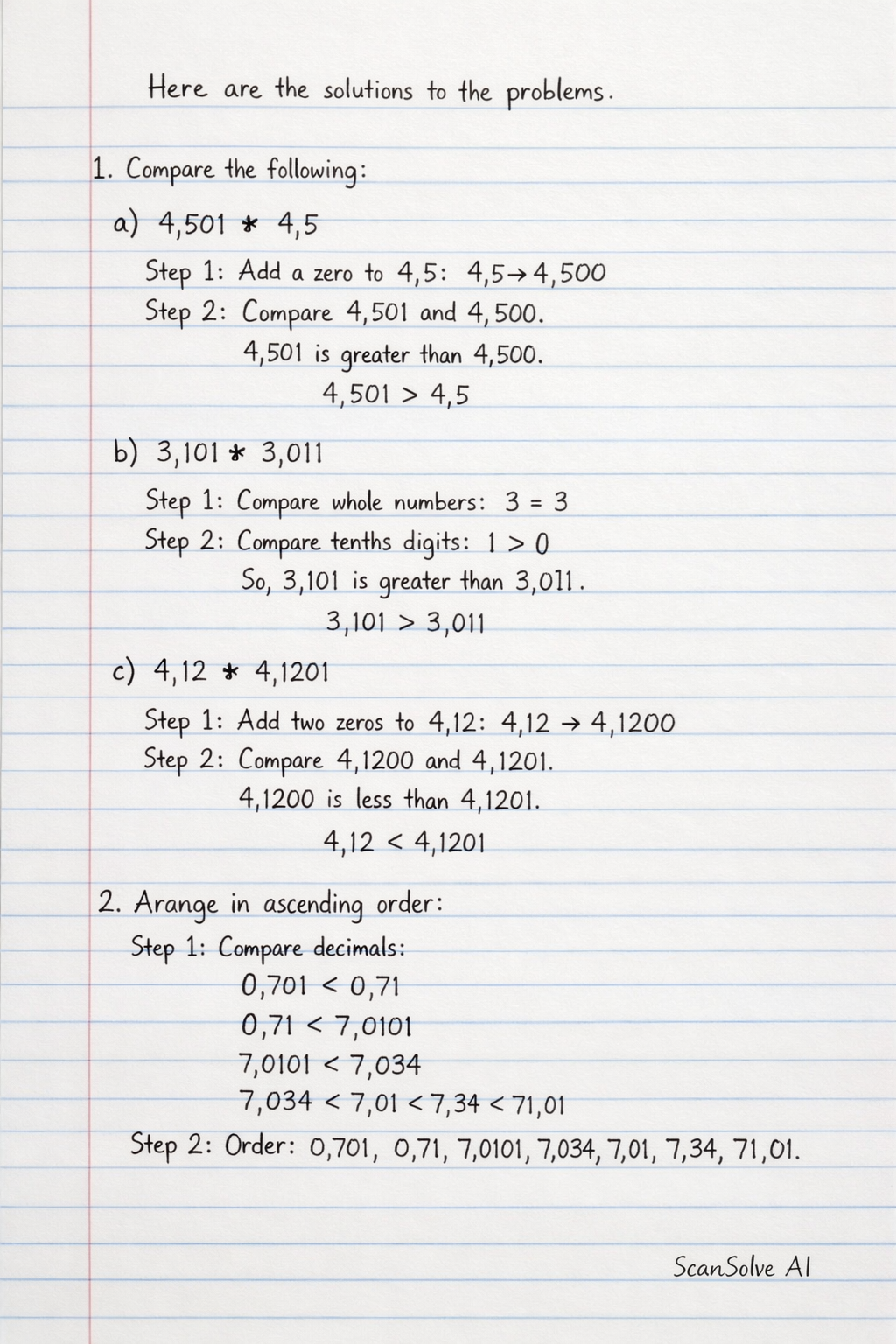
13 stepsHere are the solutions to the problems.
1. Compare the following two decimal fractions by replacing the * with the correct relationship sign <, > or =.
a) Compare 4,501 and 4,5.
Add a zero to 4,5 to make it 4,500 for easier comparison.
Compare 4,501 and 4,500.
4,501 is greater than 4,500.
b) Compare 3,101 and 3,011.
Compare the digits from left to right.
The whole number part is 3 for both.
Compare the tenths digit
1 in 3,101 and 0 in 3,011.
Since , 3,101 is greater than 3,011.c) Compare 4,12 and 4,1201.
Add two zeros to 4,12 to make it 4,1200 for easier comparison.
Compare 4,1200 and 4,1201.
4,1200 is less than 4,1201.
2. Arrange the following decimal fractions in ascending order:
Write all numbers with the same number of decimal places (four decimal places in this case) by adding trailing zeros.
7,0100
0,7010
0,7100
7,3400
7,0101
71,0100
7,0340Compare the numbers, starting with the smallest whole number part, then comparing decimal places from left to right.
The smallest numbers are those with 0 as the whole number part: 0,7010 and 0,7100.
Comparing 0,7010 and 0,7100: .Next are numbers with 7 as the whole number part: .
Comparing these:
7,0100
7,0101
7,0340
7,3400Finally, the largest number is 71,0100.
List them in ascending order.
3. Complete the following sequences:
a) up to 8
Identify the pattern.
Each term increases by 0,5.
Continue adding 0,5 until the term reaches 8.
4,5
5 ()
5,5 ()
6 ()
6,5 ()
7 ()
7,5 ()
8 ()
The completed sequence is:b)
Identify the pattern.
Each term decreases by 0,2.
Continue subtracting 0,2 for the next few terms.
3,8
3,6 ()
3,4 ()
3,2 ()
3,0 ()
2,8 ()
2,6 ()
The next few terms in the sequence are:
Still stuck on this one?
Ask a follow-up, and the answer starts from this question.
More Mathematics Questions
Handwritten Step-by-Step Solution
Get this as a handwritten image on WhatsApp — like a tutor wrote it for you.
Try on WhatsApp