
We read your photo as:
Fill in >, < or =. 2. What fractions are shown by the arrow?
ScanSolve AI Answer
Step-by-step solution
12 stepsHere are the solutions to the problems.
1. Fill in or .
- a)
Find a common denominator for and , which is 12.
$$ \frac{1}{3} = \frac{1 \times 4}{3 \times 4} = \frac{4}{12} $$ $$ \frac{1}{4} = \frac{1 \times 3}{4 \times 3} = \frac{3}{12} $$Compare the fractions.
$$ \frac{4}{12} > \frac{3}{12} $$ So, $\boxed{\frac{1}{3} > \frac{1}{4}}$.- b)
Find a common denominator for and , which is 15.
$$ \frac{3}{5} = \frac{3 \times 3}{5 \times 3} = \frac{9}{15} $$ $$ \frac{2}{3} = \frac{2 \times 5}{3 \times 5} = \frac{10}{15} $$Compare the fractions.
$$ \frac{9}{15} < \frac{10}{15} $$ So, $\boxed{\frac{3}{5} < \frac{2}{3}}$.- c)
Find a common denominator for and , which is 35.
$$ \frac{4}{7} = \frac{4 \times 5}{7 \times 5} = \frac{20}{35} $$ $$ \frac{2}{5} = \frac{2 \times 7}{5 \times 7} = \frac{14}{35} $$Compare the fractions.
$$ \frac{20}{35} > \frac{14}{35} $$ So, $\boxed{\frac{4}{7} > \frac{2}{5}}$.- d)
Find a common denominator for and , which is 6.
$$ \frac{1}{3} = \frac{1 \times 2}{3 \times 2} = \frac{2}{6} $$Compare the fractions.
$$ \frac{1}{6} < \frac{2}{6} $$ So, $\boxed{\frac{1}{6} < \frac{1}{3}}$.- e)
Simplify the fraction .
$$ \frac{2}{8} = \frac{2 \div 2}{8 \div 2} = \frac{1}{4} $$Compare the fractions.
$$ \frac{1}{4} = \frac{1}{4} $$ So, $\boxed{\frac{2}{8} = \frac{1}{4}}$.- f)
Find a common denominator for and , which is 10.
$$ \frac{2}{5} = \frac{2 \times 2}{5 \times 2} = \frac{4}{10} $$Compare the fractions.
$$ \frac{4}{10} > \frac{3}{10} $$ So, $\boxed{\frac{2}{5} > \frac{3}{10}}$.2. What fractions are shown by the arrow?
-
a) The number line is divided into 4 equal parts between 0 and 1. Each part represents . The arrow points to the third mark. The fraction is .
-
b) The number line is divided into 4 equal parts between 1 and 2. Each part represents . The arrow points to the second mark after 1. The fraction is .
-
c) The number line is divided into 4 equal parts between 4 and 5. Each part represents . The arrow points to the third mark after 4. The fraction is .
-
d) This part of the question is not visible in the image.
-
Still stuck on this one?
Ask a follow-up, and the answer starts from this question.
More Mathematics Questions
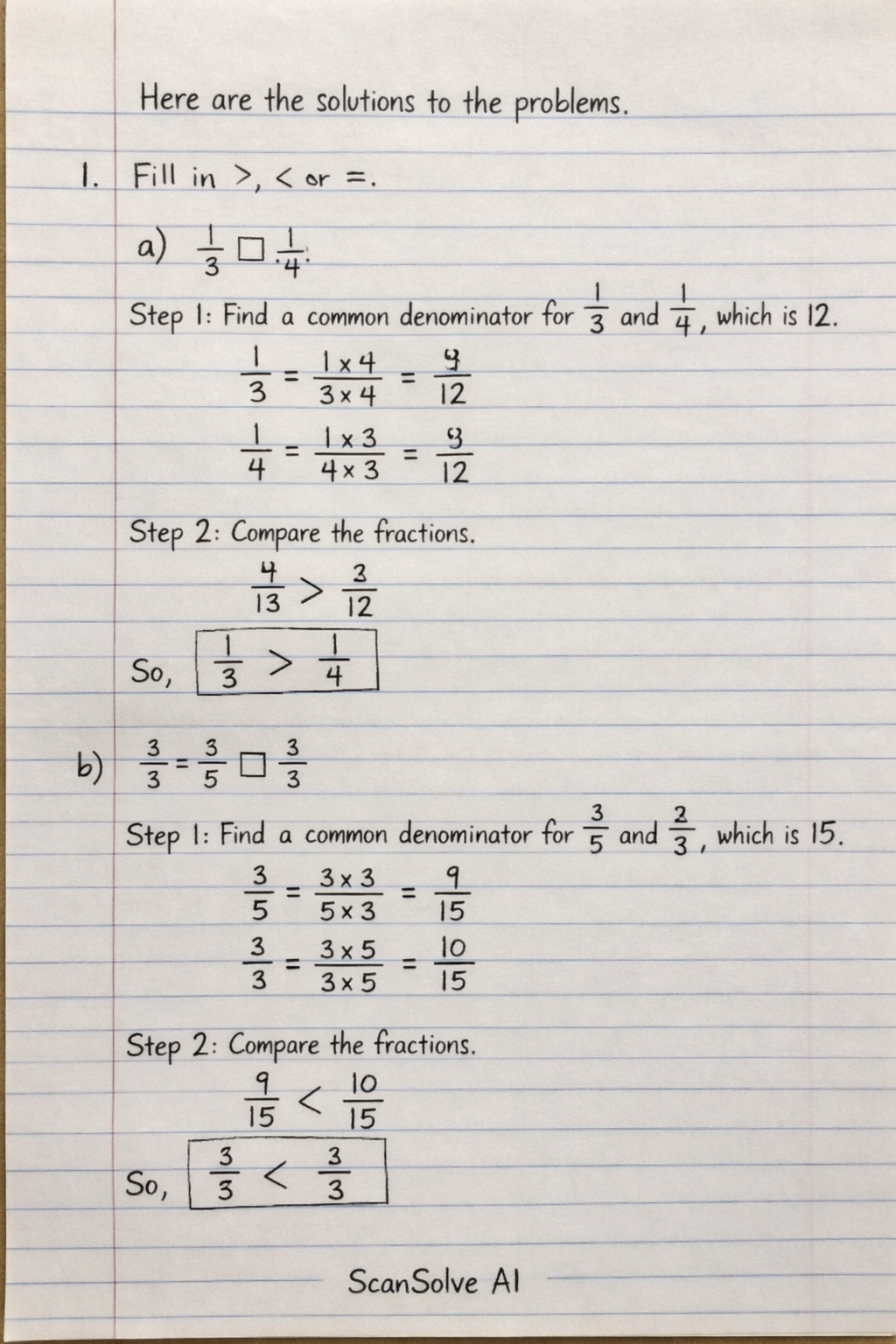
Handwritten Step-by-Step Solution
Get this as a handwritten image on WhatsApp — like a tutor wrote it for you.
Try on WhatsApp