

This mathematics problem involves applying core mathematical principles and formulas. Below you will find a complete step-by-step solution with detailed explanations for each step, helping you understand not just the answer but the method behind it.
ScanSolve AI Answer
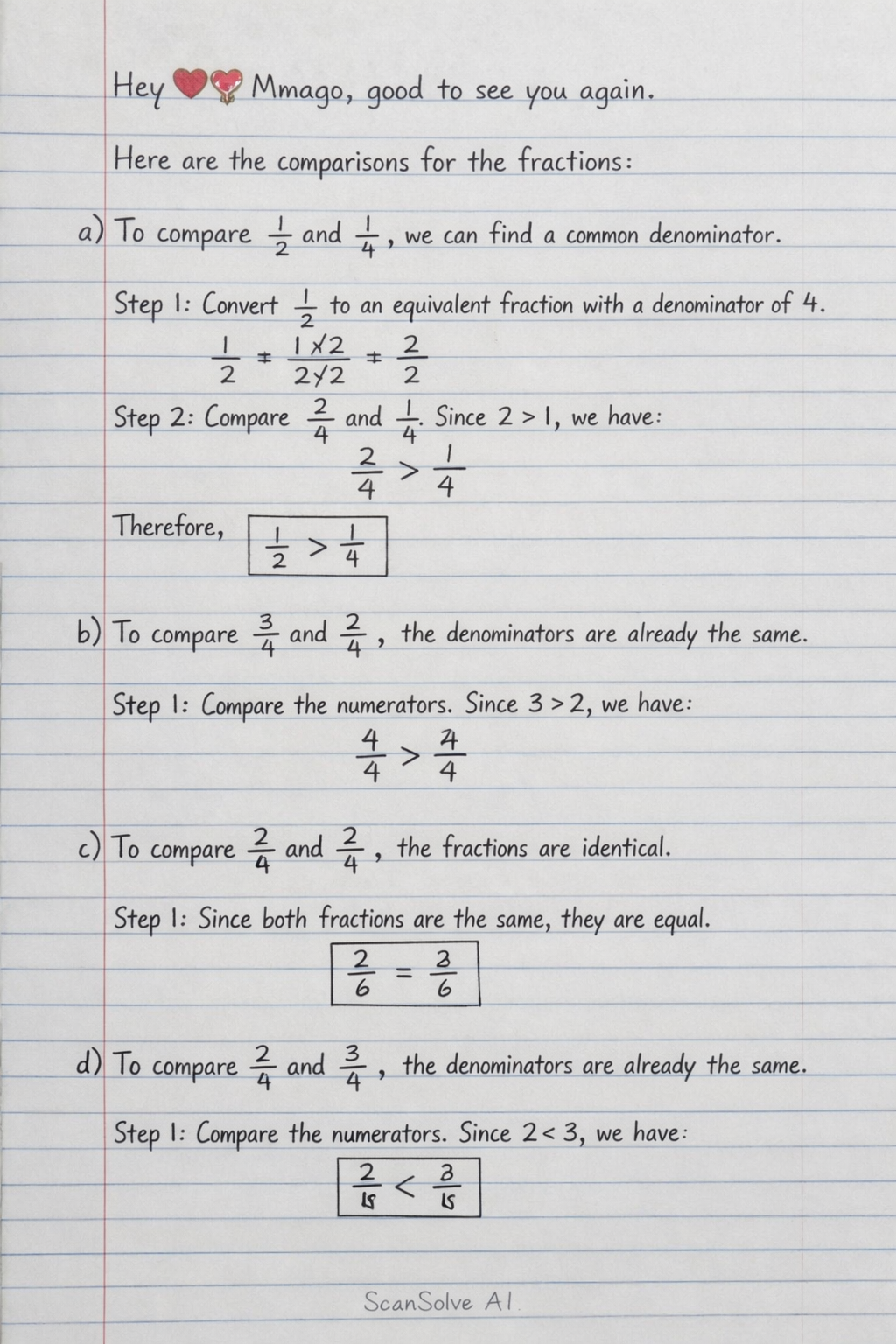
Here are the comparisons for the fractions: a) To compare (1)/(2) and (1)/(4), we can find a common denominator. Step 1: Convert (1)/(2) to an equivalent fraction with a denominator of 4. (1)/(2) = (1 × 2)/(2 × 2) = (2)/(4) Step 2: Compare (2)/(4) and (1)/(4). Since 2 > 1, we have: (2)/(4) > (1)/(4) Therefore, (1)/(2) > (1)/(4) b) To compare (3)/(4) and (2)/(4), the denominators are already the same. Step 1: Compare the numerators. Since 3 > 2, we have: (3)/(4) > (2)/(4) c) To compare (2)/(6) and (2)/(6), the fractions are identical. Step 1: Since both fractions are the same, they are equal. (2)/(6) = (2)/(6) d) To compare (2)/(8) and (3)/(8), the denominators are already the same. Step 1: Compare the numerators. Since 2 < 3, we have: (2)/(8) < (3)/(8) Send me the next one 📸