

This mathematics problem involves applying core mathematical principles and formulas. Below you will find a complete step-by-step solution with detailed explanations for each step, helping you understand not just the answer but the method behind it.
ScanSolve AI Answer
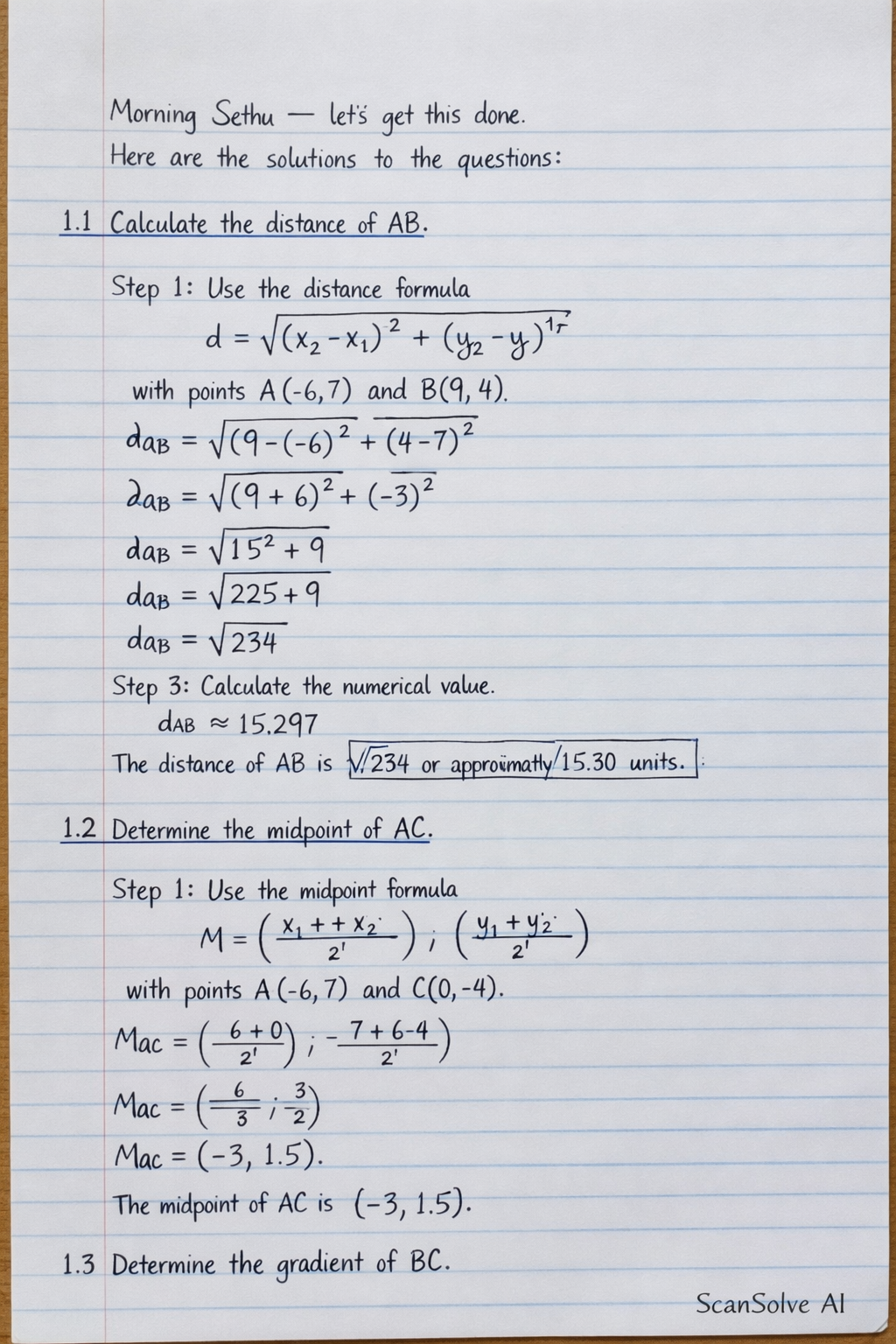
Here are the solutions to the questions: 1.1 Calculate the distance of AB. Step 1: Use the distance formula d = sqrt((x_2 - x_1)^2 + (y_2 - y_1)^2) with points A(-6, 7) and B(9, 4). d_AB = sqrt((9 - (-6))^2 + (4 - 7)^2) Step 2: Simplify the expression. d_AB = sqrt((9 + 6)^2 + (-3)^2) d_AB = sqrt((15)^2 + 9) d_AB = sqrt(225 + 9) d_AB = sqrt(234) Step 3: Calculate the numerical value. d_AB ≈ 15.297 The distance of AB is sqrt(234) or approximately 15.30 units. 1.2 Determine the midpoint of AC. Step 1: Use the midpoint formula M = ((x_1 + x_2)/(2), (y_1 + y_2)/(2)) with points A(-6, 7) and C(0, -4). M_AC = ((-6 + 0)/(2), (7 + (-4))/(2)) Step 2: Simplify the coordinates. M_AC = ((-6)/(2), (3)/(2)) M_AC = (-3, 1.5) The midpoint of AC is (-3, 1.5). 1.3 Determine the gradient of BC. Step 1: Use the gradient formula m = (y_2 - y_1)/(x_2 - x_1) with points B(9, 4) and C(0, -4). m_BC = (-4 - 4)/(0 - 9) Step 2: Simplify the expression. m_BC = (-8)/(-9) m_BC = (8)/(9) The gradient of BC is (8)/(9). 1.4 Find the equation of the line BC. Step 1: Use the point-slope form y - y_1 = m(x - x_1) with the gradient m_BC = (8)/(9) and point C(0, -4). y - (-4) = (8)/(9)(x - 0) Step 2: Simplify the equation to the form y = mx + c. y + 4 = (8)/(9)x y = (8)/(9)x - 4 The equation of the line BC is y = (8)/(9)x - 4. 1.5 Determine the inclination angle, , of the line BC. Step 1: Use the relationship = m, where m is the gradient of BC. = (8)/(9) Step 2: Calculate the angle . = ((8)/(9)) ≈ 41.6339^ The inclination angle is approximately 41.63^. 1.6 Determine the value of t. Step 1: For ABCD to be a trapezium, at least one pair of opposite sides must be parallel. From the diagram, AD appears parallel to BC. If AD is parallel to BC, their gradients must be equal: m_AD = m_BC. We know m_BC = (8)/(9) from question 1.3. Step 2: Calculate the gradient of AD using points A(-6, 7) and D(t, 3). m_AD = (3 - 7)/(t - (-6)) m_AD = (-4)/(t + 6) Step 3: Set m_AD = m_BC and solve for t. (-4)/(t + 6) = (8)/(9) -4 × 9 = 8 × (t + 6) -36 = 8t + 48 -36 - 48 = 8t -84 = 8t t = (-84)/(8) t = -(21)/(2) t = -10.5 The value of t is -10.5. What's next?