If 25 sin θ = -7 and 0° < θ < 270°, determine with the aid of a diagram, the values of the following: 1.1 tan θ 1.2 sec (180° – θ)
|Mathematics
If 25 sin θ = -7 and 0° < θ < 270°, determine with the aid of a diagram, the values of the following: 1.1 tan θ 1.2 sec (180° – θ)
ScanSolve AI Answer
Answer
*247∗
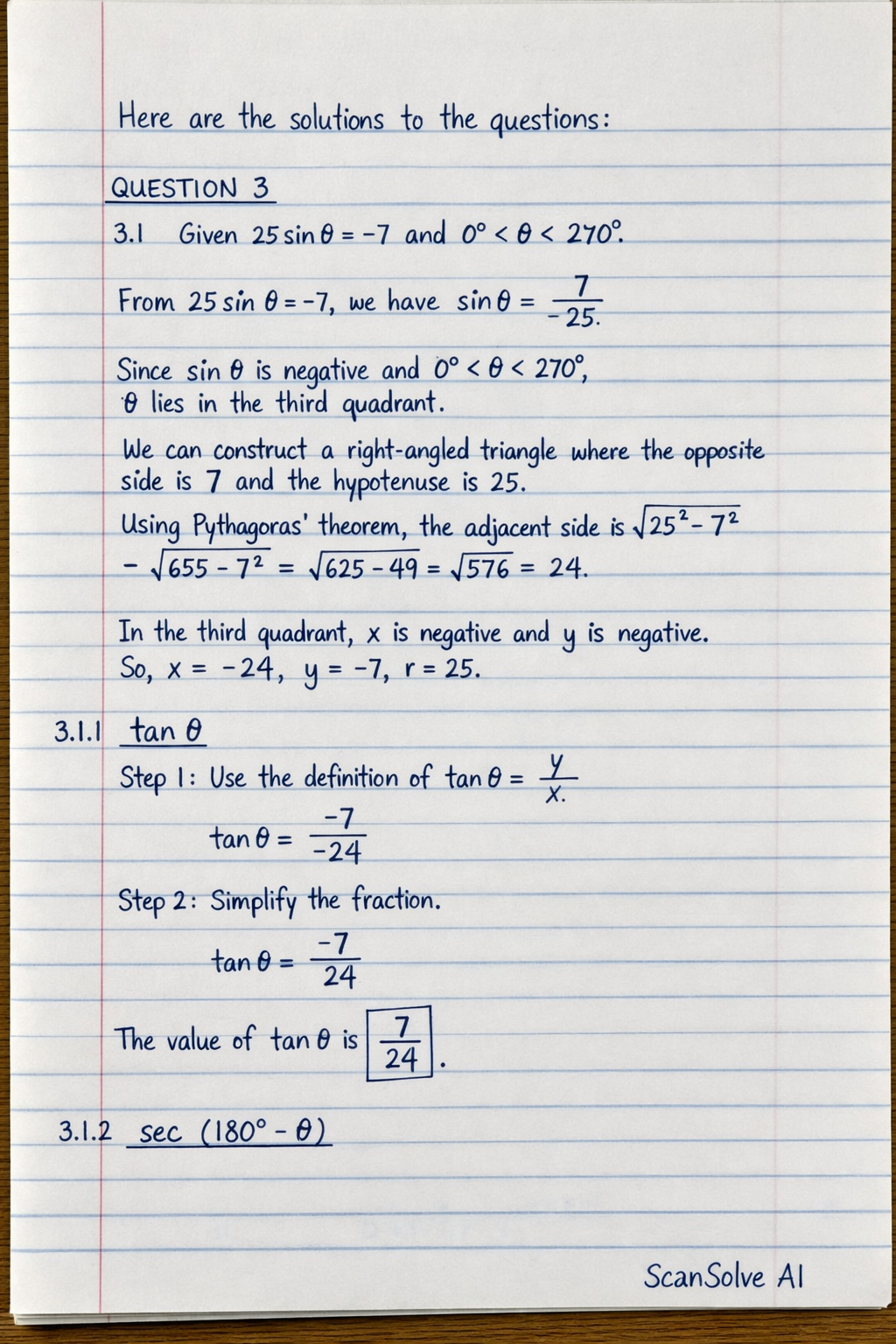
Here are the solutions to the questions:
QUESTION 3
3.1 Given 25sinθ=−7 and 0∘<θ<270∘.
From 25sinθ=−7, we have sinθ=−257.
Since sinθ is negative and 0∘<θ<270∘, θ lies in the third quadrant.
We can construct a right-angled triangle where the opposite side is 7 and the hypotenuse is 25.
Using Pythagoras' theorem, the adjacent side is 252−72=625−49=576=24.
In the third quadrant, x is negative and y is negative. So, x=−24, y=−7, r=25.
3.1.1 tan θ
Step 1: Use the definition of tanθ=xy.
tanθ=−24−7
Step 2: Simplify the fraction.
tanθ=247
The value of tanθ is \boxed{*\frac{7}{24}*}}.
3.1.2 sec (180∘−θ)
Step 1: Use the reduction formula sec(180∘−θ)=−secθ.
Step 2: Calculate cosθ=rx.
cosθ=25−24
Step 3: Calculate secθ=cosθ1.
secθ=25−241=−2425
Step 4: Substitute the value of secθ into the reduction formula.
sec(180∘−θ)=−(−2425)sec(180∘−θ)=2425
The value of sec(180∘−θ) is \boxed{*\frac{25}{24}*}}.
3.2 Determine the values of β, if cos(β−60∘)=0.25 and 0∘≤β≤360∘.
Step 1: Let A=β−60∘. So, cosA=0.25.
Step 2: Find the reference angle α.
α=arccos(0.25)≈75.52∘
Step 3: Since cosA is positive, A is in the first or fourth quadrant.
General solutions for A:
A=α+k⋅360∘ or A=360∘−α+k⋅360∘, where k is an integer.
Step 4: Substitute A=β−60∘ and solve for β.
Case 1: A=75.52∘+k⋅360∘β−60∘=75.52∘+k⋅360∘β=135.52∘+k⋅360∘
For k=0, β=135.52∘. (This is within 0∘≤β≤360∘)
Case 2: A=360∘−75.52∘+k⋅360∘=284.48∘+k⋅360∘β−60∘=284.48∘+k⋅360∘β=344.48∘+k⋅360∘
For k=0, β=344.48∘. (This is within 0∘≤β≤360∘)
Step 1: Simplify the terms in the numerator using reduction formulas.
• cot(180∘+θ)=cotθ (cot is positive in Q3)
• sec(360∘−θ)=secθ (sec is positive in Q4)
Numerator: cotθ⋅secθ
Step 2: Simplify the terms in the denominator using reduction formulas.
• sin(360∘−θ)=−sinθ (sin is negative in Q4)
• sin(180∘+θ)=−sinθ (sin is negative in Q3)
• cos(540∘+θ)=cos(180∘+360∘+θ)=cos(180∘+θ)=−cosθ (cos is negative in Q3)
• cos(180∘−θ)=−cosθ (cos is negative in Q2)
Step 3: Substitute the simplified terms into the expression.
(−sinθ)(−sinθ)+(−cosθ)(−cosθ)(cotθ)(secθ)=sin2θ+cos2θcotθ⋅secθ
Step 4: Use the identity sin2θ+cos2θ=1 for the denominator.
=1cotθ⋅secθ
Step 5: Express cotθ and secθ in terms of sinθ and cosθ.
=sinθcosθ⋅cosθ1
Step 6: Simplify the expression.
=sinθ1=cscθ
The simplified expression is \boxed{*\csc \theta*}}.
4.2 Prove that:1+cosx1+1−cosx1=2csc2x
Step 1: Start with the Left Hand Side (LHS) and find a common denominator.
LHS=1+cosx1+1−cosx1LHS=(1+cosx)(1−cosx)(1−cosx)+(1+cosx)
Step 2: Simplify the numerator and the denominator.
LHS=1−cos2x1−cosx+1+cosxLHS=1−cos2x2
Step 3: Use the Pythagorean identity sin2x+cos2x=1, which implies 1−cos2x=sin2x.
LHS=sin2x2
Step 4: Use the reciprocal identity cscx=sinx1, which implies csc2x=sin2x1.
LHS=2csc2x
Step 5: Compare the LHS with the Right Hand Side (RHS).
LHS=RHS
The identity is proven.
QUESTION 5
Given the functions defined by f(x)=tan3x and g(x)=sin6x for x∈[0∘;90∘].
5.1 On the same axes, given in your SPECIAL ANSWER BOOK, draw the graphs of f and g. Clearly show the turning points, asymptotes, endpoints, and the intercepts with the axes.
For f(x)=tan3x:
• Period: 3180∘=60∘.
• Asymptotes: x=30∘ and x=90∘.
• x-intercepts: (0∘,0) and (60∘,0).
• y-intercept: (0∘,0).
• Endpoints: (0∘,0). The graph approaches infinity as x→90∘ from the left.
• Key points for sketching: (15∘,1), (45∘,−1), (75∘,1).
For g(x)=sin6x:
• Period: 6360∘=60∘.
• Amplitude: 1.
• x-intercepts: (0∘,0), (30∘,0), (60∘,0), (90∘,0).
• y-intercept: (0∘,0).
• Turning points: Maximum at (15∘,1) and (75∘,1). Minimum at (45∘,−1).
• Endpoints: (0∘,0) and (90∘,0).
5.2 Write down the period of f and g.
Step 1: Calculate the period for f(x)=tan3x.
Pf=∣B∣180∘=3180∘=60∘
Step 2: Calculate the period for g(x)=sin6x.
Pg=∣B∣360∘=6360∘=60∘
The period of f(x) is ∗60∘∗.
The period of g(x) is ∗60∘∗.
5.3 Use your graphs to determine for which values of x is tan3x=sin6x. Give any TWO values.
By observing the key points and intercepts from the graph analysis in 5.1, the graphs intersect at several points within the given domain.
• At x=0∘: f(0∘)=tan(0∘)=0, g(0∘)=sin(0∘)=0. So x=0∘ is a solution.
• At x=15∘: f(15∘)=tan(45∘)=1, g(15∘)=sin(90∘)=1. So x=15∘ is a solution.
• At x=45∘: f(45∘)=tan(135∘)=−1, g(45∘)=sin(270∘)=−1. So x=45∘ is a solution.
• At x=60∘: f(60∘)=tan(180∘)=0, g(60∘)=sin(360∘)=0. So x=60∘ is a solution.
• At x=75∘: f(75∘)=tan(225∘)=1, g(75∘)=sin(450∘)=sin(90∘)=1. So x=75∘ is a solution.
Any two of these values can be given.
Two values for which tan3x=sin6x are ∗0∘and15∘∗. (Other valid answers include 45∘,60∘,75∘)
3 done, 2 left today. You're making progress.
Was this helpful?
Need help with your own homework?
Get instant step-by-step solutions to any question. Free to start.
This mathematics problem involves applying core mathematical principles and formulas. Below you will find a complete step-by-step solution with detailed explanations for each step, helping you understand not just the answer but the method behind it.
ScanSolve AI Answer
Here are the solutions to the questions: QUESTION 3 3.1 Given 25 = -7 and 0^ < < 270^. From 25 = -7, we have = -(7)/(25). Since is negative and 0^ < < 270^, lies in the third quadrant. We can construct a right-angled triangle where the opposite side is 7 and the hypotenuse is 25. Using Pythagoras' theorem, the adjacent side is sqrt(25^2 - 7^2) = sqrt(625 - 49) = sqrt(576) = 24. In the third quadrant, x is negative and y is negative. So, x = -24, y = -7, r = 25. 3.1.1 tan Step 1: Use the definition of = (y)/(x). = (-7)/(-24) Step 2: Simplify the fraction. = (7)/(24) The value of is (7)/(24). 3.1.2 sec (180^ - ) Step 1: Use the reduction formula (180^ - ) = - . Step 2: Calculate = (x)/(r). = (-24)/(25) Step 3: Calculate = (1)/( ). = (1)/(-24)25 = -(25)/(24) Step 4: Substitute the value of into the reduction formula. (180^ - ) = - (-(25)/(24)) (180^ - ) = (25)/(24) The value of (180^ - ) is (25)/(24). 3.2 Determine the values of , if ( - 60^) = 0.25 and 0^ 360^. Step 1: Let A = - 60^. So, A = 0.25. Step 2: Find the reference angle . = (0.25) ≈ 75.52^ Step 3: Since A is positive, A is in the first or fourth quadrant. General solutions for A: A = + k · 360^ or A = 360^ - + k · 360^, where k is an integer. Step 4: Substitute A = - 60^ and solve for . Case 1: A = 75.52^ + k · 360^ 60^ = 75.52^ + k · 360^ = 135.52^ + k · 360^ For k=0, = 135.52^. (This is within 0^ 360^) Case 2: A = 360^ - 75.52^ + k · 360^ = 284.48^ + k · 360^ 60^ = 284.48^ + k · 360^ = 344.48^ + k · 360^ For k=0, = 344.48^. (This is within 0^ 360^) The values of are 135.52^ and 344.48^. QUESTION 4 4.1 Simplify: ((180^+)(360^-))/((360^-)(180^+)+(540^+)(180^-)) Step 1: Simplify the terms in the numerator using reduction formulas. • (180^+) = (cot is positive in Q3) • (360^-) = (sec is positive in Q4) Numerator: · Step 2: Simplify the terms in the denominator using reduction formulas. • (360^-) = - (sin is negative in Q4) • (180^+) = - (sin is negative in Q3) • (540^+) = (180^ + 360^ + ) = (180^+) = - (cos is negative in Q3) • (180^-) = - (cos is negative in Q2) Step 3: Substitute the simplified terms into the expression. (( )( ))/((- )(- ) + (- )(- )) = ( · )/(^2 + ^2 ) Step 4: Use the identity ^2 + ^2 = 1 for the denominator. = ( · )/(1) Step 5: Express and in terms of and . = ( )/( ) · (1)/( ) Step 6: Simplify the expression. = (1)/( ) = The simplified expression is . 4.2 Prove that: (1)/(1+ x) + (1)/(1- x) = 2^2 x Step 1: Start with the Left Hand Side (LHS) and find a common denominator. LHS = (1)/(1+ x) + (1)/(1- x) LHS = ((1- x) + (1+ x))/((1+ x)(1- x)) Step 2: Simplify the numerator and the denominator. LHS = (1- x + 1+ x)/(1-^2 x) LHS = (2)/(1-^2 x) Step 3: Use the Pythagorean identity ^2 x + ^2 x = 1, which implies 1 - ^2 x = ^2 x. LHS = (2)/(^2 x) Step 4: Use the reciprocal identity x = (1)/( x), which implies ^2 x = (1)/(^2 x). LHS = 2 ^2 x Step 5: Compare the LHS with the Right Hand Side (RHS). LHS = RHS The identity is proven. QUESTION 5 Given the functions defined by f(x) = 3x and g(x) = 6x for x [0^; 90^]. 5.1 On the same axes, given in your SPECIAL ANSWER BOOK, draw the graphs of f and g. Clearly show the turning points, asymptotes, endpoints, and the intercepts with the axes. For f(x) = 3x: • Period: (180^)/(3) = 60^. • Asymptotes: x = 30^ and x = 90^. • x-intercepts: (0^, 0) and (60^, 0). • y-intercept: (0^, 0). • Endpoints: (0^, 0). The graph approaches infinity as x 90^ from the left. • Key points for sketching: (15^, 1), (45^, -1), (75^, 1). For g(x) = 6x: • Period: (360^)/(6) = 60^. • Amplitude: 1. • x-intercepts: (0^, 0), (30^, 0), (60^, 0), (90^, 0). • y-intercept: (0^, 0). • Turning points: Maximum at (15^, 1) and (75^, 1). Minimum at (45^, -1). • Endpoints: (0^, 0) and (90^, 0). 5.2 Write down the period of f and g. Step 1: Calculate the period for f(x) = 3x. P_f = (180^)/(|B|) = (180^)/(3) = 60^ Step 2: Calculate the period for g(x) = 6x. P_g = (360^)/(|B|) = (360^)/(6) = 60^ The period of f(x) is 60^. The period of g(x) is 60^. 5.3 Use your graphs to determine for which values of x is 3x = 6x. Give any TWO values. By observing the key points and intercepts from the graph analysis in 5.1, the graphs intersect at several points within the given domain. • At x=0^: f(0^) = (0^) = 0, g(0^) = (0^) = 0. So x=0^ is a solution. • At x=15^: f(15^) = (45^) = 1, g(15^) = (90^) = 1. So x=15^ is a solution. • At x=45^: f(45^) = (135^) = -1, g(45^) = (270^) = -1. So x=45^ is a solution. • At x=60^: f(60^) = (180^) = 0, g(60^) = (360^) = 0. So x=60^ is a solution. • At x=75^: f(75^) = (225^) = 1, g(75^) = (450^) = (90^) = 1. So x=75^ is a solution. Any two of these values can be given. Two values for which 3x = 6x are 0^ and 15^. (Other valid answers include 45^, 60^, 75^) 3 done, 2 left today. You're making progress.