
We read your photo as:
Complete the following arithmetic problems, demonstrating properties of addition and subtraction, and solving a word problem.
ScanSolve AI Answer
Answer
Step-by-step solution
5 stepsComplete 3.1.1
The equation is .
This demonstrates the commutative property of addition ().Complete 3.1.2
The equation is .
Assuming 'C' is a typographical error and the numbers are intended to be 8 and 7, similar to the simple arithmetic context of the other problems.To find the missing number, subtract 1 from 15:
Complete 3.1.3
The equation is .
Write the number sentence and then solve for 3.2
The problem states: "James has 13 apples and Kate has 7 apples less than James. How many apples does Kate have?"
The number sentence is .i)
ii)
This is correct.
State True or False for 4.1
The statement is .
Simplify both sides of the equation:
Left side: .
Right side: .
The statement becomes .
This is an equation, not a statement that is universally true or false without a defined value for 'C'. If 'C' is a variable, the statement is only true if . Since no value for 'C' is given, the statement is not always true. Therefore, as a general statement
Still stuck on this one?
Ask a follow-up, and the answer starts from this question.
More Mathematics Questions
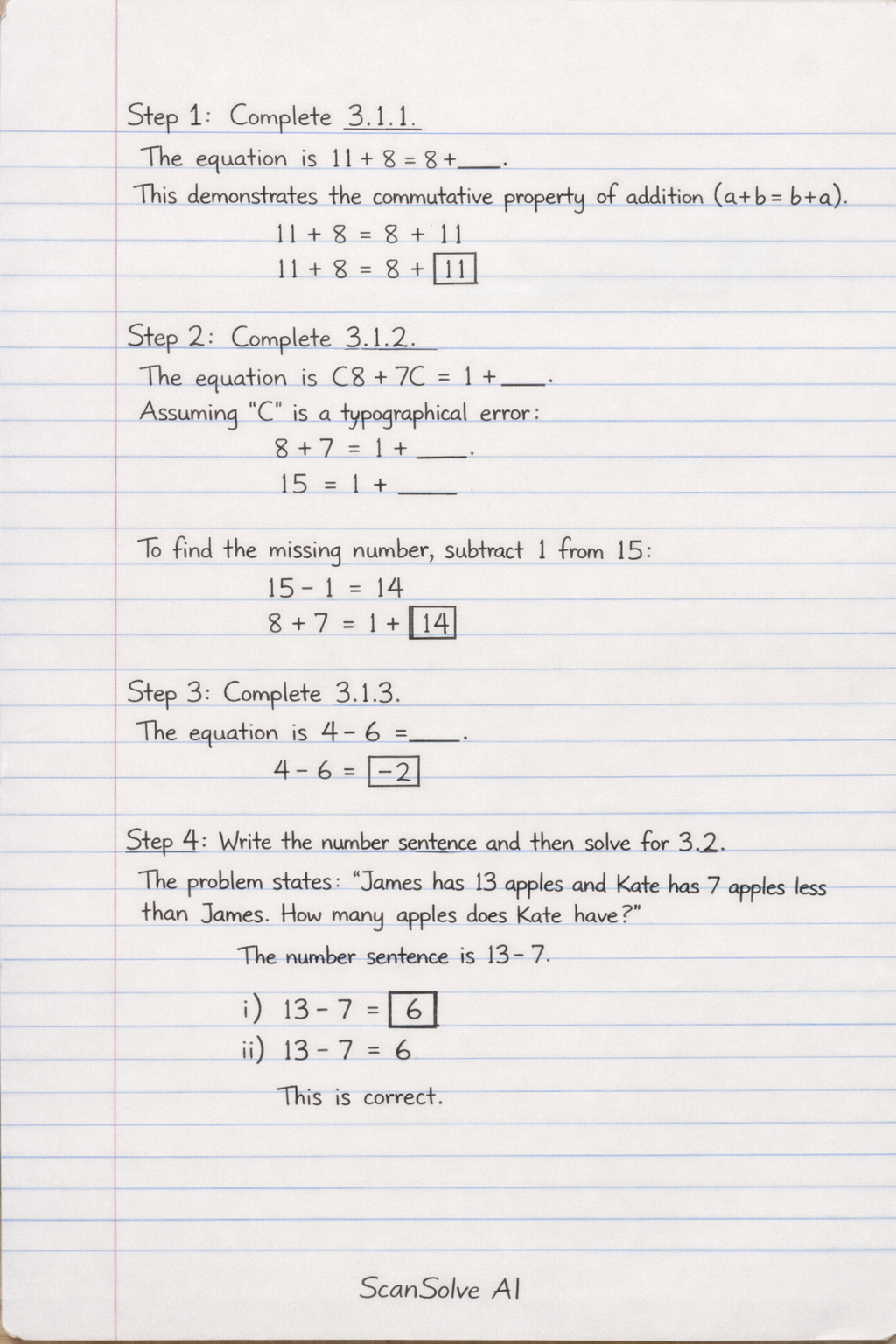
Handwritten Step-by-Step Solution
Get this as a handwritten image on WhatsApp — like a tutor wrote it for you.
Try on WhatsApp