
We read your photo as:
Solve the following math problems using properties of addition and basic arithmetic.
ScanSolve AI Answer
Step-by-step solution
15 stepsHere are the solutions to your math assignment:
Q1. Fill in the blanks using properties of addition.
- a)
Add the numbers.
$$ 69,799 + 1 = 70,000 $$ The blank is $\boxed{70,000}$.- b)
Apply the additive identity property, which states that any number added to zero remains the same.
$$ 40,110 + 0 = 40,110 $$ The blank is $\boxed{40,110}$.- c)
Apply the commutative property of addition, which states that changing the order of addends does not change the sum ().
$$ 58,176 + 29,990 = 29,990 + 58,176 $$ The blank is $\boxed{58,176}$.- d)
Apply the associative property of addition, which states that changing the grouping of addends does not change the sum ().
$$ 67,715 + (12,143 + 29,100) = 29,100 + (67,715 + 12,143) $$ The blank is $\boxed{12,143}$.Q2. Find the sum of the greatest 3-digit number and smallest 6-digit number.
Identify the greatest 3-digit number.
The greatest 3-digit number is 999.
Identify the smallest 6-digit number.
The smallest 6-digit number is 100,000.
Calculate their sum.
The sum is .
Q3. Which number is 9,001 more than 35,841?
Add 9,001 to 35,841.
The number is .
Q4. Fill in the blanks:
Fill in the units column.
8 + \text{_} = 1(implies8 + \text{_} = 11). So, the missing digit is 3. Carry over 1.Fill in the tens column.
(carry-over) . This matches the given result.
Fill in the hundreds column.
\text{_} + 7 = 1(implies\text{_} + 7 = 11). So, the missing digit is 4. Carry over 1.Fill in the thousands column.
(carry-over) . So, the missing digit in the sum is 6.
Fill in the ten thousands column.
. So, the missing digit in the sum is 3.
The completed addition is:
The blanks are , , , .
Q5. Seema spent ₹ 75,953 on food and clothing and paid ₹ 35,595 as house rent. She saved ₹ 1,85,580. How much she earn during the year?
Calculate Seema's total spending.
Total spending = Money spent on food and clothing + Money paid for house rent
Total spending = ₹Calculate Seema's total earnings.
Total earnings = Total spending + Total savings
Total earnings = ₹Seema earned during the year.
Still stuck on this one?
Ask a follow-up, and the answer starts from this question.
More Mathematics Questions
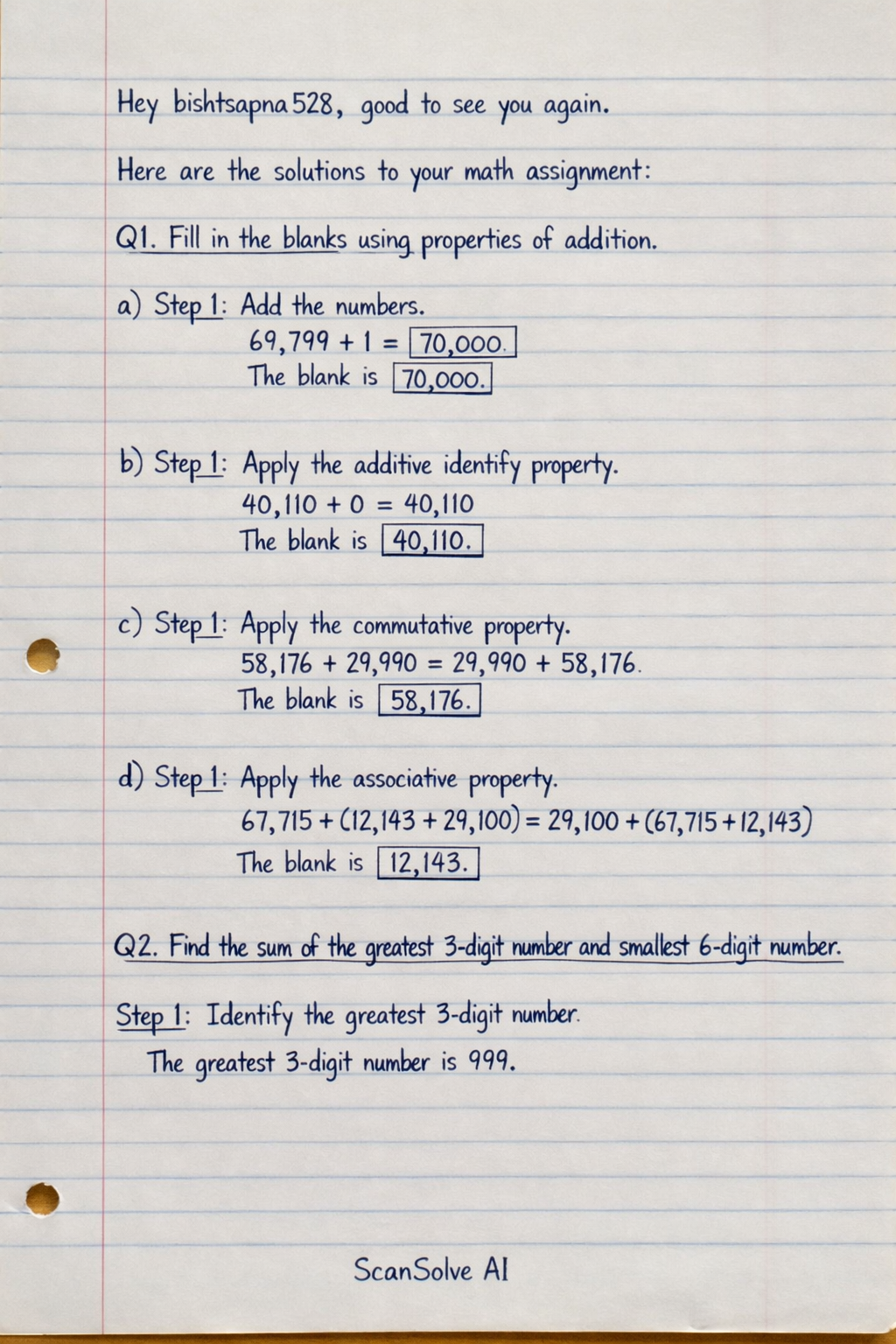
Handwritten Step-by-Step Solution
Get this as a handwritten image on WhatsApp — like a tutor wrote it for you.
Try on WhatsApp