
We read your photo as:
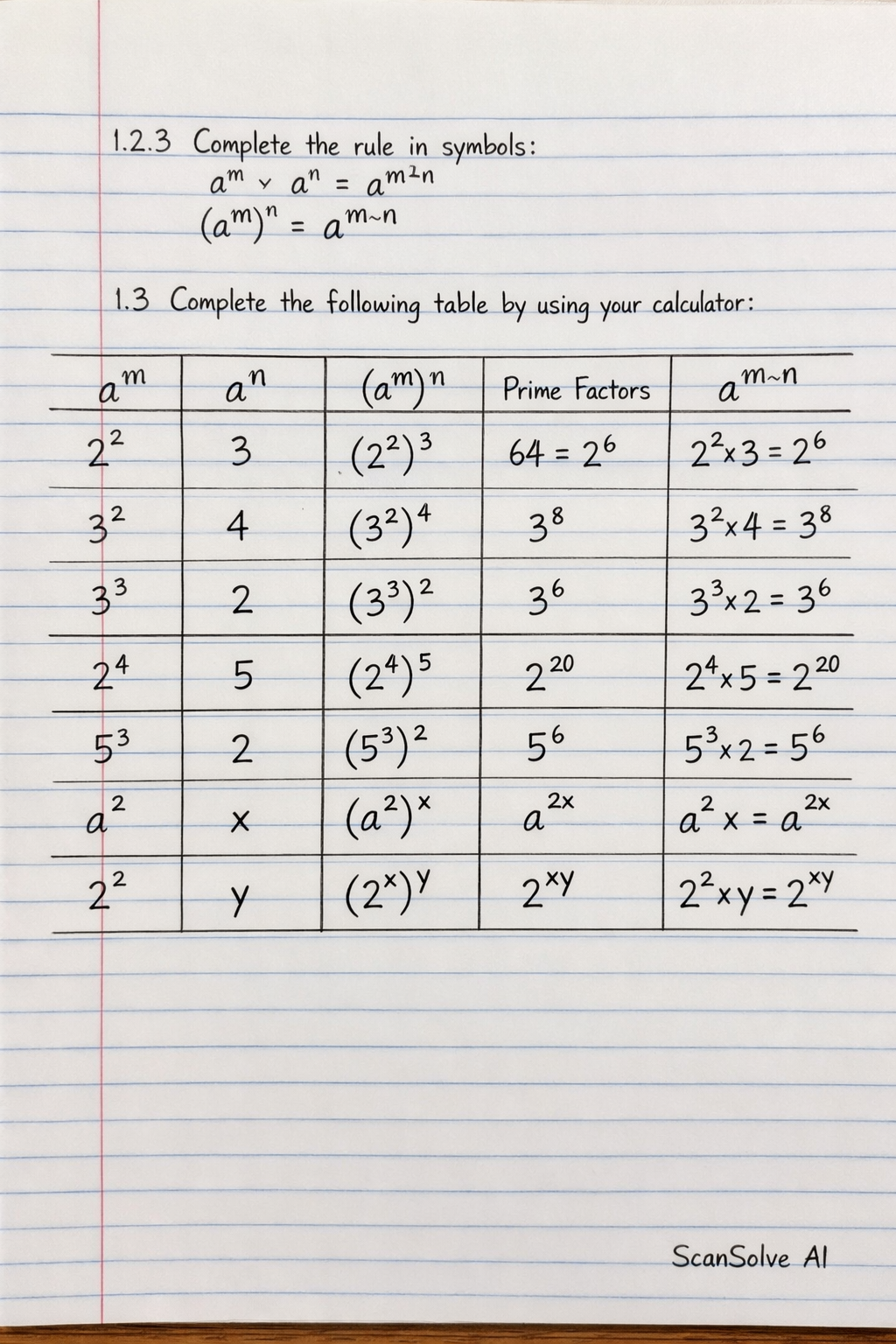
Complete the following exercises on exponents and powers: 2.3 Complete the rule in symbols: a^m / aⁿ = a^? (a^m)ⁿ = a^? 3 Complete the following table using your calculator (first line is an example
ScanSolve AI Answer
Step-by-step solution
6 stepshere are the solutions to the math questions.
1.2.3 Complete the rule in symbols:
1.3 Complete the following table by using your calculator. The first line has been done for you as an example.
| Prime Factors | ||||
|---|---|---|---|---|
| 3 | ||||
| 4 | ||||
| 2 | ||||
| 5 | ||||
| 2 | ||||
1.3.2 Explain the general rule of what is happening in the table above in your own words.
When a power is raised to another power, the exponents are multiplied together, while the base remains the same.
1.3.3 Complete the rule in symbols:
1.3.4 Does this rule apply for every number in the bracket? ? Show your workings.
Yes, the rule applies to each factor within the bracket.
Rewrite the expression using the rule .
Apply the rule to each factor.
Simplify the exponents and calculate the value.
Answer: ✅ Yes, the rule applies to each factor within the bracket.
1.3.5 Is the same as ? Show your workings.
Calculate the value of the left-hand side (LHS).
Calculate the value of the right-hand side (RHS).
Compare the LHS and RHS.
Since , the expressions are the same.
Answer: ✅ Yes, they are the same.ACTIVITY 2: FUNCTIONS AND RELATIONS
2.1 Use the following rule: To find the y-values, add 3 to the x-values and then divide by 5.
The rule can be written as .2.1.1 Complete the table of values.
| | $y
Still stuck on this one?
Ask a follow-up, and the answer starts from this question.
More Mathematics Questions
Handwritten Step-by-Step Solution
Get this as a handwritten image on WhatsApp — like a tutor wrote it for you.
Try on WhatsApp