We read your photo as:

Solve the following problems involving exponents and powers.

Mathematics

ScanSolve AI Answer

Step-by-step solution

4 steps

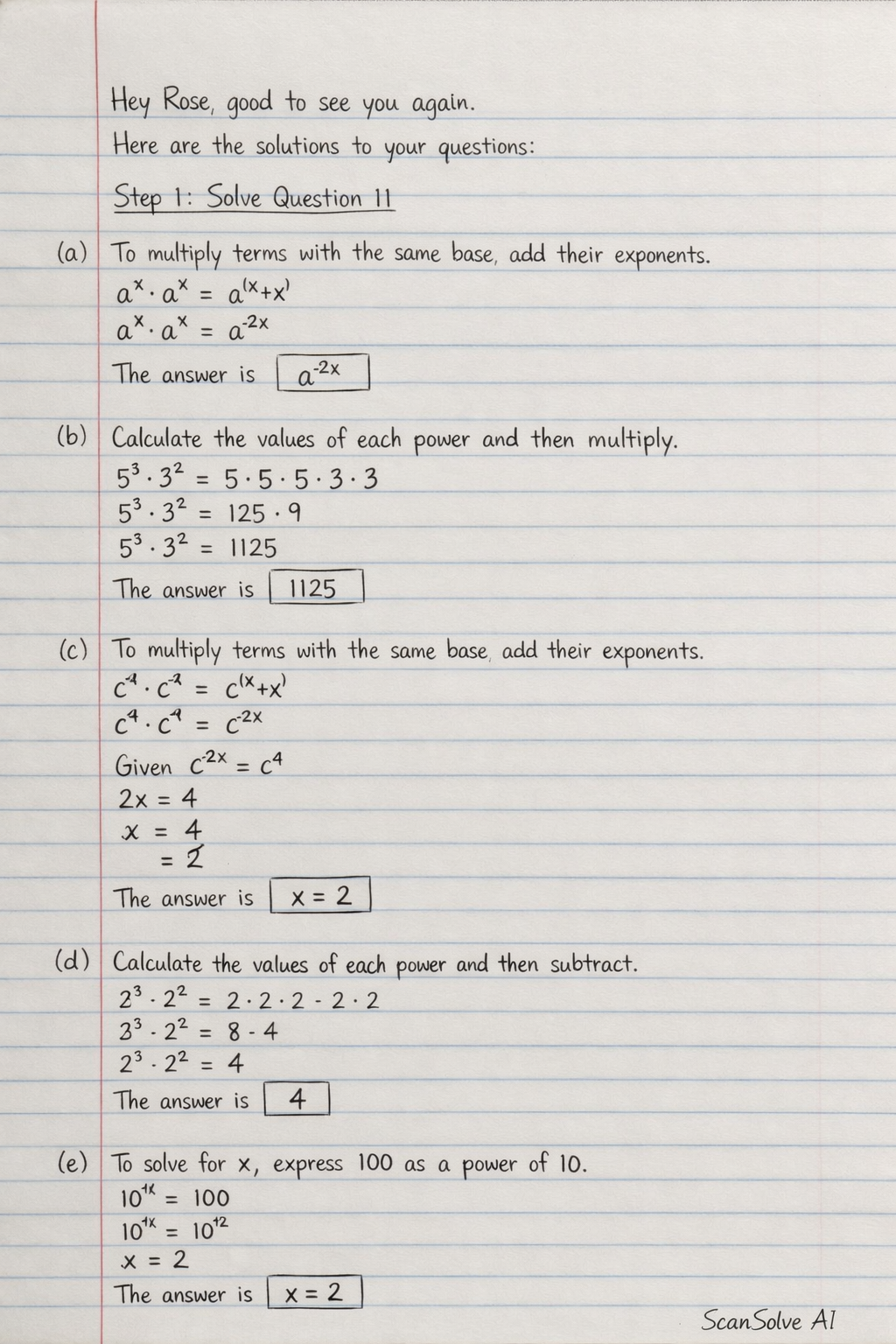
Here are the solutions to your questions:

  1. Solve Question 11

    a) To multiply terms with the same base, add their exponents.

    ax×ax=ax+x=a2xa^x \times a^x = a^{x+x} = a^{2x}

    The answer is a2x\boxed{a^{2x}}.

    b) Calculate the values of each power and then multiply.

    53×32=(5×5×5)×(3×3)5^3 \times 3^2 = (5 \times 5 \times 5) \times (3 \times 3) 53×32=125×95^3 \times 3^2 = 125 \times 9 53×32=11255^3 \times 3^2 = 1125

    The answer is 1125\boxed{1125}.

    c) To multiply terms with the same base, add their exponents.

    cx×cx=cx+x=c2xc^x \times c^x = c^{x+x} = c^{2x}

    Given c2x=c4c^{2x} = c^4, the exponents must be equal.

    2x=42x = 4 x=42x = \frac{4}{2} x=2x = 2

    The answer is x=2\boxed{x=2}.

    d) Calculate the values of each power and then subtract.

    23−22=(2×2×2)−(2×2)2^3 - 2^2 = (2 \times 2 \times 2) - (2 \times 2) 23−22=8−42^3 - 2^2 = 8 - 4 23−22=42^3 - 2^2 = 4

    The answer is 4\boxed{4}.

    e) To solve for xx, express 100 as a power of 10.

    10x=10010^x = 100 10x=10210^x = 10^2

    Since the bases are the same, the exponents must be equal.

    x=2x = 2

    The answer is x=2\boxed{x=2}.

    f) The equation is 6x−6x=2166^x - 6^x = 216.

    0=2160 = 216

    This statement is false, so there is no solution for xx.
    The answer is No solution\boxed{\text{No solution}}.

    g) To solve for xx, express 16 as a power of 4.

    4x=164^x = 16 4x=424^x = 4^2

    Since the bases are the same, the exponents must be equal.

    x=2x = 2

    The answer is x=2\boxed{x=2}.

  2. Solve Question 12

    a) Decrease 1000 by 10% then by 20%.
    First decrease by 10%:

    1000×(1−0.10)=1000×0.90=9001000 \times (1 - 0.10) = 1000 \times 0.90 = 900

    Then decrease the new amount (900) by 20%:

    900×(1−0.20)=900×0.80=720900 \times (1 - 0.20) = 900 \times 0.80 = 720

    The answer is 720\boxed{720}.

    b) After increasing by 15%, it became 34500. What is the original amount?
    Let the original amount be AA.

    A×(1+0.15)=34500A \times (1 + 0.15) = 34500 A×1.15=34500A \times 1.15 = 34500 A=345001.15A = \frac{34500}{1.15} A=30000A = 30000

    The answer is 30000\boxed{30000}.

    c) What amount when decreased by 12% becomes 528000?
    Let the original amount be AA.

    A×(1−0.12)=528000A \times (1 - 0.12) = 528000 A×0.88=528000A \times 0.88 = 528000 A=5280000.88A = \frac{528000}{0.88} A=600000A = 600000

    The answer is 600000\boxed{600000}.

    d) When 2000 is decreased by P%, it becomes 16000. Find the value of P.
    Assumption: The question likely meant "increased by P%" or the initial value was 20000, as a decrease from 2000 cannot result in 16000. I will proceed assuming it meant "When 2000 is increased by P%, it becomes 16000."
    Let the original amount be 2000.

    2000×(1+P100)=160002000 \times (1 + \frac{P}{100}) = 16000 1+P100=1600020001 + \frac{P}{100} = \frac{16000}{2000} 1+P100=81 + \frac{P}{100} = 8 P100=8−1\frac{P}{100} = 8 - 1 P100=7\frac{P}{100} = 7 P=7×100P = 7 \times 100 P=700P = 700

    The answer is P=700\boxed{P=700}.

    e) Increase 48000 by 12.5% then by 2.25%.
    First increase by 12.5%:

    48000×(1+0.125)=48000×1.125=5400048000 \times (1 + 0.125) = 48000 \times 1.125 = 54000

    Then increase the new amount (54000) by 2.25%:

    54000×(1+0.0225)=54000×1.0225=5521554000 \times (1 + 0.0225) = 54000 \times 1.0225 = 55215

    The answer is 55215\boxed{55215}.

  3. Solve Question 13

    a) Jin covered a distance of 50 km in 2 hours. Calculate speed in km/hr.
    Speed is calculated as distance divided by time.

    Speed=DistanceTime\text{Speed} = \frac{\text{Distance}}{\text{Time}} Speed=50 km2 hr\text{Speed} = \frac{50 \text{ km}}{2 \text{ hr}} Speed=25 km/hr\text{Speed} = 25 \text{ km/hr}

    The speed in km/hr is 25 km/hr\boxed{25 \text{ km/hr}}.

    b) What was the speed in m/sec?
    Convert 25 km/hr to m/sec.

    1 km=1000 m1 \text{ km} = 1000 \text{ m} 1 hr=3600 sec1 \text{ hr} = 3600 \text{ sec} Speed=25kmhr×1000 m1 km×1 hr3600 sec\text{Speed} = 25 \frac{\text{km}}{\text{hr}} \times \frac{1000 \text{ m}}{1 \text{ km}} \times \frac{1 \text{ hr}}{3600 \text{ sec}} Speed=25×10003600 m/sec\text{Speed} = \frac{25 \times 1000}{3600} \text{ m/sec} Speed=250003600 m/sec\text{Speed} = \frac{25000}{3600} \text{ m/sec} Speed=25036 m/sec\text{Speed} = \frac{250}{36} \text{ m/sec} Speed=12518 m/sec\text{Speed} = \frac{125}{18} \text{ m/sec} Speed≈6.94 m/sec\text{Speed} \approx 6.94 \text{ m/sec}

    The speed in m/sec is 12518 m/sec\boxed{\frac{125}{18} \text{ m/sec}} or approximately 6.94 m/sec\boxed{6.94 \text{ m/sec}}.

  4. Solve Question 14

    A cyclist covered 200 m in 10 seconds. Find the constant speed in km/hr.
    First, calculate the speed in m/sec.

    Speed=DistanceTime\text{Speed} = \frac{\text{Distance}}{\text{Time}} Speed=200 m10 sec\text{Speed} = \frac{200 \text{ m}}{10 \text{ sec}} Speed=20 m/sec\text{Speed} = 20 \text{ m/sec}

    Now, convert 20 m/sec to km/hr.

    1 m=11000 km1 \text{ m} = \frac{1}{1000} \text{ km} 1 sec=13600 hr1 \text{ sec} = \frac{1}{3600} \text{ hr} Speed=20msec×1 km1000 m×3600 sec1 hr\text{Speed} = 20 \frac{\text{m}}{\text{sec}} \times \frac{1 \text{ km}}{1000 \text{ m}} \times \frac{3600 \text{ sec}}{1 \text{ hr}} Speed=20×36001000 km/hr\text{Speed} = \frac{20 \times 3600}{1000} \text{ km/hr} Speed=720001000 km/hr\text{Speed} = \frac{72000}{1000} \text{ km/hr} Speed=72 km/hr\text{Speed} = 72 \text{ km/hr}

    The constant speed in km/hr is 72 km/hr\boxed{72 \text{ km/hr}}.

Was this helpful?

Still stuck on this one?

Ask a follow-up, and the answer starts from this question.

Got a different question?Ask your own question
Handwritten step-by-step solution preview

Handwritten Step-by-Step Solution

Get this as a handwritten image on WhatsApp — like a tutor wrote it for you.

Try on WhatsApp