Solve the following two math problems involving exponents and logarithms:
|Mathematics
Solve the following two math problems involving exponents and logarithms:
ScanSolve AI Answer
Answer
2.5
You're on a roll — here are the solutions to the math problems.
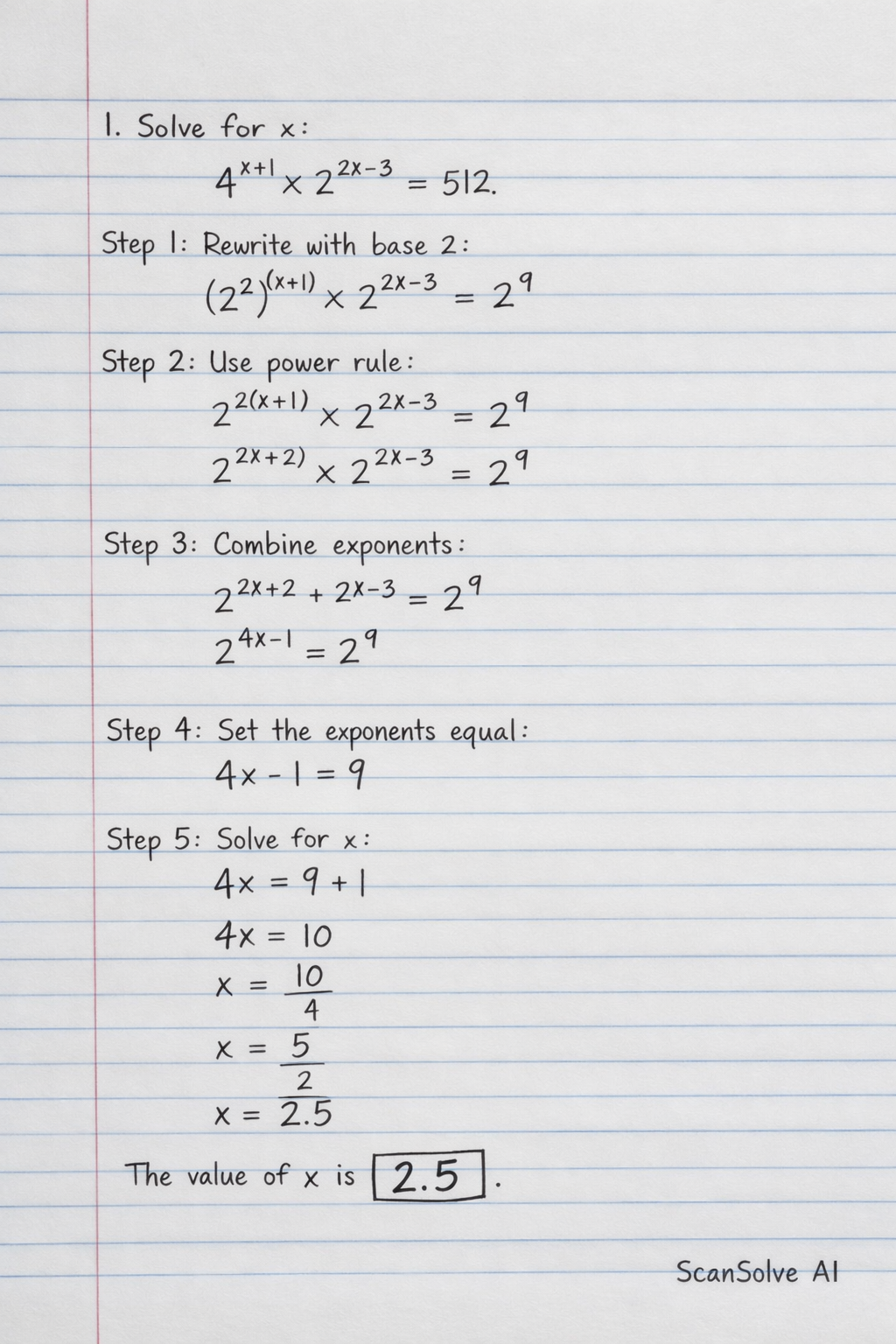
1. Solve for x:4x+1×22x−3=512
Step 1: Express all numbers with a base of 2.
(22)x+1×22x−3=29
Step 2: Apply the power rule (am)n=amn.
22(x+1)×22x−3=2922x+2×22x−3=29
Step 3: Apply the product rule am×an=am+n.
2(2x+2)+(2x−3)=2924x−1=29
Step 4: Equate the exponents since the bases are the same.
4x−1=9
Step 5: Solve for x.
4x=9+14x=10x=410x=25x=2.5
The value of x is ∗2.5∗.
2. Use logarithms to evaluate:0.6932.735×0.0846
Let N=0.6932.735×0.0846.
Step 1: Take the logarithm (base 10) of both sides.
logN=log(0.6932.735×0.0846)
Step 2: Apply logarithm properties log(AB)=logA+logB and log(BA)=logA−logB.
logN=log(2.735)+log(0.0846)−log(0.693)
Step 3: Find the logarithms of each number.
log(2.735)≈0.4376log(0.0846)≈2ˉ.9274or−1.0726log(0.693)≈1ˉ.8407or−0.1593
Using characteristic and mantissa:
log(2.735)=0.4376log(0.0846)=2.9274log(0.693)=1.8407
Step 4: Perform the addition and subtraction.
logN=0.4376+2ˉ.9274−1ˉ.8407logN=(0.4376−2+0.9274)−(−1+0.8407)logN=(0.4376+0.9274−2)−(0.8407−1)logN=1.3650−2−0.8407+1logN=0.5243−1logN=1ˉ.5243
Step 5: Find the antilogarithm.
N=101ˉ.5243N=10−1×100.5243N≈0.1×3.344N≈0.3344
The evaluated value is approximately ∗0.3344∗.
3. The volume of a cylindrical piece of wood is 2187cm3, given that the area of the base is 243cm2, use the laws of indices and a base of 3 to find the height of the piece of wood leaving the answer in index form.
Step 1: Recall the formula for the volume of a cylinder.
V=Abase×h
Step 2: Substitute the given values.
2187cm3=243cm2×h
Step 3: Solve for h.
h=2432187cm
Step 4: Express 2187 and 243 as powers of 3.
31=332=933=2734=8135=24336=72937=2187
So, 2187=37 and 243=35.
Step 5: Substitute the index forms into the equation for h.
h=3537
Step 6: Apply the division rule for indices am/an=am−n.
h=37−5h=32cm
The height of the piece of wood in index form is ∗32cm∗.
3. The length of a rectangular hall is (x+4) m and the width is (x−3) m. If its area is 77m2, find its dimensions.
Step 1: Write the formula for the area of a rectangle.
Area=Length×Width
Step 2: Substitute the given expressions for length, width, and area.
77=(x+4)(x−3)
Step 3: Expand the right side of the equation.
77=x2−3x+4x−1277=x2+x−12
Step 4: Rearrange the equation into a standard quadratic form ax2+bx+c=0.
x2+x−12−77=0x2+x−89=0
Step 5: Solve the quadratic equation for x. We can use the quadratic formula x=2a−b±b2−4ac.
Here, a=1, b=1, c=−89.
x=2(1)−1±12−4(1)(−89)x=2−1±1+356x=2−1±357x≈2−1±18.894
Two possible values for x:
x1=2−1+18.894=217.894≈8.947x2=2−1−18.894=2−19.894≈−9.947
Step 6: Choose the valid value for x. Since dimensions (length and width) cannot be negative, x−3 must be positive. If x=−9.947, then x−3=−12.947, which is not possible. Therefore, we use x≈8.947.
Step 7: Calculate the dimensions using x≈8.947.
Length=x+4=8.947+4=12.947mWidth=x−3=8.947−3=5.947m
The dimensions of the hall are approximately Length=∗12.95m∗,Width=∗5.95m∗.
4. List all the composite numbers from 81 to 100.
A composite number is a positive integer that has at least one divisor other than 1 and itself. In other words, it is not a prime number.
Numbers from 81 to 100:
81, 82, 83, 84, 85, 86, 87, 88, 89, 90, 91, 92, 93, 94, 95, 96, 97, 98, 99, 100.
Step 1: Identify prime numbers in this range (numbers only divisible by 1 and themselves).
83 (divisors: 1, 83)
89 (divisors: 1, 89)
97 (divisors: 1, 97)
Step 2: All other numbers in the list are composite.
81 (9×9)
82 (2×41)
84 (2×42)
85 (5×17)
86 (2×43)
87 (3×29)
88 (2×44)
90 (9×10)
91 (7×13)
92 (2×46)
93 (3×31)
94 (2×47)
95 (5×19)
96 (2×48)
98 (2×49)
99 (9×11)
100 (10×10)
The composite numbers from 81 to 100 are:
∗81,82,84,85,86,87,88,90,91,92,93,94,95,96,98,99,100∗.
Got more? Send 'em 📸
Was this helpful?
Need help with your own homework?
Get instant step-by-step solutions to any question. Free to start.
This mathematics problem involves applying core mathematical principles and formulas. Below you will find a complete step-by-step solution with detailed explanations for each step, helping you understand not just the answer but the method behind it.
ScanSolve AI Answer
You're on a roll — here are the solutions to the math problems. 1. Solve for x: 4^x+1 × 2^2x-3 = 512 Step 1: Express all numbers with a base of 2. (2^2)^x+1 × 2^2x-3 = 2^9 Step 2: Apply the power rule (a^m)^n = a^mn. 2^2(x+1) × 2^2x-3 = 2^9 2^2x+2 × 2^2x-3 = 2^9 Step 3: Apply the product rule a^m × a^n = a^m+n. 2^(2x+2) + (2x-3) = 2^9 2^4x-1 = 2^9 Step 4: Equate the exponents since the bases are the same. 4x-1 = 9 Step 5: Solve for x. 4x = 9+1 4x = 10 x = (10)/(4) x = (5)/(2) x = 2.5 The value of x is 2.5. 2. Use logarithms to evaluate: (2.735 × 0.0846)/(0.693) Let N = (2.735 × 0.0846)/(0.693). Step 1: Take the logarithm (base 10) of both sides. N = ( (2.735 × 0.0846)/(0.693) ) Step 2: Apply logarithm properties (AB) = A + B and ((A)/(B)) = A - B. N = (2.735) + (0.0846) - (0.693) Step 3: Find the logarithms of each number. (2.735) ≈ 0.4376 (0.0846) ≈ 2.9274 or -1.0726 (0.693) ≈ 1.8407 or -0.1593 Using characteristic and mantissa: (2.735) = 0.4376 (0.0846) = 2.9274 (0.693) = 1.8407 Step 4: Perform the addition and subtraction. N = 0.4376 + 2.9274 - 1.8407 N = (0.4376 - 2 + 0.9274) - (-1 + 0.8407) N = (0.4376 + 0.9274 - 2) - (0.8407 - 1) N = 1.3650 - 2 - 0.8407 + 1 N = 0.5243 - 1 N = 1.5243 Step 5: Find the antilogarithm. N = 10^1.5243 N = 10^-1 × 10^0.5243 N ≈ 0.1 × 3.344 N ≈ 0.3344 The evaluated value is approximately 0.3344. 3. The volume of a cylindrical piece of wood is 2187 cm^3, given that the area of the base is 243 cm^2, use the laws of indices and a base of 3 to find the height of the piece of wood leaving the answer in index form. Step 1: Recall the formula for the volume of a cylinder. V = A_base × h Step 2: Substitute the given values. 2187 cm^3 = 243 cm^2 × h Step 3: Solve for h. h = (2187)/(243) cm Step 4: Express 2187 and 243 as powers of 3. 3^1 = 3 3^2 = 9 3^3 = 27 3^4 = 81 3^5 = 243 3^6 = 729 3^7 = 2187 So, 2187 = 3^7 and 243 = 3^5. Step 5: Substitute the index forms into the equation for h. h = (3^7)/(3^5) Step 6: Apply the division rule for indices a^m / a^n = a^m-n. h = 3^7-5 h = 3^2 cm The height of the piece of wood in index form is 3^2 cm. 3. The length of a rectangular hall is (x+4) m and the width is (x-3) m. If its area is 77 m^2, find its dimensions. Step 1: Write the formula for the area of a rectangle. Area = Length × Width Step 2: Substitute the given expressions for length, width, and area. 77 = (x+4)(x-3) Step 3: Expand the right side of the equation. 77 = x^2 - 3x + 4x - 12 77 = x^2 + x - 12 Step 4: Rearrange the equation into a standard quadratic form ax^2 + bx + c = 0. x^2 + x - 12 - 77 = 0 x^2 + x - 89 = 0 Step 5: Solve the quadratic equation for x. We can use the quadratic formula x = -b ± sqrt(b^2 - 4ac)2a. Here, a=1, b=1, c=-89. x = -1 ± sqrt(1^2 - 4(1)(-89))2(1) x = -1 ± sqrt(1 + 356)2 x = -1 ± sqrt(357)2 x ≈ (-1 ± 18.894)/(2) Two possible values for x: x_1 = (-1 + 18.894)/(2) = (17.894)/(2) ≈ 8.947 x_2 = (-1 - 18.894)/(2) = (-19.894)/(2) ≈ -9.947 Step 6: Choose the valid value for x. Since dimensions (length and width) cannot be negative, x-3 must be positive. If x = -9.947, then x-3 = -12.947, which is not possible. Therefore, we use x ≈ 8.947. Step 7: Calculate the dimensions using x ≈ 8.947. Length = x+4 = 8.947 + 4 = 12.947 m Width = x-3 = 8.947 - 3 = 5.947 m The dimensions of the hall are approximately Length = 12.95 m, Width = 5.95 m. 4. List all the composite numbers from 81 to 100. A composite number is a positive integer that has at least one divisor other than 1 and itself. In other words, it is not a prime number. Numbers from 81 to 100: 81, 82, 83, 84, 85, 86, 87, 88, 89, 90, 91, 92, 93, 94, 95, 96, 97, 98, 99, 100. Step 1: Identify prime numbers in this range (numbers only divisible by 1 and themselves). 83 (divisors: 1, 83) 89 (divisors: 1, 89) 97 (divisors: 1, 97) Step 2: All other numbers in the list are composite. 81 (9 × 9) 82 (2 × 41) 84 (2 × 42) 85 (5 × 17) 86 (2 × 43) 87 (3 × 29) 88 (2 × 44) 90 (9 × 10) 91 (7 × 13) 92 (2 × 46) 93 (3 × 31) 94 (2 × 47) 95 (5 × 19) 96 (2 × 48) 98 (2 × 49) 99 (9 × 11) 100 (10 × 10) The composite numbers from 81 to 100 are: 81, 82, 84, 85, 86, 87, 88, 90, 91, 92, 93, 94, 95, 96, 98, 99, 100. Got more? Send 'em 📸