

This mathematics problem involves applying core mathematical principles and formulas. Below you will find a complete step-by-step solution with detailed explanations for each step, helping you understand not just the answer but the method behind it.
ScanSolve AI Answer
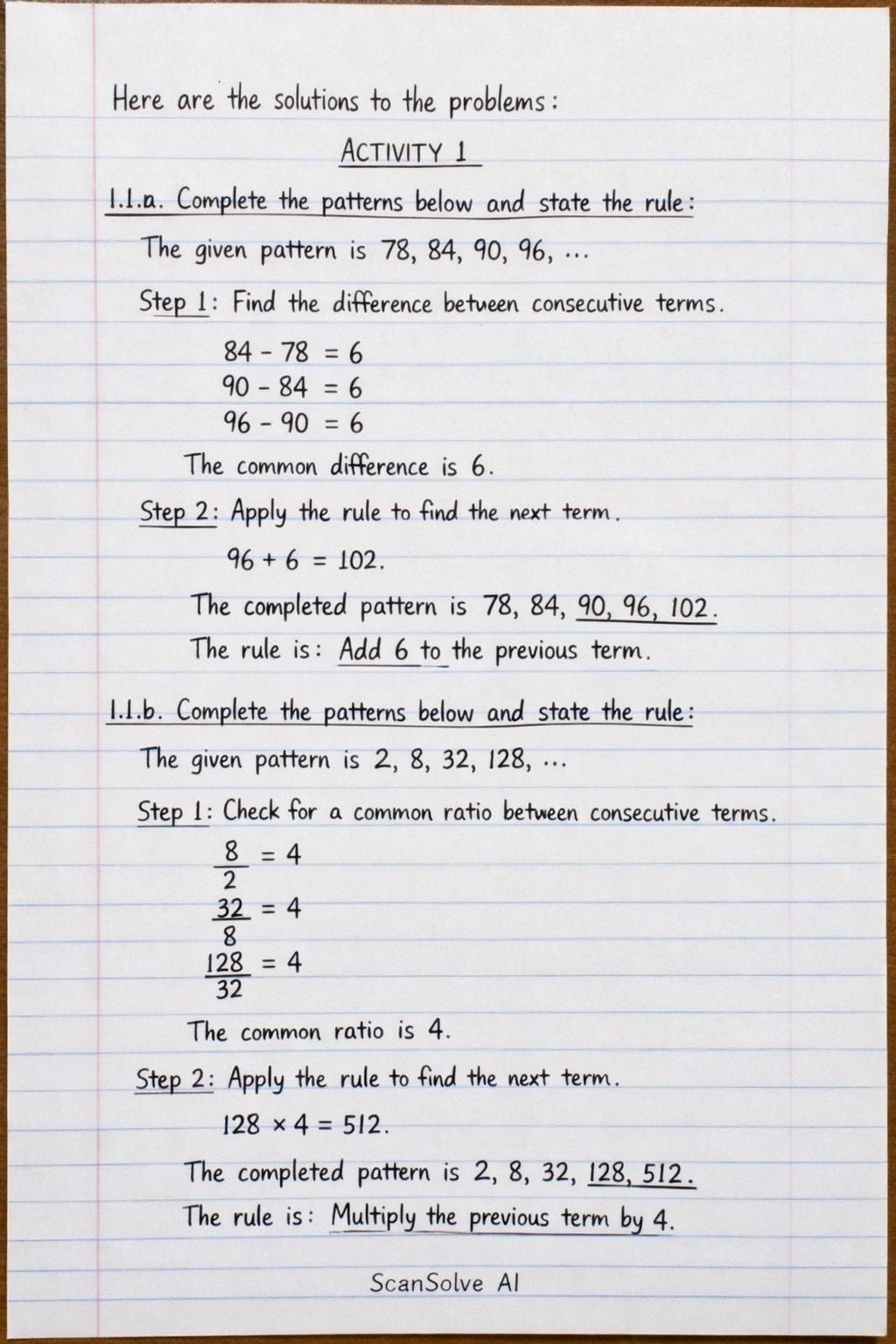
Here are the solutions to the problems: ACTIVITY 1 1.1.a. Complete the patterns below and state the rule: The given pattern is 78, 84, 90, 96, Step 1: Find the difference between consecutive terms. 84 - 78 = 6 90 - 84 = 6 96 - 90 = 6 The common difference is 6. Step 2: Apply the rule to find the next term. 96 + 6 = 102 The completed pattern is 78, 84, 90, 96, 102. The rule is: Add 6 to the previous term. 1.1.b. Complete the patterns below and state the rule: The given pattern is 2, 8, 32, 128, Step 1: Check for a common ratio between consecutive terms. (8)/(2) = 4 (32)/(8) = 4 (128)/(32) = 4 The common ratio is 4. Step 2: Apply the rule to find the next term. 128 × 4 = 512 The completed pattern is 2, 8, 32, 128, 512. The rule is: Multiply the previous term by 4. 1.2. Xolile fills up his car's tank with petrol. When full, the tank holds 60 L of petrol. The table below shows how much petrol is left in the tank as Xolile drives. Based on this information, how many kilometres can Xolile expect to drive until the petrol tank is completely empty? Step 1: Determine the rate of petrol consumption from the table. From the table: • For every 40 km driven (40 - 0, 80 - 40, etc.), the petrol in the tank decreases by 4 L (60 - 56, 56 - 52, etc.). So, 4 L of petrol is consumed for every 40 km driven. Step 2: Calculate the fuel efficiency (km per litre). Fuel efficiency = Distance drivenPetrol consumed = 40 km4 L = 10 km/L Step 3: Calculate the total distance Xolile can drive with a full tank (60 L). Total distance = Total petrol × Fuel efficiency Total distance = 60 L × 10 km/L = 600 km Xolile can expect to drive 600 km until the petrol tank is completely empty. ACTIVITY 2 2. For his party, Yolanda arranges small square tables in a straight line so that one person sits at each side of the table. For example, if there are 4 tables, then 10 people can sit at the tables, as shown. Step 1: Analyze the seating arrangement for different numbers of tables. • For 1 table: There are 2 people on the long sides and 1 person on each end. So, 2 × 1 + 2 = 4 people. • For 2 tables: There are 2 people on the long sides of each table, but the middle sides are joined. So, 2 × 2 + 2 = 6 people. • For 3 tables: 2 × 3 + 2 = 8 people. • For 4 tables: (Given) 10 people. This matches 2 × 4 + 2 = 10. Step 2: Determine the rule for the number of people (P) based on the number of tables (n). The pattern shows that for each additional table, 2 more people can be seated. This is an arithmetic progression. The rule can be expressed as: P = 2n + 2 Where P is the number of people and n is the number of tables. That's 2 down. 3 left today — send the next one.