
We read your photo as:
Complete the flow diagrams, tables, and identify the rules for the given numeric patterns.
ScanSolve AI Answer
Step-by-step solution
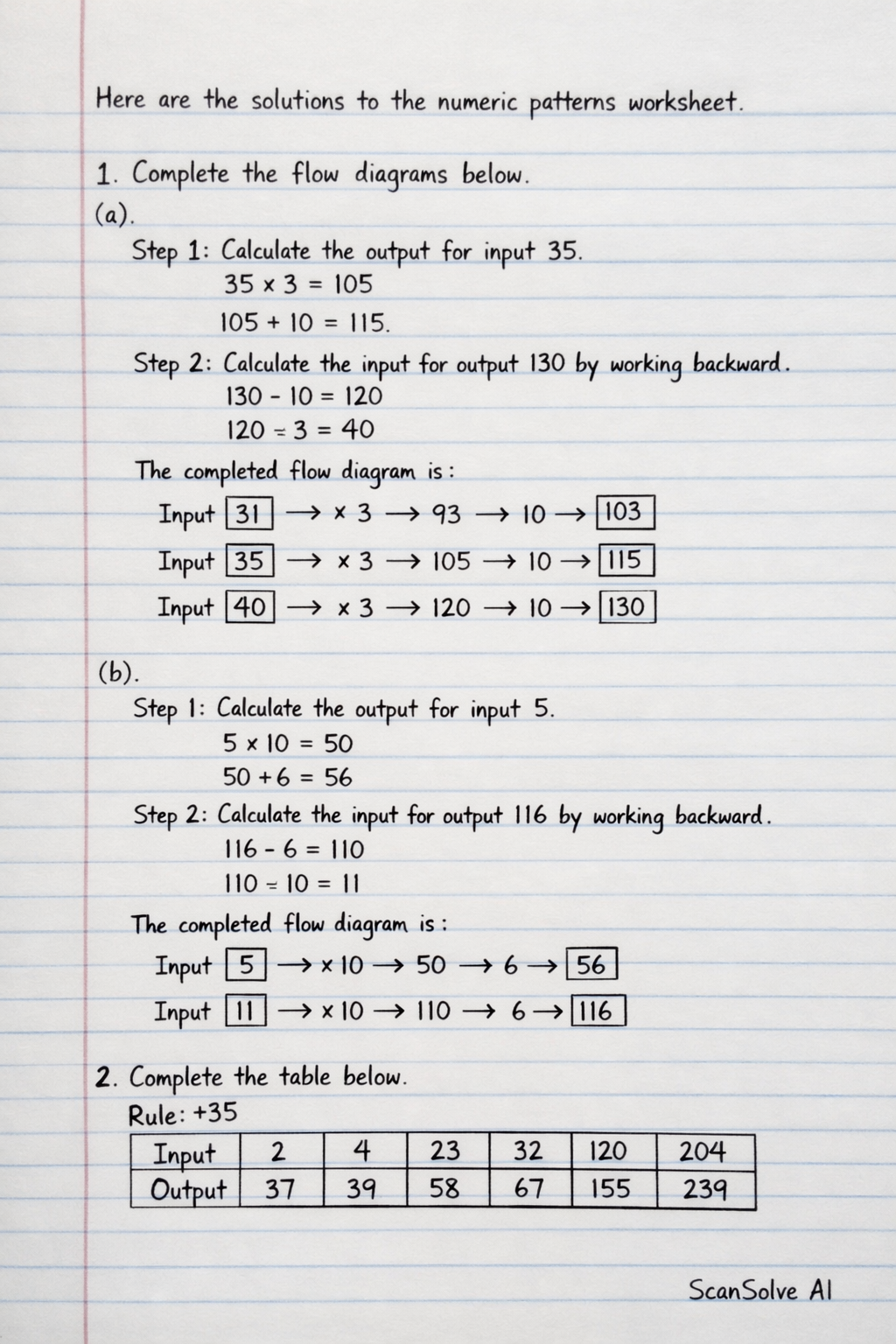
11 stepsHere are the solutions to the numeric patterns worksheet.
1. Complete the flow diagrams below.
a)
Calculate the output for input 35.
Calculate the input for output 130 by working backward.
The completed flow diagram is:
Input 31
Input 35
Inputb)
Calculate the output for input 5.
Calculate the input for output 116 by working backward.
The completed flow diagram is:
Input 5
Input2. Complete the table below.
Rule:Input 2 4 23 32 120 204 Output 37 39 58 67 155 239 3. Identify the rule for the table below.
Examine the relationship between Input and Output for each pair.
For Input 1, Output 9:
For Input 3, Output 27:
For Input 5, Output 45:
For Input 9, Output 81:
For Input 20, Output 180:
The rule is to multiply the input by 9.
Rule:4. Fill in the missing numbers and identify the rule for the sequences below.
a) Sequence: 8 000, 4 000, 2 000, ___, ___, ___
Identify the pattern by finding the relationship between consecutive terms.
The rule is to divide by 2.Apply the rule to find the missing numbers.
The sequence is: 8 000, 4 000, 2 000, , ,
Rule:b) Sequence: 5, 10, 20, ___, ___, ___
Identify the pattern.
The rule is to multiply by 2.Apply the rule to find the missing numbers.
The sequence is: 5, 10, 20, , ,
Rule:c) Sequence: 140, 180, 220, ___, ___, ___
Identify the pattern.
The rule is to add 40.Apply the rule to find the missing numbers.
The sequence is: 140, 180, 220, , ,
Rule:
Still stuck on this one?
Ask a follow-up, and the answer starts from this question.
More Mathematics Questions
Handwritten Step-by-Step Solution
Get this as a handwritten image on WhatsApp — like a tutor wrote it for you.
Try on WhatsApp