
We read your photo as:
The solution shows answers to flow diagrams and tables, including sequence patterns and input-output relationships. What are the questions associated with these examples?
ScanSolve AI Answer
Step-by-step solution
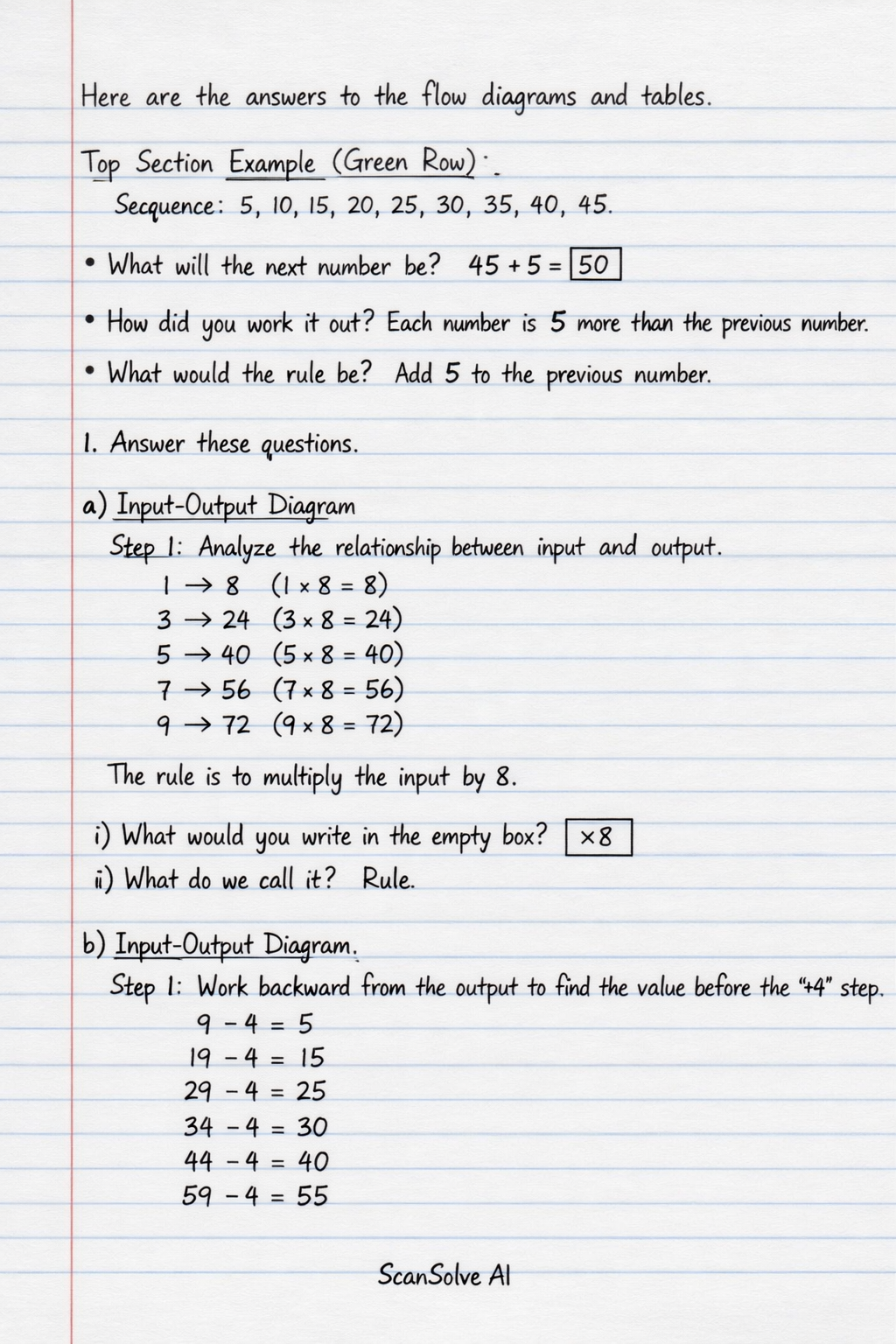
4 stepsHere are the answers to the flow diagrams and tables.
Top Section Example (Green Row):
Sequence:
- What will the next number be? .
- How did you work it out? Each number is 5 more than the previous number.
- What would the rule be? Add 5 to the previous number.
1. Answer these questions.
Part a· 1 step
Input-Output Diagram
Analyze the relationship between input and output.
For each pair of input and output:
The rule is to multiply the input by 8.
Part a(i)
What would you write in the empty box?
Part a(ii)
What do we call it? *Rule
Part b· 2 steps
Input-Output Diagram
Work backward from the output to find the value before the "+4" step.
For each output, subtract 4:
Analyze the relationship between the input and the value before the "+4" step.
The rule for the first empty box is to multiply the input by 5.
Part b(i)
What would you write in the empty box?
Part b(ii)
What do we call it? *Rule
Part c· 1 step
Input-Output Diagram
Analyze the relationship between input and output.
For each pair of input and output:
The rule is to multiply the input by 5.
Part c(i)
What would you write in the empty box?
Part c(ii)
What do we call it? *Rule
Still stuck on this one?
Ask a follow-up, and the answer starts from this question.
More Mathematics Questions
Handwritten Step-by-Step Solution
Get this as a handwritten image on WhatsApp — like a tutor wrote it for you.
Try on WhatsApp