
We read your photo as:
Complete the tables and describe the rules for the given geometric patterns.
ScanSolve AI Answer
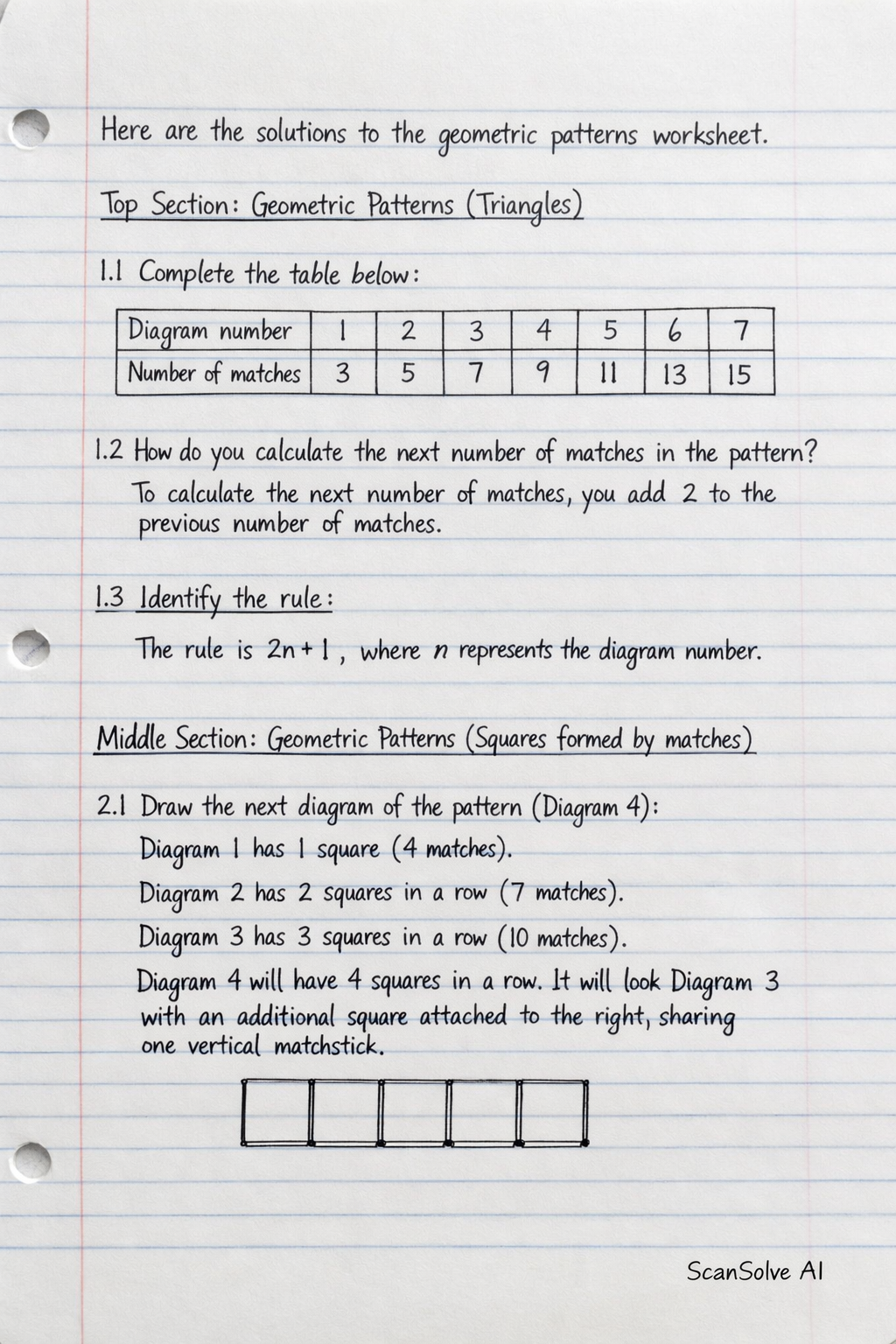
Here are the solutions to the geometric patterns worksheet.
Top Section: Geometric Patterns (Triangles)
1.1 Complete the table below.
| Diagram number | 1 | 2 | 3 | 4 | 5 | 6 | 7 |
|---|---|---|---|---|---|---|---|
| Number of matches | 3 | 5 | 7 | 9 |
1.2 How do you calculate the next number of matches in the pattern?
To calculate the next number of matches, you add 2 to the previous number of matches.
1.3 Identify the rule.
The rule is , where represents the diagram number.
Middle Section: Geometric Patterns (Squares formed by matches)
2.1 Draw the next diagram of the pattern (Diagram 4).
Diagram 1 has 1 square (4 matches).
Diagram 2 has 2 squares in a row (7 matches).
Diagram 3 has 3 squares in a row (10 matches).
Diagram 4 will have 4 squares in a row. It will look like Diagram 3 with an additional square attached to the right, sharing one vertical matchstick.
2.2 Complete the following table.
The pattern in the table is adding 3 to the number of matches for each subsequent diagram.
| Diagram number | 1 | 2 | 3 | 4 | 5 | 6 | 9 |
|---|---|---|---|---|---|---|---|
| Number of matches | 6 | 9 | 12 |
2.3 Write the rule of the match pattern in your own words.
The rule is to start with 6 matches for the first diagram and add 3 matches for each subsequent diagram. Algebraically, the rule is , where is the diagram number.
Bottom Section: Geometric Patterns (Squares and Dots)
1.1 Draw the next diagram in this geometric pattern (Diagram 4).
Diagram 1 has 1 square.
Diagram 2 has 2 squares in a row.
Diagram 3 has 3 squares in a row.
Diagram 4 will have 4 squares in a row. It will look like Diagram 3 with an additional square attached to the right.
1.2 Count the number of squares used in each diagram and complete the table.
| Diagram number | 1 | 2 | 3 | 4 | 5 | 7 | 9 | 10 |
|---|---|---|---|---|---|---|---|---|
| Number of squares | 1 | 2 | 3 |
1.3 Identify the rule.
The rule is that the number of squares is equal to the diagram number. Algebraically, , where is the number of squares and is the diagram number.
2.1 Draw the next two diagrams (Diagram 4 and Diagram 5).
This pattern represents triangular numbers.
Diagram 1: 1 dot
Diagram 2: 3 dots (arranged as a triangle)
Diagram 3: 6 dots (arranged as a triangle)
Diagram 4 will have 10 dots, arranged as a triangle with 4 dots on the bottom row.
Diagram 5 will have 15 dots, arranged as a triangle with 5 dots on the bottom row.
2.2 Complete the table below.
The pattern follows the triangular number sequence, .
| Diagram number | 1 | 2 | 3 | 4 | 5 | 7 | 10 | 11 |
|---|---|---|---|---|---|---|---|---|
| Number of dots | 1 | 3 | 6 |
2.3 Identify the rule.
The rule is , where is the number of dots and is the diagram number.
Last free one today — make
Still stuck on this one?
Ask a follow-up, and the answer starts from this question.
More Mathematics Questions
Handwritten Step-by-Step Solution
Get this as a handwritten image on WhatsApp — like a tutor wrote it for you.
Try on WhatsApp