
Complex numbers
Mathematics
ScanSolve AI Answer
Answer
Step-by-step solution
6 stepsThe equation from the image is .
Identify the coefficients of the quadratic equation .
From :
Apply the quadratic formula.
The quadratic formula is:
Substitute the identified coefficients into the formula.
Simplify the expression under the square root (the discriminant).
Simplify the square root of the negative number using the imaginary unit , where .
Substitute the simplified square root back into the formula and simplify the entire expression.
The solutions are:
The final answers are .
Was this helpful?
Try one yourself
A new problem that tests the same skill.
Still stuck on this one?
Ask a follow-up, and the answer starts from this question.
Got a different question?Ask your own question
More Mathematics Questions
QIdentify the complex number expression.QWhich of the following is the exponential form of a complex number?QIdentify the complex number and its conjugate.QExpress the following complex numbers in Cartesian form, given their real (x) and imaginary (y)…QSolve the equation E in the set of complex numbers.
Browse by topic:Pre-Calculus
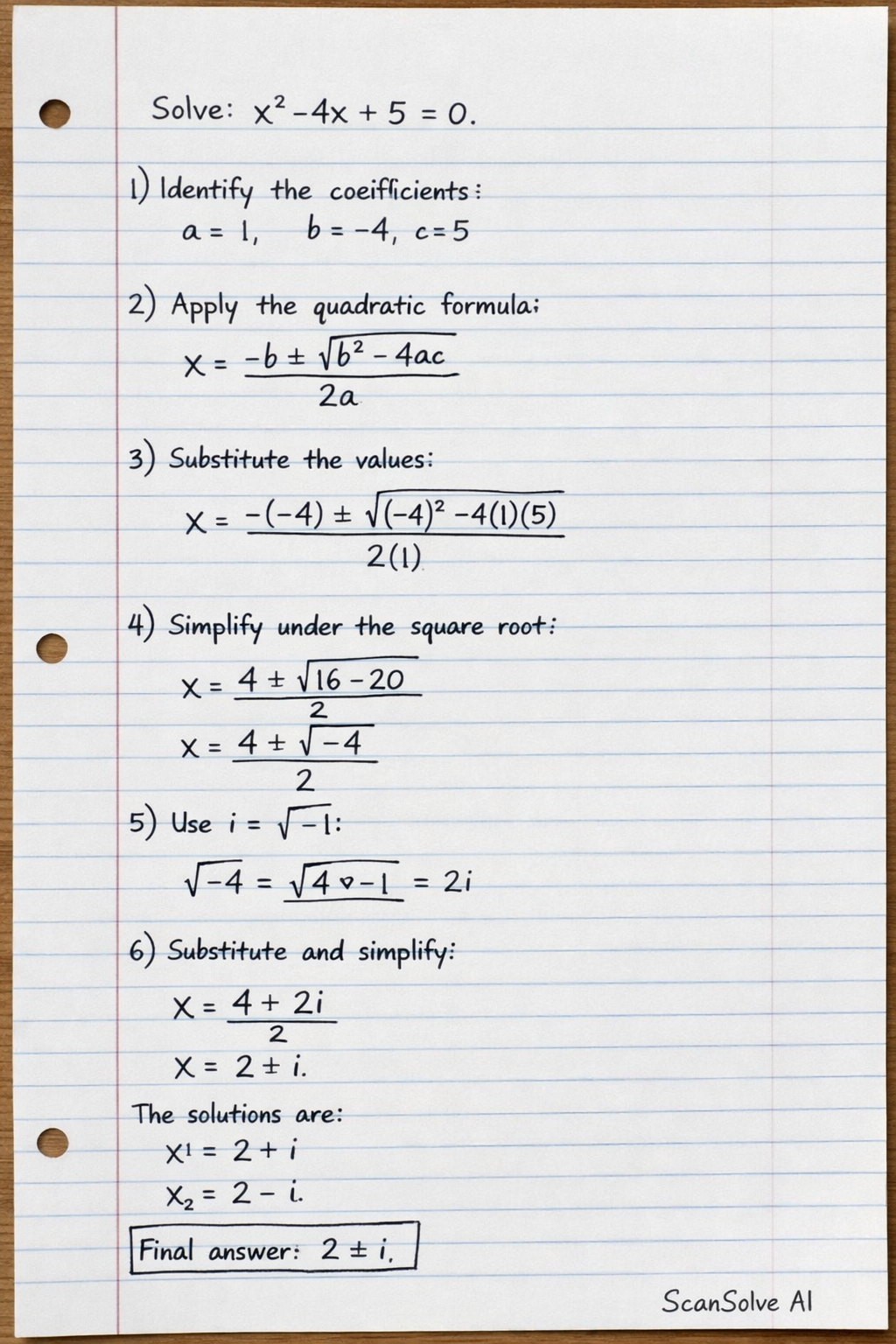
Handwritten Step-by-Step Solution
Get this as a handwritten image on WhatsApp — like a tutor wrote it for you.
Try on WhatsApp