
We read your photo as:
Identify the complex number expression.
Mathematics
ScanSolve AI Answer
Answer
Step-by-step solution
9 stepsIdentify the complex number expression.
Let the given expression be .
Apply the property of conjugates for division.
The conjugate of a quotient is the quotient of the conjugates: .
So, the conjugate of , denoted as , is:Find the conjugate of the numerator.
The conjugate of a sum or difference is the sum or difference of the conjugates. The conjugate of a real number is itself, and the conjugate of is .
Find the conjugate of the denominator.
The conjugate of is .
Substitute the conjugates back into the expression for .
Rationalize the denominator.
Multiply the numerator and the denominator by the conjugate of the denominator, which is .
Multiply the denominators.
Multiply the numerators.
Combine the results to get the final conjugate expression.
The conjugate of the expression is:
Was this helpful?
Try one yourself
A new problem that tests the same skill.
Still stuck on this one?
Ask a follow-up, and the answer starts from this question.
Got a different question?Ask your own question
More Mathematics Questions
QIdentify the complex number and its conjugate.QIdentify the given complex number z.QIdentify the quadratic expression.QWhich of the following is the exponential form of a complex number?QIdentify the integral expression.
Browse by topic:Pre-Calculus
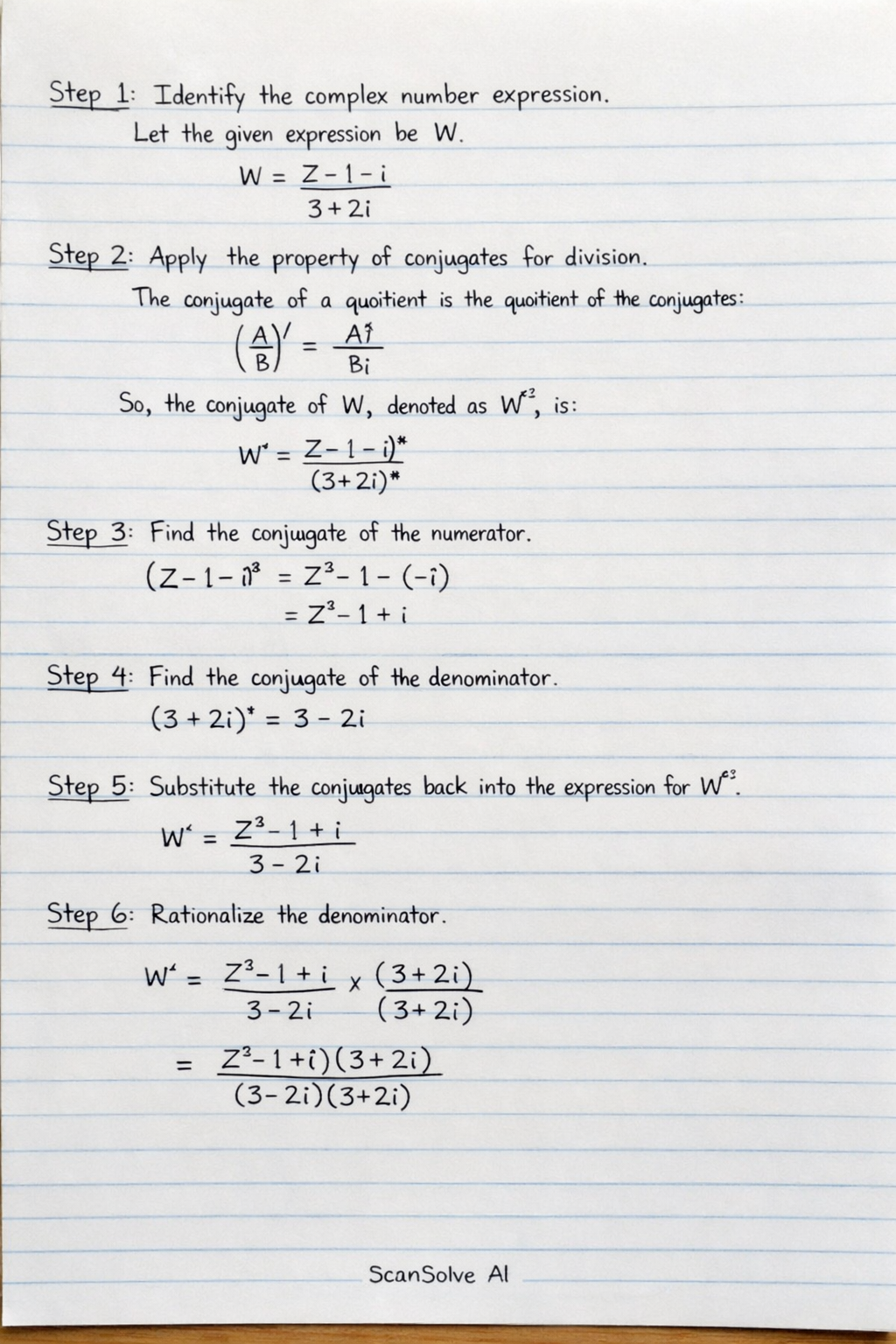
Handwritten Step-by-Step Solution
Get this as a handwritten image on WhatsApp — like a tutor wrote it for you.
Try on WhatsApp