

This mathematics problem involves applying core mathematical principles and formulas. Below you will find a complete step-by-step solution with detailed explanations for each step, helping you understand not just the answer but the method behind it.
ScanSolve AI Answer
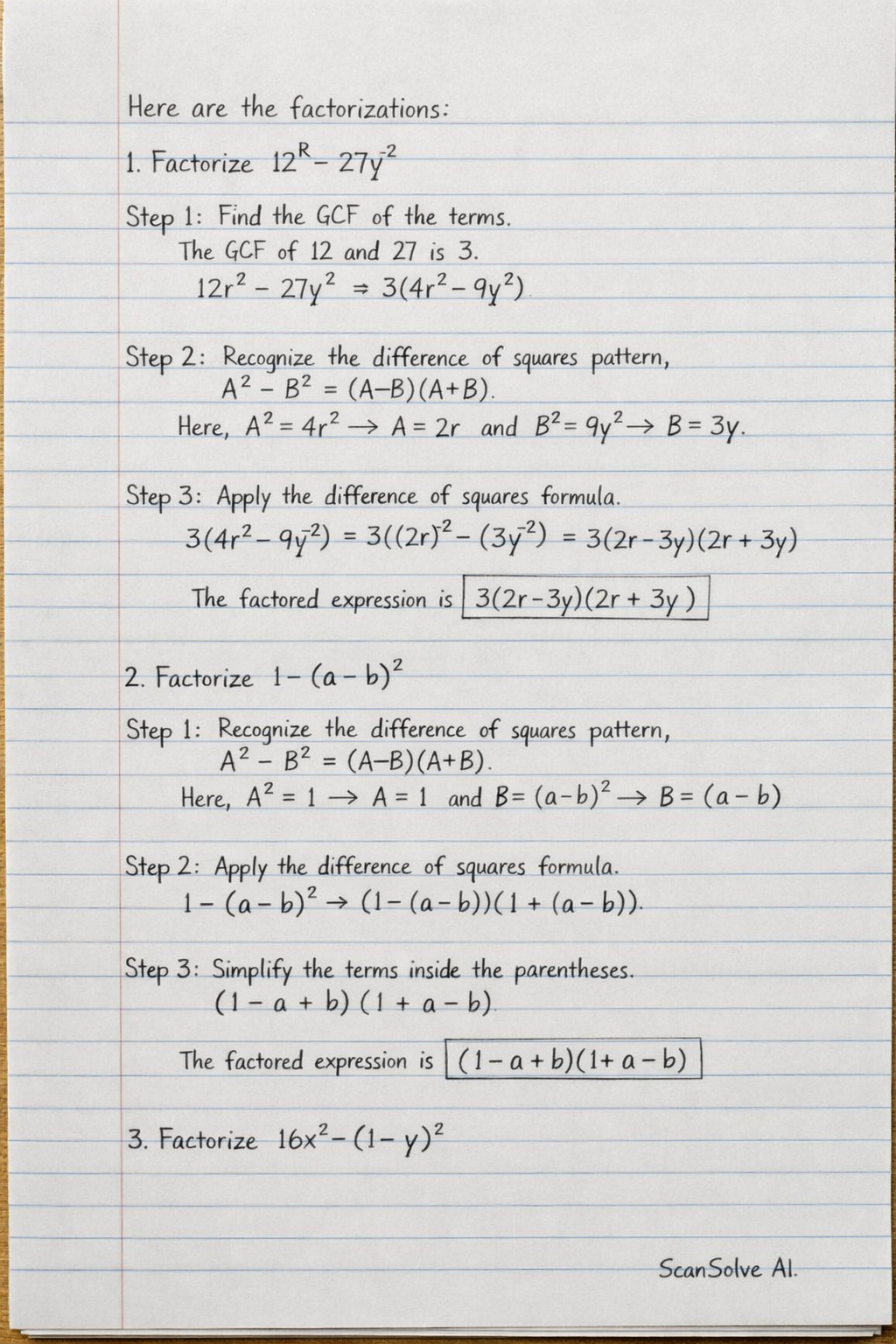
Here are the factorizations: 1. Factorize 12r^2 - 27y^2 Step 1: Find the greatest common factor (GCF) of the terms. The GCF of 12 and 27 is 3. 12r^2 - 27y^2 = 3(4r^2 - 9y^2) Step 2: Recognize the difference of squares pattern, A^2 - B^2 = (A-B)(A+B). Here, A^2 = 4r^2 A = 2r and B^2 = 9y^2 B = 3y. Step 3: Apply the difference of squares formula. 3(4r^2 - 9y^2) = 3((2r)^2 - (3y)^2) = 3(2r - 3y)(2r + 3y) The factored expression is 3(2r - 3y)(2r + 3y). 2. Factorize 1 - (a-b)^2 Step 1: Recognize the difference of squares pattern, A^2 - B^2 = (A-B)(A+B). Here, A^2 = 1 A = 1 and B^2 = (a-b)^2 B = (a-b). Step 2: Apply the difference of squares formula. 1 - (a-b)^2 = (1 - (a-b))(1 + (a-b)) Step 3: Simplify the terms inside the parentheses. (1 - a + b)(1 + a - b) The factored expression is (1 - a + b)(1 + a - b). 3. Factorize 16x^2 - (1-y)^2 Step 1: Recognize the difference of squares pattern, A^2 - B^2 = (A-B)(A+B). Here, A^2 = 16x^2 A = 4x and B^2 = (1-y)^2 B = (1-y). Step 2: Apply the difference of squares formula. 16x^2 - (1-y)^2 = (4x - (1-y))(4x + (1-y)) Step 3: Simplify the terms inside the parentheses. (4x - 1 + y)(4x + 1 - y) The factored expression is (4x - 1 + y)(4x + 1 - y). 4. Factorize Completely 3 - 12x^2 Step 1: Find the greatest common factor (GCF) of the terms. The GCF of 3 and 12 is 3. 3 - 12x^2 = 3(1 - 4x^2) Step 2: Recognize the difference of squares pattern, A^2 - B^2 = (A-B)(A+B). Here, A^2 = 1 A = 1 and B^2 = 4x^2 B = 2x. Step 3: Apply the difference of squares formula. 3(1 - 4x^2) = 3((1)^2 - (2x)^2) = 3(1 - 2x)(1 + 2x) The completely factored expression is 3(1 - 2x)(1 + 2x). Send me the next one 📸