

This mathematics problem involves applying core mathematical principles and formulas. Below you will find a complete step-by-step solution with detailed explanations for each step, helping you understand not just the answer but the method behind it.
ScanSolve AI Answer
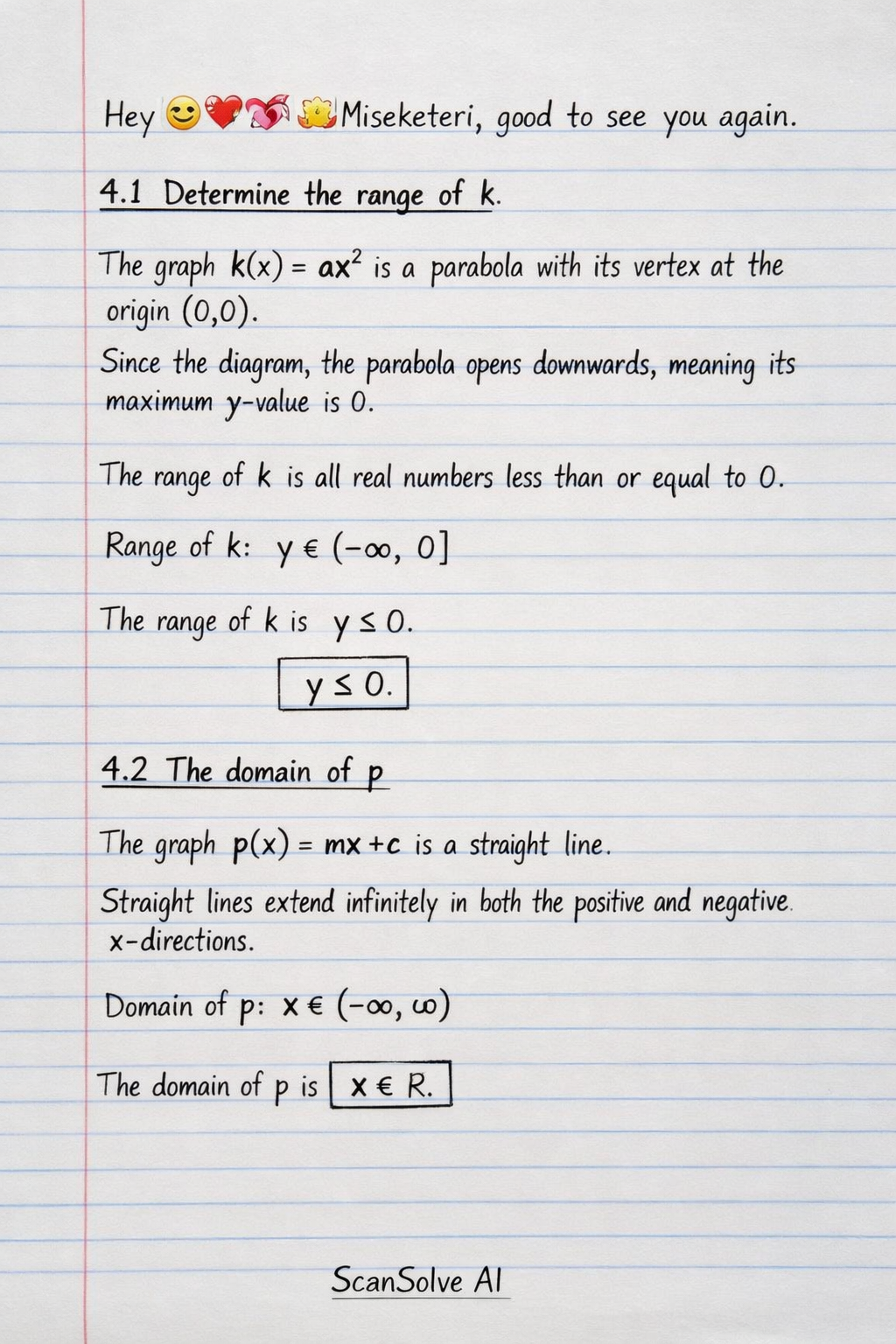
Hey 🥹❤️🔥M💞🥹Miseketeri, good to see you again. 4.1 Determine the range of k The graph k(x) = ax^2 is a parabola with its vertex at the origin (0,0). From the diagram, the parabola opens downwards, meaning its maximum y-value is 0. The range of k is all real numbers less than or equal to 0. Range of k: y (-, 0] The range of k is y 0. 4.2 The domain of p The graph p(x) = mx + c is a straight line. Straight lines extend infinitely in both the positive and negative x-directions. Domain of p: x (-, ) The domain of p is x R. 4.3 Given that the gradient of AD is 1, determine the equation of AD in the form of p(x) = mx + c Step 1: Identify the given information. The line p(x) = mx + c passes through points A, B, C, and D. The gradient of AD (which is the gradient of line p) is given as m=1. Point C is (0, -6). This is the y-intercept of the line. Step 2: Substitute the gradient and y-intercept into the equation. The equation of the line is p(x) = mx + c. Given m=1 and c=-6. p(x) = 1x - 6 p(x) = x - 6 The equation of AD is p(x) = x - 6. 4.4 Determine the equation of k in the form of k(x) = ax^2 if B is equidistant from A to C Step 1: Find the coordinates of point B. Point B is equidistant from A(6,0) and C(0,-6). This means B is the midpoint of the line segment AC. Using the midpoint formula B = ((x_1+x_2)/(2), (y_1+y_2)/(2)): B = ((6+0)/(2), (0+(-6))/(2)) B = ((6)/(2), (-6)/(2)) B = (3, -3) Step 2: Use point B to find the value of a for k(x) = ax^2. Since B(3,-3) lies on the parabola k(x) = ax^2, substitute these coordinates into the equation: -3 = a(3)^2 -3 = 9a a = (-3)/(9) a = -(1)/(3) Step 3: Write the equation of k(x). k(x) = -(1)/(3)x^2 The equation of k is k(x) = -(1)/(3)x^2. 4.5 Calculate the co-ordinates of D Step 1: Set the equations of p(x) and k(x) equal to each other to find the intersection points. From 4.3, p(x) = x - 6. From 4.4, k(x) = -(1)/(3)x^2. x - 6 = -(1)/(3)x^2 Step 2: Solve the quadratic equation for x. Multiply by 3 to clear the fraction: 3(x - 6) = -x^2 3x - 18 = -x^2 Rearrange into standard quadratic form ax^2 + bx + c = 0: x^2 + 3x - 18 = 0 Factor the quadratic equation: (x+6)(x-3) = 0 The possible x-coordinates for the intersection points are x = -6 or x = 3. Step 3: Identify the coordinates of D. We know from 4.4 that point B has an x-coordinate of 3. Therefore, point D must have an x-coordinate of -6. Substitute x=-6 into the equation of the line p(x) = x - 6 to find the y-coordinate of D: y = -6 - 6 y = -12 The coordinates of D are (-6, -12). 4.6 What kind of a triangle is ACO according to the lengths of the sides and give a reason Step 1: Identify the coordinates of the vertices. A = (6,0) C = (0,-6) O = (0,0) (the origin) Step 2: Calculate the lengths of the sides OA, OC, and AC using the distance formula d = sqrt((x_2-x_1)^2 + (y_2-y_1)^2). Length of OA: OA = sqrt((6-0)^2 + (0-0)^2) = sqrt(6^2 + 0^2) = sqrt(36) = 6 Length of OC: OC = sqrt((0-0)^2 + (-6-0)^2) = sqrt(0^2 + (-6)^2) = sqrt(36) = 6 Length of AC: AC = sqrt((0-6)^2 + (-6-0)^2) = sqrt((-6)^2 + (-6)^2) = sqrt(36+36) = sqrt(72) = 6sqrt(2) Step 3: Classify the triangle based on side lengths. Since OA = OC = 6, two sides of the triangle are equal in length. Therefore, ACO is an isosceles triangle. 4.7 Without any calculations give the value of C The vertices of ACO are A(6,0), C(0,-6), and O(0,0). The line segment OC lies along the y-axis, and the line segment OA lies along the x-axis. This means that AOC is a right angle (90^). Since OA = 6 and OC = 6 (from 4.6), ACO is an isosceles right-angled triangle. In an isosceles right-angled triangle, the two non-right angles are equal and each measures 45^. The angle C is opposite side OA, and angle A is opposite side OC. Since OA=OC, then C = A. Therefore, C = 45^. The value of C is 45^. Drop the next question! 📸