
We read your photo as:
Consider the rectangular box shown below. Draw the views as seen from X and Y. Find the: total surface area, volume, diagonal HA, angle the diagonal makes with the base.
ScanSolve AI Answer
Step-by-step solution
5 stepsDescribe the views from X and Y.
a)
The rectangular box has dimensions: Length () = 6 m, Width () = 7 m, Height () = 8 m.- The view from X (front view) shows the face ABEH. This is a rectangle with dimensions , which is .
- The view from Y (right side view) shows the face BCFE. This is a rectangle with dimensions , which is .
Calculate the total surface area.
b)(i)
The formula for the total surface area () of a rectangular box is .Calculate the volume.
b)(ii)
The formula for the volume () of a rectangular box is .Calculate the length of the space diagonal.
b)(iii)
The question asks for "diagonal HA". In the provided diagram, HA is a vertical edge of the box, with length 8 m. However, the term "diagonal" usually refers to a line segment connecting two non-adjacent vertices. Given part (iv) asks for the angle this diagonal makes with the base, which is typically a non-90 degree angle for a space diagonal, we will assume "diagonal HA" is a mislabeling and refers to the space diagonal of the rectangular box (e.g., from A to F, the opposite vertex).
The length of the space diagonal () is given by .
Here, m, m, m.Calculate the angle the space diagonal makes with the base.
b)(iv)
We need to find the angle () that the space diagonal (e.g., AF) makes with the base (ABCD).
Consider the right-angled triangle formed by the space diagonal (AF), the height of the box (CF = H), and the diagonal of the base (AC).
First, calculate the length of the base diagonal (AC).Now, in the right triangle formed by A, C, and F, we have:
Opposite side to is CF (height) = 8 m.
Adjacent side to is AC (base diagonal) = m.
The tangent of the angle is given by .
Still stuck on this one?
Ask a follow-up, and the answer starts from this question.
More Mathematics Questions
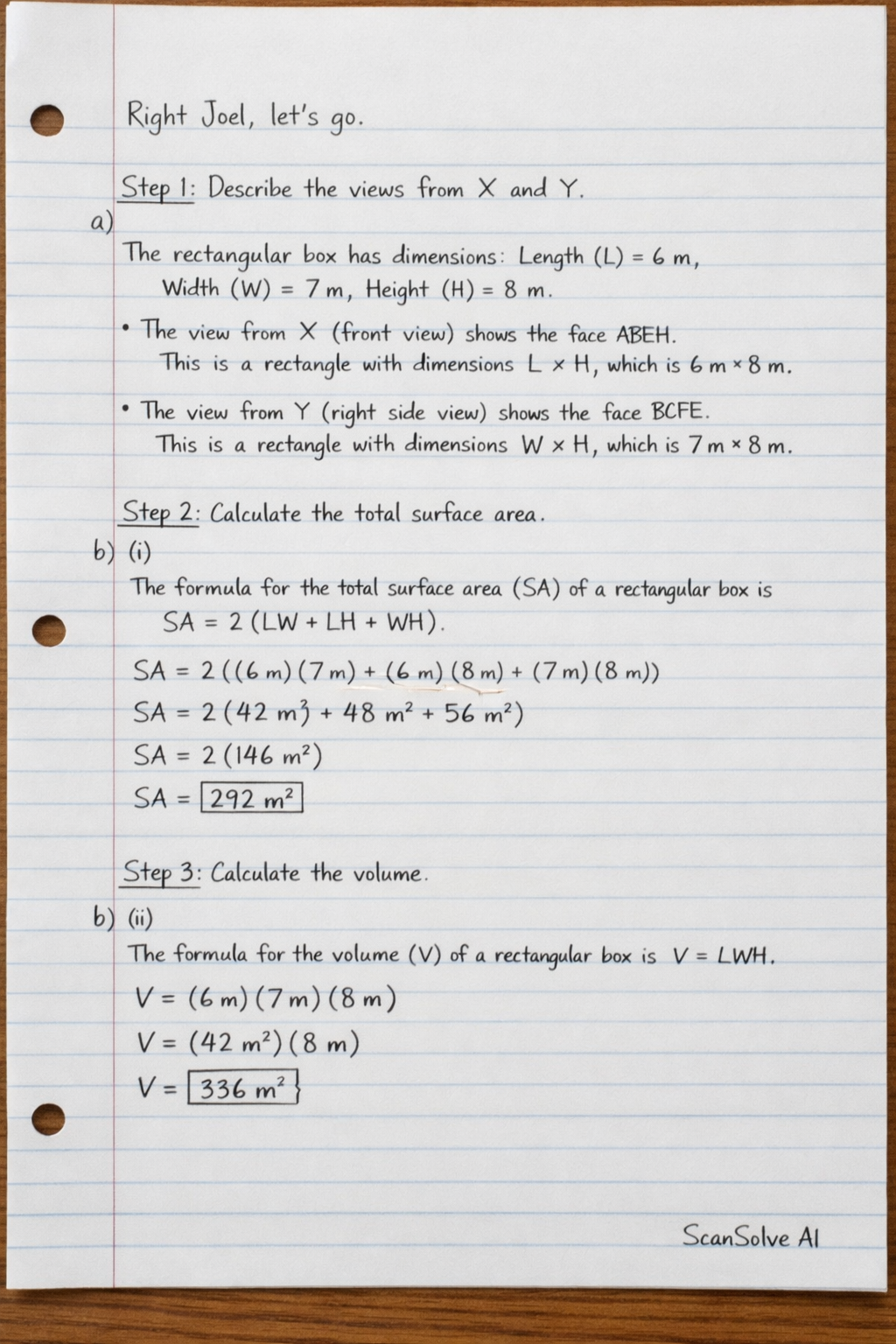
Handwritten Step-by-Step Solution
Get this as a handwritten image on WhatsApp — like a tutor wrote it for you.
Try on WhatsApp